

For millions of people across the globe, the arrival of a payday is not a moment of celebration, but a brief sigh of relief in a never-ending cycle of survival. As we navigate the economic landscape of 2026, the phenomenon of “living paycheck to paycheck” has transitioned from a localized struggle to a global epidemic, affecting not just low-income earners but high-salaried professionals as well.
Defining the Cycle: What Does It Actually Mean?
Living paycheck to paycheck is formally defined as a financial situation where an individual’s or household’s monthly income is entirely consumed by their immediate expenses. In this state, there is zero discretionary income left over for savings, investments, or emergencies.
From a psychological perspective, it is a state of financial fragility. It means that a single “black swan” event—a car repair, a medical bill, or a week of missed work—can lead to total insolvency. It is a razor-thin margin of error that keeps the body in a constant state of low-level stress.
Worldwide Statistics: The 2026 Reality
Recent data from global financial monitors suggests that the “squeezed middle” is more vulnerable than ever. Despite cooling inflation in some sectors, the rising cost of housing and essential services continues to outpace wage growth.
-
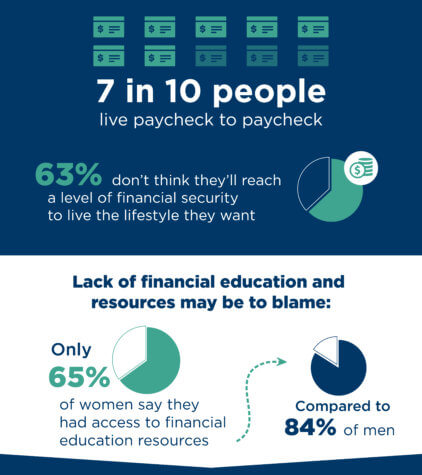
United States: As of early 2026, approximately 63% of American adults report living paycheck to paycheck. Notably, nearly 40% of those earning over $100,000 annually fall into this category, citing “lifestyle creep” and high debt-to-income ratios as the primary drivers.
-
United Kingdom: In the UK, 52% of the workforce is struggling to make it to the end of the month without dipping into credit or overdrafts.
-
Australia: Financial fragility has risen to 48%, largely due to the mortgage interest rate spikes seen over the last 24 months.
-
Developing Economies: In emerging markets across Southeast Asia and Latin America, the figure often exceeds 80%, though this is more closely tied to baseline poverty levels than lifestyle choices.
Why Is This Happening? (Beyond the Numbers)
While it’s easy to point at “avocado toast” or “expensive coffee,” the reality is systemic. The compounding effect of inflation, coupled with the gig economy’s lack of benefits and the normalization of “Buy Now, Pay Later” (BNPL) schemes, has created a debt trap. Many people are not overspending on luxuries; they are overspending on the fixed costs of being alive.
How to Stop Living Paycheck to Paycheck: A Strategic Roadmap
Breaking the cycle requires more than just “saving more.” It requires a complete overhaul of your financial architecture.
1. The “Fixed Cost” Audit
Most people focus on cutting small variables (like Netflix). To truly break the cycle, you must attack your fixed costs. These are the bills that stay the same every month: rent/mortgage, insurance, and utilities. If your fixed costs exceed 50% to 60% of your take-home pay, you are mathematically predisposed to stay in the cycle.
-
Action: Consider downsizing, refinancing high-interest debt, or negotiating insurance premiums.
2. Automate the “Invisible” Save
Willpower is a finite resource. If you wait until the end of the month to see what’s left to save, the answer will always be zero.
-
Action: Set up an automatic transfer of even 1% to 3% of your paycheck to a separate high-yield savings account the moment your salary hits. You must treat savings as a non-negotiable “bill” you owe to your future self.
3. Build the “Inconvenience Fund”
The primary reason people stay in the paycheck cycle is that an “inconvenience” (like a flat tire) turns into a “crisis.”
-
Action: Your first goal is not a six-month emergency fund; it is a $1,000 to $2,000 Inconvenience Fund. This prevents you from reaching for a high-interest credit card when life happens, which is what keeps the debt cycle spinning.
4. The “Side-Hustle” for Scaling, Not Survival
If your primary income doesn’t cover your bills, you have an income problem, not a spending problem. In 2026, leveraging digital platforms—whether through SEO-optimized content websites, fitness coaching, or niche consulting—is the fastest way to bridge the gap.
-
Action: Dedicate five hours a week to an income-generating skill. Use every cent of that secondary income to pay off debt or build your buffer—never use it to upgrade your lifestyle.
Frequently Asked Questions (FAQ)
Q1: Can high-income earners really live paycheck to paycheck? A: Yes. This is known as “Henry” (High Earner, Not Rich Yet). High fixed costs, like expensive car leases and large mortgages, can leave a six-figure earner with as little liquidity as someone making a third of their salary.
Q2: Should I pay off debt or save for an emergency first? A: Follow a hybrid approach. Build a small $1,000 “Inconvenience Fund” first so you don’t go deeper into debt. Once that is set, aggressively pay off high-interest debt (anything over 7%).
Q3: Is the 50/30/20 rule still relevant in 2026? A: It’s a great baseline (50% Needs, 30% Wants, 20% Savings). However, in high-cost-of-living areas, many find a 60/20/20 or even a 70/10/20 split more realistic until their income scales.
Legal Disclaimer
The information provided in this article is for educational and informational purposes only and does not constitute professional financial advice. Financial situations are unique to each individual; please consult with a certified financial planner or advisor before making significant changes to your investment or debt management strategy.
Editor’s Opinion: The Trap of “Wait and See”
In my experience observing digital trends and economic shifts, the biggest mistake people make is waiting for the “perfect time” to start saving—usually when they get that next raise or promotion. But as we see in the statistics, raises almost always lead to lifestyle expansion.
Breaking the paycheck cycle is a mental shift before it is a numerical one. It is the realization that a $500 buffer provides more peace of mind than a $500 monthly car payment for a vehicle you can barely afford to insure. The goal isn’t to look rich; it’s to be free. Start small, automate the process, and stop giving your future away to interest rates.
Related content
Building a stable financial foundation is just the first step toward long-term security. To understand how to transition from simply surviving to building generational wealth, read our comprehensive follow-up: “The Architecture of Financial Autonomy: Strategic Wealth Building and Asset Management.” While the paycheck-to-paycheck guide focuses on the immediate tactics of escaping a survival cycle, this architectural analysis explores the higher-level strategies of asset allocation, tax-advantaged investing, and the compounding growth of diversified portfolios. By mastering these advanced frameworks, you can move beyond a $1,000 safety net and begin constructing a financial fortress that generates passive income and ensures true, lifelong autonomy.

