

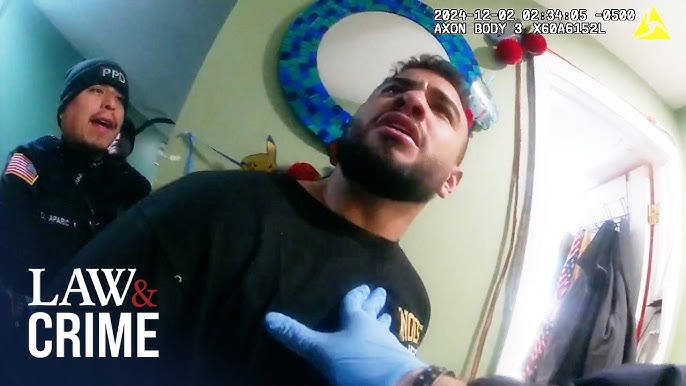
In the landscape of domestic homicide investigations, the transition from an initial emergency call to a first-degree murder conviction often hinges on the immediate intersection of physical forensics and digital evidence. On a cold morning in December 2024, emergency dispatchers in Pleasantville, New Jersey, received a frantic 911 call from 28-year-old Boris Lainez-Rosales. His narrative was immediate, specific, and designed to deflect culpability: he claimed his 25-year-old pregnant girlfriend, Leslianette Quintana-Betancourt, had sustained catastrophic injuries from an accidental fall down a flight of stairs.
Click here to watch the baseball bat attack
When first responders arrived at the scene, however, the mechanical reality of the victim’s trauma instantly contradicted the story. What followed was an intensive, multi-agency investigation that stripped away the fabrication, culminating in a definitive guilty plea.
By analyzing the critical body-worn camera footage, the patterns of blunt-force domestic ambushes, and the specialized legal framework utilized to secure justice for the victims, this case study provides a high-value examination of a tragedy that deeply shook the Atlantic County justice system.
📹 Video Breakdown and Key Investigative Timestamps
In a definitive episode of Crime Fix, Law&Crime’s investigative correspondent Angenette Levy provides a meticulous, frame-by-frame analysis of the body-worn camera footage and the subsequent legal proceedings. Below is a structured timeline breakdown of that investigative broadcast:
-
[0:00 – 2:30] 🚨 The Initial 911 Call and First Responder Dispatch
The episode opens with the actual audio and transcripts of the emergency call placed by Boris Lainez-Rosales. Analysts dissect his tone and the immediate positioning of the “stairwell accident” defense before police even arrived on the scene.
-
[2:31 – 5:15] 📹 Body-Cam Analysis: The First Five Minutes
Angenette Levy walks viewers through the tense, raw footage captured by Pleasantville police officers as they entered the home. The video highlights the physical layout of the residence, the positioning of the victim, and the suspicious, erratic behavioral tells displayed by Lainez-Rosales during the initial interrogation.
-
[5:16 – 7:40] 🧬 Shattering the Fabrication: The Medical Examiner’s Findings
This segment details the exact forensic pathology report that destroyed the suspect’s defense. Experts explain how the localized skull fractures and deep tissue trauma could only be attributed to targeted, downward swings of a heavy object, completely ruling out an accidental fall.
-
[7:41 – 9:55] 🔨 The Discovery of the Weapon and Arrest Sequence
The video documents the exact moment investigators located the baseball bat inside the home, coated in forensic evidence. This discovery triggered the immediate escalation of charges from aggravated assault to first-degree murder.
-
[9:56 – End] 🏛️ The Courtroom Reckoning: The First-Degree Guilty Plea
The final block of the program covers the absolute legal capitulation of Boris Lainez-Rosales. Facing an airtight wall of digital, physical, and video evidence, the defendant waived his right to a jury trial and formally entered a plea of guilty to first-degree murder.

📸 Forensic Disconnection: The Pleasantville Crime Scene Arrival
When patrol officers from the Pleasantville Police Department stepped across the threshold of the residence, their body-worn cameras captured a highly chaotic and deeply disturbing scene. Lainez-Rosales was present, attempting to project the frantic panic of a grieving partner. However, seasoned homicide investigators are trained to look for the “forensic mismatch”—the point where a suspect’s verbal timeline completely fractures when exposed to physical evidence.
[The Falsified Narrative vs. Forensic Reality]
Suspect Assertion ──> Accidental fall down domestic stairs.
Medical Reality   ──> Concentrated, high-velocity blunt-force trauma to the cranium.
Weapon Recovered  ──> A baseball bat hidden within the immediate living space.
Result            ──> 911 call exposed as an intentional, stage-managed coverup.
The injuries sustained by Leslianette Quintana-Betancourt were starkly inconsistent with a tumbling fall down a staircase. A fall typically produces diffuse, multi-focal bruising, abrasions, and deceleration injuries across various planes of the body. Instead, first responders and medical personnel noted localized, high-velocity, catastrophic blunt-force trauma concentrated heavily on the victim’s skull—injuries explicitly indicative of an intentional, repeated physical assault with a dense weapon. Within a short window of processing the environment, detectives recovered the true instrument of destruction: a baseball bat that had been used to beat the defenseless, pregnant young woman to death.
✒️ Editor’s Opinion: The Dangerous Myth of the “Staged Accident”
There is a recurring, deeply sinister pattern in domestic homicides where the perpetrator immediately attempts to script the initial narrative before emergency services can even establish a pulse. They use the 911 call not to seek genuine medical intervention, but to construct a pre-packaged legal defense. We see this time and again: the “slip in the shower,” the “accidental overdose,” or, as in the case of Boris Lainez-Rosales, the “fall down the stairs.”
This tactic relies on a fundamental underestimation of modern forensic science. Lainez-Rosales truly believed that by simply saying the words “she fell,” he could blind police officers to the horrific biological reality in front of them.
He expected the system to treat the scene as a medical misfortune rather than an active, blood-spattered crime scene.
What he failed to realize is that a baseball bat leaves an unmistakable, distinct signature on the human body—a signature that no amount of frantic play-acting can erase.
This sense of absolute entitlement to control, alter, or end a partner’s life represents the most volatile escalation of intimate partner stalking and fixation. When an abuser feels their dominance slipping, the transition from psychological coercion to sudden, fatal physical violence often occurs in spaces where the victim should feel entirely secure. A similarly terrifying manifestation of this obsessive, possessive rage is explored in Slaughter at Skyline Chili: Ohio Mom Stabbed to Death During Waitress Shift by ‘Obsessed’ Ex. In that investigation, an estranged partner crossed physical and legal boundaries to ambush his victim at her place of employment, demonstrating how a perpetrator’s unhinged fixation frequently culminates in a calculated, public assault. Whether an offender attempts to conceal their violence behind a stage-managed domestic accident or executes an open attack in a crowded workplace, both cases underscore a chilling systemic reality: the lethal danger to a victim peaks exponentially when an obsessed partner decides to permanently assert total control.
The immediate deployment of body-worn cameras by the Pleasantville Police Department was crucial here. It captured his raw, unedited reactions, his shifting stories, and the precise state of the environment before it could be altered. His subsequent guilty plea wasn’t an act of remorse; it was a total surrender to an airtight evidentiary trap. The justice system must continue to treat these staged domestic “accidents” with immediate, aggressive skepticism, ensuring that abusers who weaponize the sanctity of the home are met with unyielding, permanent incarceration.
❓ Frequently Asked Questions (FAQ)
Q: What sentence does Boris Lainez-Rosales face after pleading guilty?
A: By pleading guilty to first-degree murder in New Jersey, Lainez-Rosales faces a mandatory minimum sentence of 30 years to life in a state prison, with the requirement to serve every single day of that minimum term before becoming eligible for parole.
Q: Did the unborn child survive the assault?
A: Tragically, no. The severe, systemic trauma inflicted upon Leslianette Quintana-Betancourt resulted in the immediate termination of the pregnancy at the scene, adding an extra layer of devastation to the homicide investigation.
Q: Why did the suspect choose to plead guilty instead of going to trial?
A: The combination of explicit body-cam footage, the recovered murder weapon (the baseball bat), and a definitive medical examiner’s report left the defense with zero statistical probability of an acquittal at a jury trial.

