

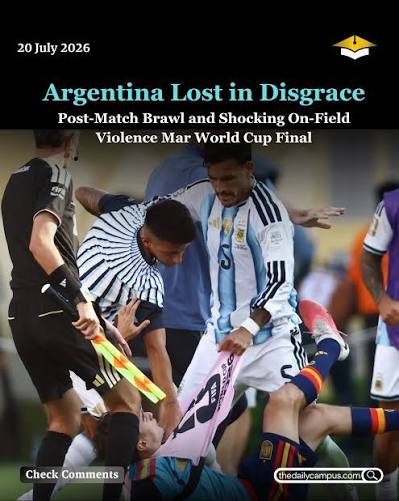
The 2026 FIFA World Cup was meant to be the ultimate coronation for a generation led by Lionel Messi. Instead, it concluded with a narrative of heartbreak, tactical cynicism, and a profound loss of sporting dignity. Argentina’s journey to the final in New Jersey was marred by controversial play, and their eventual 1–0 defeat to Spain was followed by a post-match display that left the global footballing community in shock.
For many, Argentina’s reputation shifted from that of a resilient, championship-winning side to one branded as “classless” and an “embarrassment to the game.” The criticism stems from a combination of their ultra-defensive “anti-football” tactics throughout the tournament and their behavior when those tactics ultimately failed to deliver a trophy.
Pundits and fans alike pointed to a perceived arrogance that had permeated the squad. Throughout the knockout stages, Argentina relied on extreme defensive blocks and “spoiling” tactics, frustrating opponents and spectators alike. When Spain finally broke through in the 106th minute via Ferran Torres, the pressure valve burst. Rather than accepting defeat with the grace expected of defending champions, the Argentine squad’s conduct during the medal ceremony served as the final straw.
The Medal Ceremony Outrage
The most egregious display of poor sportsmanship occurred when the Argentine players refused to watch Spain receive the trophy. While Spain had formed a guard of honour for the Argentine players as they collected their silver medals, the favour was not returned. The Argentine squad walked to the far side of the pitch, turning their backs on their opponents. This act, described by many as “classless,” drew condemnation from fans, pundits, and even players like Spain’s Dani Olmo, who noted that elite athletes have a duty to act as role models for younger generations.
https://www.facebook.com/photo/?fbid=1601904077966024&set=a.815136006642839
Enzo Fernández: The Moment That Changed Everything
If one moment encapsulates Argentina’s downfall, it is the 93rd-minute dismissal of Enzo Fernández. In a final that was perfectly poised at 0–0, Argentina had relied on an inspired Emiliano Martínez to stay in the game. However, Fernández—already on a yellow card for earlier dissent—committed a reckless, late challenge on Pau Cubarsí.
https://www.youtube.com/watch?v=gjgnJG9Gw5A
Did Fernández Cost Argentina the Title?
Critics were unforgiving. England legend Alan Shearer described the decision as “daft” and “stupid,” noting that a player on a yellow card simply cannot afford such a lapse in judgement. By reducing his team to 10 men for the entirety of extra time, Fernández robbed Argentina of any realistic chance to counter-attack or stabilize their formation.
It was a “needless” red card that left the defending champions exhausted and exposed. Spain’s eventual dominance in extra time was a direct consequence of the tactical disadvantage Fernández’s dismissal created. In the eyes of many, he did not just fail to perform; he actively sabotaged his team’s defensive structure during the most critical 30 minutes of the tournament.
https://www.facebook.com/photo/?fbid=1509528017880988&set=a.619187550248377
Discipline and Disarray: A Tournament-Long Trend
The final was not an isolated incident. The match concluded with a mass melee, involving Leandro Paredes, who was also sent off for his role in an altercation with Spanish players. This, combined with the team’s conduct on the podium and the hostile atmosphere in the stands—where fans chanted Messi’s name during Rodri’s Golden Ball presentation—painted a picture of a team that had lost its discipline and its perspective.
Frequently Asked Questions (FAQ)
1. Why was Argentina’s behaviour at the 2026 final considered “classless”? Argentina was criticised for turning their backs on Spain during the trophy presentation and refusing to watch their opponents receive the cup, despite Spain previously forming a guard of honour for them.
2. What was Enzo Fernández’s red card for? Fernández received a second yellow card in the 93rd minute of the final for a reckless, late challenge on Spain defender Pau Cubarsí.
3. Did Argentina play well in the 2026 World Cup final? They were widely criticised for a negative, ultra-defensive style. They failed to register a single shot in regulation time and relied on record-breaking saves from Emiliano Martínez to stay in the game.
4. What was the post-match reaction to Argentina’s conduct? Broadcasters like Adrian Durham and players like Dani Olmo publicly condemned the team, calling them an “embarrassment” and highlighting the need for players to set better examples for the future.
The Midnight Meltdown in New Jersey: Spain’s Historic Deflation of Argentina and the Ugly Brawl That Stained the 2026 Final

https://www.facebook.com/photo/?fbid=1569142021248045&set=a.796671641828424
The tension that had simmered throughout the 120 minutes of the final reached a boiling point the moment the referee sounded the final whistle. The match, now dubbed “The Midnight Meltdown in New Jersey,” was not merely a tactical defeat for Argentina; it was an emotional collapse that culminated in an ugly, sprawling brawl across the pitch. As Spain celebrated a historic 1–0 victory, the frustration of Argentina’s defensive-minded squad erupted into physical confrontations between players and technical staff. This chaotic scene, featuring red cards for dissenters like Leandro Paredes, served as a grim exclamation point to a tournament already under fire for the team’s conduct. The optics of the brawl, coupled with the squad’s subsequent refusal to acknowledge the Spanish celebrations during the trophy presentation, transformed what should have been a respectful exchange of professional sport into a stain on the 2026 World Cup’s legacy. It solidified the narrative that Argentina had not just been defeated on the scoreboard, but had lost the moral high ground in a display of sportsmanship that the global audience found impossible to overlook.

