

Introduction
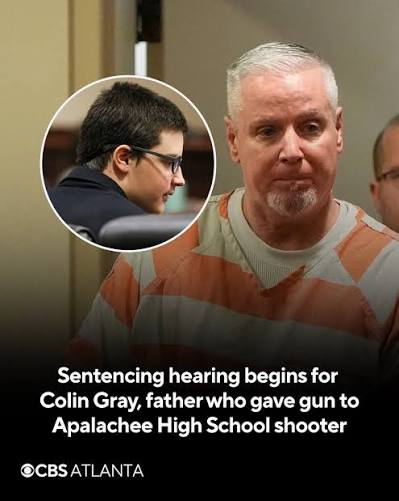
In a landmark moment for the American legal system, Colin Gray, the 55-year-old father of the teenager who perpetrated the 2024 massacre at Apalachee High School, has been sentenced to 15 years in prison. This sentence, handed down by Barrow County Superior Court Chief Judge Nicholas Primm, marks a significant shift in how the justice system holds parents accountable for the actions of their children. The case serves as a somber reminder that legal responsibility is increasingly extending beyond the shooter to those who facilitate access to the weapons used in these tragedies.
The Facts of the Case
The tragedy at Apalachee High School in Winder, Georgia, claimed the lives of four individuals: students Mason Schermerhorn and Christian Angulo, both 14, and teachers Cristina Irimie, 53, and Richard Aspinwall, 39. Nine others were wounded during the attack.
Colin Gray was found guilty in March on 27 counts, including second-degree murder, involuntary manslaughter, and cruelty to children. The prosecution’s case centered on a pivotal fact: Gray had gifted his son, Colt Gray—then 14—a semiautomatic rifle as a Christmas present. Despite clear warning signs regarding his son’s deteriorating mental health and a known fascination with mass shootings, the elder Gray left the weapon unsecured in the teenager’s room.
A New Legal Frontier: Parental Accountability
The sentencing of Colin Gray follows a national trend of “parental accountability” trials. Prosecutors argued that by providing a high-powered firearm to a child in crisis, Gray ignored “substantial and unjustifiable risks.”
During the sentencing hearing, Judge Primm was direct in his assessment, telling Gray, “It is clear you failed as a parent.” However, the judge also noted the complexity of the law, explaining that sentencing for crimes of negligence is uniquely difficult because there was no overt intent to commit the crime itself. Nevertheless, the legal outcome underscores a growing consensus: parents who ignore explicit warning signs and facilitate access to deadly weaponry may face significant criminal consequences.
The Human Toll: Voices from the Courtroom
The sentencing hearing provided a harrowing look at the “life sentences of grief” imposed on the victims’ families. Family members, many of whom had also testified during the shooter’s trial—where the teenager was sentenced to life without parole—urged the judge to impose the maximum penalty.
“He did not pull the trigger but purchased and left a firearm accessible to a minor,” said Shayna Aspinwall, widow of the slain teacher Richard Aspinwall. Her testimony, along with that of Mason Schermerhorn’s mother, Breanna Schermerhorn, highlighted the preventability of the tragedy. They argued that Gray’s choice to look away from his son’s crisis directly facilitated the loss of their loved ones.
Legal Ramifications and Future Precedents
While prosecutors sought an 80-year term, the 15-year sentence establishes a sobering precedent for parents across the United States. Similar efforts to hold parents criminally responsible have been seen in cases like the Crumbley trials in Michigan, signaling a departure from traditional “hands-off” approaches to parental liability.
By criminalizing the failure to secure firearms or the negligence regarding a child’s mental state and access to weapons, the judiciary is sending a clear message: gun ownership and parenting come with profound responsibilities that, if ignored, carry heavy legal burdens.
Frequently Asked Questions (FAQ)
Q: Why was Colin Gray sentenced to 15 years instead of 80? A: While prosecutors requested 80 years, Judge Primm imposed a 15-year sentence, noting that while Gray failed as a parent, he did not possess the specific intent to commit murder. The judge had the difficult task of balancing the severity of the tragedy with the legal limitations regarding negligence.
Q: What specific charges was Gray convicted of? A: He was convicted of 27 counts, including second-degree murder, involuntary manslaughter, cruelty to children, and reckless conduct.
Q: Is this the first case of a parent being sentenced for a child’s school shooting? A: It is part of a growing number of cases where parents are being held accountable. It follows other high-profile convictions where parents were found criminally liable for failing to secure firearms used by their children in mass shootings.
Q: What happened to the shooter? A: Colt Gray, who pleaded guilty to 55 counts including murder, was sentenced to life in prison without the possibility of parole just days before his father’s sentencing.
The Ripple Effect: Historical Context of Negligence
This shift in legal accountability is not happening in a vacuum; it echoes decades of tragic precedents where the intersection of parental negligence and access to weaponry turned unthinkable. Investigations into cases like Echoes of a Birthday Tragedy: A Father’s Grief and the Stockton Mass Shooting highlight a hauntingly similar trajectory: warnings missed, red flags ignored, and the catastrophic outcomes that follow when a parent fails to act as the final line of defense against their own child’s capacity for violence. These historical case studies illustrate that the tragedy in Georgia is part of a longer, painful narrative where the failure to intervene in a child’s downward spiral—compounded by the availability of lethal force—leaves an entire community to bear the weight of a preventable disaster. By contextualizing the sentencing of Colin Gray within these broader historical patterns, it becomes clear that society is finally moving toward a consensus that parental responsibility is not merely a moral suggestion, but a fundamental pillar of public safety.
Conclusion
The sentencing of Colin Gray closes a significant legal chapter in the Apalachee High School tragedy, but for the families of the victims, the pain remains. This case serves as a stark warning to gun owners and parents alike: the safety of the community often relies on the responsible management of the household. As legal standards continue to evolve, the distinction between a “failure to parent” and a “criminal act” will likely continue to be debated in courtrooms across the nation.

