

Introduction: A High-Stakes Legal Reckoning
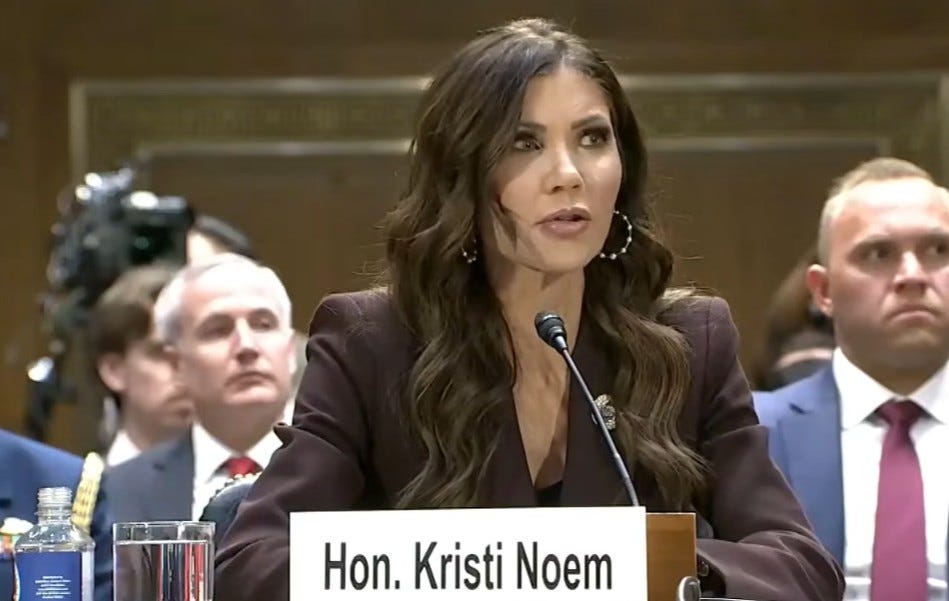
The political landscape is often defined by rhetoric, but it is anchored by the rule of law. Recent developments concerning former Secretary of Homeland Security Kristi Noem have shifted from the realm of political maneuvering to serious federal investigation. Following her high-profile testimony before Congress in early March 2026, Noem now faces a formal referral for prosecution by the Department of Justice (DOJ).
The referral, spearheaded by ranking members of the House and Senate Judiciary Committees, Jamie Raskin and Dick Durbin, suggests that Noem’s attempt to defend her administrative record crossed the line from political spin into criminal mendacity. As the DOJ evaluates the evidence, the case stands as a critical litmus test for congressional oversight and the consequences of providing false testimony under oath.
1. The Core of the Allegations: Testimony Under Fire
The controversy stems from Noem’s back-to-back appearances before the Senate and House Judiciary Committees on March 3rd and 4th, 2026. At the time, Noem was fighting to maintain her standing within the administration. However, rather than clarifying the actions of the Department of Homeland Security (DHS), her testimony allegedly contained several “materially false” statements regarding agency operations and internal investigations.
Democratic leaders Jamie Raskin and Dick Durbin have been vocal in their assertion that these were not mere “slips of the tongue” or failures of memory. Instead, they argue that Noem engaged in a calculated effort to mislead lawmakers to shield herself and the administration from scrutiny.
2. Legal Analysis: Navigating 18 U.S.C. §1001 and §1621
To understand the gravity of this referral, one must examine the specific federal statutes cited in the letter to Attorney General Pam Bondi. These laws form the backbone of federal accountability.
18 U.S.C. §1001: Making False Statements
Often referred to as the “False Statements Act,” this statute is the DOJ’s primary tool against those who lie to federal investigators or Congress. Crucially, the prosecution does not need to prove the defendant was under oath. They only need to prove that the individual:
- Made a statement that was false.
- The statement was material (meaning it had a natural tendency to influence the decision-making body).
- The statement was made knowingly and willfully.
18 U.S.C. §1621: The Perjury Statute
Unlike Section 1001, perjury specifically involves statements made while under oath. For Noem, the stakes are elevated because her congressional testimony was sworn. A conviction for perjury requires proof that the defendant willfully subscribed as true a material matter which they did not believe to be true.
The Challenge of “Materiality”
In legal terms, “materiality” is the pivot point. Noem’s defense will likely argue that any inaccuracies in her testimony were minor details that did not impact the ultimate outcome of the congressional inquiry. The prosecution, conversely, will focus on how her alleged lies obstructed the committees’ ability to conduct meaningful oversight of the DHS.
3. The Statue of Limitations and Political Strategy
One of the most striking aspects of this referral is the timing. Ranking members Raskin and Durbin noted that the statute of limitations for these federal crimes extends well beyond the current administration’s term.
This is a strategic legal maneuver. By referring the case now, the Judiciary Committees ensure that the documentation is formalized and the investigation is initiated. Even if a friendly administration seeks to stall the process, the legal “clock” is ticking in a way that creates long-term vulnerability for Noem. It signals that accountability is not limited to a specific political cycle.
4. The Administrative Fallout: From DHS to Obscurity
Kristi Noem’s trajectory has been a dramatic arc within the Republican party. Once seen as a potential running mate or a leading light for the future of the GOP, her tenure at DHS was marked by friction. Her reassignment by the President—prior to the perjury allegations becoming public—was already viewed as a demotion.
If the DOJ proceeds with an indictment, it would effectively end her political career. The precedent set by this case would also serve as a warning to future cabinet members: the privilege of high office does not grant immunity from the consequences of dishonest testimony.
5. FAQ: Understanding the Kristi Noem Prosecution Referral
Q: Does a referral automatically mean Kristi Noem will go to jail? A: No. A “referral” is a formal request from Congress to the DOJ to investigate and potentially prosecute. The DOJ must conduct its own independent review to determine if there is sufficient evidence to bring charges before a grand jury.
Q: Can a President pardon someone for perjury before Congress? A: Yes. The President has the power to grant pardons for federal crimes, including perjury and making false statements. However, doing so often carries significant political risk and can be used as evidence of a cover-up in the court of public opinion.
Q: What were the specific lies Noem is accused of telling? A: While the full letter details multiple instances, the primary allegations center on her knowledge of specific DHS directives and her communication with the White House regarding the implementation of controversial border policies.
Q: Who is Pam Bondi, and why is she the recipient of the letter? A: Pam Bondi is the Attorney General. As the head of the Department of Justice, she ultimately oversees federal prosecutors and determines the department’s priorities regarding high-level political prosecutions.
6. Conclusion: The Integrity of the Oath
The referral of Kristi Noem for prosecution is more than a partisan skirmish; it is a fundamental question of whether the truth matters in the halls of Congress. When a high-ranking official takes an oath, they enter into a contract with the American public. Breaking that contract via perjury or false statements undermines the very foundations of democratic oversight.
As the DOJ reviews the evidence provided by Raskin and Durbin, the focus remains on the evidence. If the statutes of 18 U.S.C. §1001 and §1621 were indeed violated, the legal system must provide a remedy. Regardless of the political outcome, the case against Kristi Noem serves as a stark reminder that while political winds change, the law remains a constant.

