

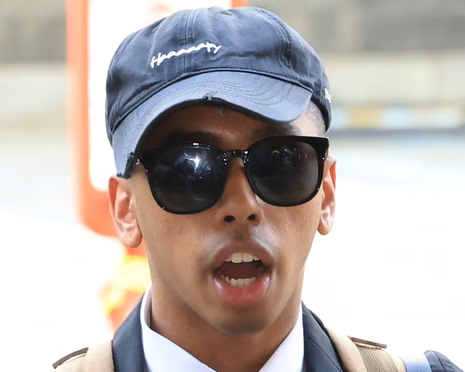
Editor’s Note: As a digital content creator and website administrator, I have closely followed the intersection of global social media trends and international law. The sentencing of Ramsey Khalid Ismael (Johnny Somali) in South Korea is not merely a celebrity news story; it is a critical case study in how sovereign nations are redefining public order in the age of live-streaming. This article provides a clinical analysis of the legal precedents, the “prison labor” system, and the future of digital accountability.
1. The Final Verdict: Prison Labor in the ROK
On April 15, 2026, the Seoul Western District Court handed down a sentence that many legal experts are calling a “watershed moment” for digital media regulation. Ramsey Khalid Ismael, known as Johnny Somali, was sentenced to six months of prison labor followed by 20 days of detention.
Unlike standard incarceration, the South Korean Jingyeok (징역) system mandates that inmates participate in vocational labor for eight hours a day. This is not “hard labor” in the historical sense, but structured work intended for rehabilitation and social contribution. For Ismael, this means his “business model”—which relies entirely on a mobile phone and an internet connection—will be replaced by manual or vocational tasks within the correctional facility.
The Full Legal Penalty:
-
Custodial Sentence: 6 months with mandatory labor.
-
Detention: 20 days for Minor Crimes Act violations.
-
Employment Restriction: A five-year ban on working at institutions related to children, adolescents, or the disabled.
-
Administrative Actions: Likely permanent deportation and re-entry ban upon release.

2. The Anatomy of the Charges: Why the Court Acted
The prosecution initially sought a three-year sentence, citing a pattern of “calculated malice.” While the final sentence of six months may seem light to some, it represents a conviction on all eight counts, including charges that Ismael initially fought:
-
Special Act on Sexual Violence Crimes: Convicted on two counts related to the creation and distribution of fabricated pornographic “deepfakes” of South Korean streamers.
-
Obstruction of Business: Four counts involving incidents at convenience stores (spilling noodles) and private businesses (Lotte World).
-
Minor Crimes Act: Two counts for disturbing public peace on subways and buses with loud, offensive audio.
3. The “Comfort Woman” Incident: A Cultural Flashpoint
While the legal charges were broad, the moral and social catalyst for the crackdown was Ismael’s defacement of the “Comfort Woman” statue in Seoul. These memorials are dedicated to the women forced into sexual slavery during World War II and are considered sacred national symbols.
Ismael’s decision to perform provocative dances and kiss the statue was viewed by the court as a direct assault on South Korean national dignity. The judge noted that such actions exceed the boundaries of “content creation” and fall into the category of hate-driven public harassment.
4. The Economics of Nuisance Streaming
To understand why Ismael continued his behavior despite repeated arrests, one must look at the Attention Economy. Nuisance streamers operate on a high-risk, high-reward financial model.
| Feature | Nuisance Streaming (Conflict-Based) | Professional Creation (Value-Based) |
| Revenue Source | Rage-donations & TTS (Text-to-Speech) | Ads, Sponsors, Affiliate & “Compound Views” |
| Growth Strategy | Violating social norms for “spikes” | Providing utility and authority |
| Risk Level | Extreme (Legal, Physical, Financial) | Low (Sustainable & Managed) |
| Platform Status | Frequently Banned (Kick, YouTube, Rumble) | AdSense & Partner Program Verified |
The “Death Spiral” of Clout
In his final court appearance, Ismael attempted to claim that his actions “would not be illegal in the United States.” However, the court rejected this “clueless tourist” defense. The evidence showed a sophisticated understanding of how to trigger algorithms for profit. By sentencing him to labor, the ROK government is essentially bankrupting the business model of clout-chasing through social disruption.
5. South Korea’s 2026 “Anti-Fake News” Legislation
The timing of this sentence coincides with South Korea’s new Information and Communications Network Act, passed in late 2025. This law allows courts to impose punitive damages up to five times the proven losses against creators who disseminate fabricated information for profit.
Ismael’s deepfake charges were a primary test for this new judicial environment. By holding a foreign creator accountable for digital sexual violence (deepfakes), the ROK has set a precedent that digital actions have physical consequences, regardless of the perpetrator’s nationality.
6. The Rise of “Vigilante” Culture
A significant portion of the “Johnny Somali” saga involved the “Somali Hunters”—local South Koreans who tracked his live-stream location to deliver physical “justice.” This highlighted a dangerous trend: when the public perceives the law as too slow to handle digital harassment, they take the law into their own hands.
The 2026 verdict is seen as the government’s attempt to reclaim the monopoly on justice. By delivering a prison sentence that includes labor and a loss of digital access, the court is signaling to the public that the legal system is capable of neutralizing digital threats.
Final Thoughts: The Future of Global Travel Content
As we move further into 2026, the “Wild West” era of IRL streaming is coming to an end. The sentencing of Johnny Somali is a call for all creators to invest in their principal—their reputation and the quality of their content. By focusing on Sustainable Authority rather than temporary notoriety, you build a digital asset that truly compounds over time.

