

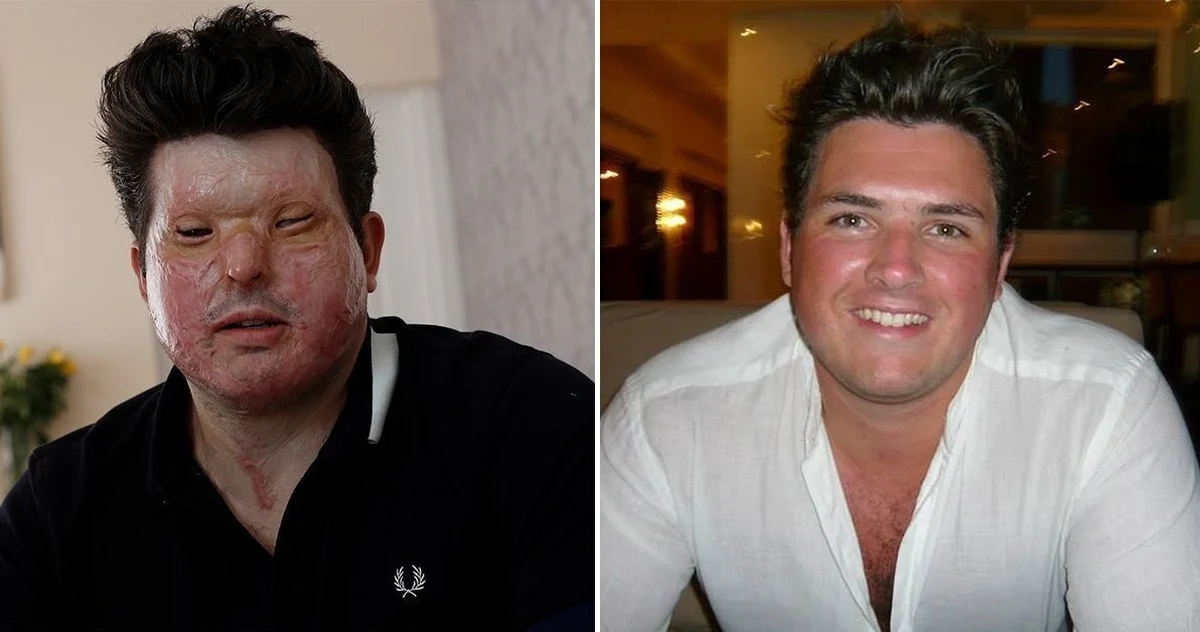
In the quiet coastal town of Truro, Cornwall, the morning of December 9, 2014, began like any other for Andreas Christopheros. A 29-year-old property developer, devoted husband, and father to a 18-month-old son, Christopheros was organized, hard-working, and deeply rooted in his community.
That peace was permanently shattered by a knock at his front door.
Expecting a courier delivery, Christopheros opened the door to confront a total stranger, David Phillips, who muttered a brief, chilling phrase: “This is for you, mate.” Before Christopheros could process the words, Phillips threw a beaker of highly concentrated, professional-grade battery acid directly into his face.
Click here to watch the sickening acid attack and aftermath
The assault was later revealed to be a catastrophic, negligent case of mistaken identity. The attacker had traveled over 300 miles from Sussex to exact revenge on someone he believed had wronged his family, completely targeting the wrong house and the wrong man.
The resulting chemical blast instantly caused severe, life-altering trauma. Yet, what began as a senseless act of horrific violence evolved over the next decade into an extraordinary testament to medical science, psychological grit, and the ultimate victory of human resilience over despair.
🏥 The Medical War: Over 70 Reconstructive Surgeries
The physical devastation inflicted by the acid was immediate and profound. The corrosive liquid dissolved the skin on Christopheros’s face, neck, and chest down to the subcutaneous tissue, destroying his eyelids, completely blinding his left eye, and severely damaging his right. Emergency medical teams rushed him to a specialized burns unit, where he was kept in a medically induced coma to manage the excruciating pain and systemic shock.
Surviving the initial attack was merely the first battle in an ongoing, brutal medical war. To date, Andreas Christopheros has undergone more than 70 reconstructive surgeries, a staggering number that illustrates the grueling, non-linear reality of chemical burn recovery.
[The Reconstruction Journey]
December 2014  ──> Initial attack; life-saving stabilization and coma management.
Phase 1 (Early) ──> Critical skin grafts using donor tissue from his thighs and scalp.
Phase 2 (Mid)   ──> Complex structural reconstruction, including building new eyelids from scratch.
Phase 3 (Late)  ──> Ongoing scar tissue release, airway preservation, and vision maintenance.
The surgical process required an elite team of plastic and ophthalmic surgeons to piece his face back together. Because his eyelids were completely burned away, surgeons had to construct new ones using skin grafts from his thighs and scalp just to protect his remaining eyesight. Every surgery required weeks of agonizing recovery, as skin grafts frequently contract, scar tissue restricts movement, and the body constantly fights against the artificial restructuring of its largest organ. Through it all, Christopheros had to relearn how to perform basic facial functions—blinking, eating, and speaking—while managing chronic, lifelong physical pain.
🏛️ The Legal Reckoning and a Controversial Sentence
The legal aftermath of the attack proved to be nearly as agonizing for the Christopheros family as the physical recovery. David Phillips was swiftly arrested and brought to trial. In October 2015, he was initially handed a life sentence with a minimum term of seven years after pleading guilty to causing grievous bodily harm with intent. The sentencing judge originally deemed Phillips an “imminent danger to the public.”
However, a subsequent decision by the Court of Appeal sparked widespread public outrage and intense legal debate.
In April 2016, appellate judges overturned the life sentence. They ruled that while the crime was undeniably horrific, the legal definition of a life sentence required a proven history of dangerousness, which the first-time offender did not technically possess under the strict letter of the law.
         [David Phillips Sentencing Shift]
┌────────────────────────────────────────┬────────────────────────────┐
│ Court Ruling                           │ Legal Outcome              │
├────────────────────────────────────────┼────────────────────────────┤
│ Initial Trial (October 2015)          │ Life (Minimum 7 Years)     │
│ Court of Appeal (April 2016)           │ Reduced to 16-Year Fixed   │
│ Parole Eligibility Timeline            │ Eligible after 8 Years     │
└────────────────────────────────────────┴────────────────────────────┘
Instead, Phillips’s sentence was altered to a fixed 16-year term. Under British sentencing guidelines for determinate sentences, this meant he would be eligible to apply for parole after serving just half of his sentence—roughly eight years.
Christopheros vocally criticized the judicial system, pointing out the profound injustice of a system where an attacker could walk free in under a decade, while the innocent victim is left serving a literal life sentence of physical disability, facial disfigurement, and trauma.
✒️ Editor’s Opinion: Reclaiming Authority Over Tragedy
In true crime journalism and digital reporting, we often focus heavily on the mechanics of malice. We analyze the dark psychology of perpetrators, trace their timelines, and debate the granular failures of the justice system. But high-value journalism requires that we shift our focus to where the true power lies: with the survivor who refuses to be defined by a criminal’s choices.
David Phillips arrived at Andreas Christopheros’s home intending to completely erase a man’s life and identity. He used chemical warfare to strip away his face.

But what the attacker completely failed to calculate was the unbreakable sovereignty of Christopheros’s mind.
Christopheros’s decision to endure over 70 surgeries, to remain a deeply present and loving father to his son, and to step into the public eye as a champion for stricter acid control laws is an act of profound, aggressive defiance. He transformed himself from a victim of a botched revenge plot into a powerful advocate, successfully lobbying for tighter restrictions on the sale of highly concentrated corrosive substances in the UK.
His journey serves as a blueprint for anyone navigating an existential crisis. It proves that while external forces can violently disrupt our physical reality, they cannot touch our internal character unless we permit them to. Christopheros didn’t just survive; he reclaimed his narrative, proving that true strength is forged not by what happens to us, but by how we choose to rebuild.
David Phillips arrived at Andreas Christopheros’s home intending to completely erase a man’s life and identity. He used chemical warfare to strip away his face.
But what the attacker completely failed to calculate was the unbreakable sovereignty of Christopheros’s mind.
Christopheros’s decision to endure over 70 surgeries, to remain a deeply present and loving father to his son, and to step into the public eye as a champion for stricter acid control laws is an act of profound, aggressive defiance. He transformed himself from a victim of a botched revenge plot into a powerful advocate, successfully lobbying for tighter restrictions on the sale of highly concentrated corrosive substances in the UK.
This refusal to capitulate to sudden, catastrophic trauma shares a profound psychological blueprint with other survivors fighting to reclaim their sovereignty after violent, unexpected tragedies. The long, grueling process of somatic and structural reconstruction is not unique to chemical burns; it is a battle mirrored by those who have had their bodies shattered by the reckless entitlement of others on the road. A similarly remarkable testament to human endurance is detailed in *Two Amputated Legs: Daniel Franecki’s Journey Beyond a Catastrophic Drink Driving Crash*. Much like Christopheros, Franecki was forced to completely rebuild his identity and kinetic foundation from absolute zero after a motorist’s catastrophic choice stripped him of his lower limbs. When we cross-examine these narratives, it becomes clear that whether a survivor is fighting to re-engineer their facial features or learning to walk again on prosthetic limbs, the underlying armor remains identical: an unyielding refusal to let a criminal’s actions dictate the final boundary of their life.
His journey serves as a blueprint for anyone navigating an existential crisis. It proves that while external forces can violently disrupt our physical reality, they cannot touch our internal character unless we permit them to. Christopheros didn’t just survive; he reclaimed his narrative, proving that true strength is forged not by what happens to us, but by how we choose to rebuild.
—
## ❓ Frequently Asked Questions (FAQ)
❓ Frequently Asked Questions (FAQ)
Q: Why was Andreas Christopheros attacked?
A: He was attacked in a tragic case of mistaken identity. The assailant, David Phillips, targeted the wrong house and the wrong person while attempting to execute a revenge plot against a completely different individual.
Q: How many surgeries has Andreas Christopheros survived?
A: He has endured more than 70 complex reconstructive and life-saving surgeries to rebuild his face, recreate his eyelids, and preserve his remaining eyesight.
Q: What sentence did the attacker receive?
A: After an initial life sentence was overturned on appeal, David Phillips was given a fixed 16-year sentence, making him eligible for parole review after serving eight years.

