

On May 14, 2022, a quiet Saturday afternoon in a tight-knit community was violently shattered by an act of calculated, racially motivated domestic terrorism. A heavily armed, self-radicalized 18-year-old white supremacist drove over 200 miles to the Tops Friendly Markets on Jefferson Avenue in Buffalo, New York. His explicit objective, meticulously documented in a hateful online manifesto, was to target a predominantly Black neighborhood and murder as many African American citizens as possible.
Click here to watch the devastating shooting
The resulting massacre left 10 innocent people dead, three others wounded, and an entire nation reeling from the sheer, unadulterated malice of the attack.
However, the true legacy of the Buffalo shooting is not defined by the cowardly actions of the perpetrator. Instead, the enduring narrative belongs to the profound resilience of the Buffalo community, the severe and historic legal reckoning that followed, and the unforgettable, raw power of the victim impact statements delivered by grieving families during the sentencing phase.
🏬 The Tragedy on Jefferson Avenue
The gunman, Payton Gendron, meticulously planned his assault to maximize civilian casualties. Wearing body armor, a tactical helmet, and a military-grade rifle modified with illegal high-capacity magazines, he began shooting before he even stepped foot inside the supermarket. He targeted victims in the parking lot before moving through the aisles of the grocery store, executing defenseless shoppers and employees.
Among the ten individuals stolen from their families were grandmothers, community advocates, a dedicated security guard who fought back valiantly, and beloved neighborhood pillars. The attack was not merely a mass shooting; it was a highly organized, ideologically driven assault aimed at breaking the spirit of a community.
[The Architecture of a Crisis]
May 14, 2022 ──> White supremacist mass shooting at Tops Market leaves 10 dead, 3 injured.
November 2022 ──> Perpetrator pleads guilty to 25 state charges, including domestic terrorism.
February 2023 ──> Emotional sentencing hearing featuring historic victim impact statements.
The Aftermath  ──> Imposition of 11 consecutive life sentences without the possibility of parole.
The shooter’s plans were deeply rooted in the “Great Replacement” theory—a white supremacist conspiracy theory that alleges white populations are systematically being replaced by non-white individuals through immigration and demographic shifts. By streaming the attack live online, the perpetrator sought to inspire copycat acts of violence, making the swift execution of justice and public denunciation of his ideology an absolute necessity.
🏛️ The Legal Reckoning: 11 Consecutive Life Sentences
The state of New York responded to the atrocity with the full weight of its revised penal code. On November 28, 2022, Gendron pled guilty to 25 state charges, including first-degree murder, attempted murder as a hate crime, and—most significantly—domestic terrorism motivated by hate. This marked the first time in New York State history that a defendant was convicted under this specific domestic terrorism statute.
On February 15, 2023, Erie County Court Judge Susan Eagan handed down a monumental sentence. Gendron was sentenced to 11 consecutive counts of life imprisonment without the possibility of parole.
         [Payton Gendron State Sentencing Breakdown]
┌──────────────────────────────────────────────┬────────────────────────────┐
│ Charge Category                              │ Sentence Imposed           │
├──────────────────────────────────────────────┼────────────────────────────┤
│ Domestic Terrorism Motivated by Hate         │ Life Without Parole        │
│ First-Degree Murder (10 Counts)              │ 10 x Life Without Parole   │
│ Attempted Murder as a Hate Crime (3 Counts)  │ Max Determinate Sentences  │
└──────────────────────────────────────────────┴────────────────────────────┘
During the sentencing, Judge Eagan made it clear that the severity of the punishment was designed to ensure the shooter would never breathe free air again, stating, “There is no place for you or your ignorant, hateful, and evil ideologies in a civilized society. There can be no mercy for you, no second chance, no rehabilitation.” While the state sentence permanently sealed his fate, Gendron still faces separate federal hate crime charges that carry the potential for the death penalty.
🎙️ The Power of the Victim Impact Statements: Wayne Jones and Broken Families
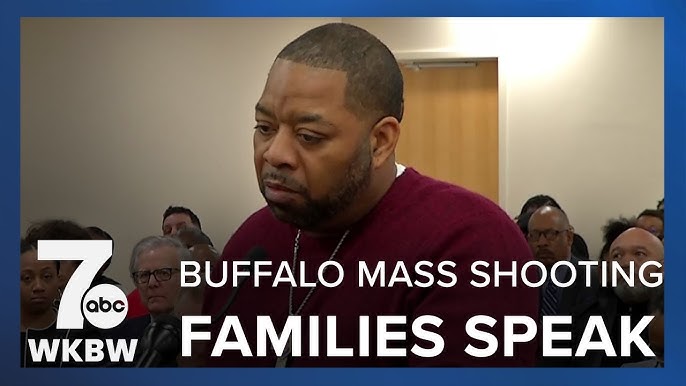
Before the final gavel fell, the courtroom was handed over to the families of the victims. For hours, the atmosphere was thick with overwhelming grief, visceral rage, and undeniable strength. These victim impact statements stripped away the clinical detachment of court proceedings, forcing the perpetrator and the world to look squarely at the agonizing human cost of white supremacy.
One of the most devastating and unforgettable moments came from Wayne Jones, the son of 65-year-old Celestine Chaney, a grandmother and cancer survivor who was executed while buying strawberries for a shortcake.
Jones stood feet away from the killer, locking eyes with him as he delivered a searing rebuke of his actions.
“You shot my mother, a defenseless 65-year-old woman who did absolutely nothing to you,” Jones said, his voice trembling with a mixture of profound sorrow and righteous anger. “You don’t know what we went through. You are a cowardly piece of garbage. You came to our community because you thought we were weak. But you didn’t break us. You made us stronger.”
Jones’s statement encapsulated the core paradox of the shooter’s mission: the violence meant to divide and terrify a Black community had instead bound them together in a unified front of absolute resilience.
Other family members shared equally shattering testimony. Barbara Massey, whose 72-year-old sister Katherine “Kat” Massey was killed, spoke with such intense emotional gravity that a relative in the gallery was momentarily overcome with grief, prompting a brief recess in the court. Kimberly Salter, the widow of heroic store security guard Aaron Salter Jr., wore a dress bearing her late husband’s image and noted that her family was praying for the shooter’s soul, demonstrating an extraordinary level of grace that contrasted sharply with the malice of the crime.
✒️ Editor’s Opinion: The Immense Value of Confronting Hate
In the digital era of true crime reporting, mass violence is too often treated as a collection of clinical data points, legislative debates, or algorithmic trends. We dissect weapon modifications, analyze radicalization timelines, and argue over penal codes. But high-value journalism demands that we never allow the statistics of a tragedy to eclipse the baseline humanity of those who were targeted.
The Buffalo Tops shooting was a stark reminder of the lethal reality of weaponized online rhetoric. The perpetrator was not a lone actor operating in a vacuum; he was a consumer of an internet ecosystem that profits off the monetization of grievance and racial animus.

The victim impact statements delivered by individuals like Wayne Jones are of immense social value because they serve as a definitive antidote to that radicalization. They strip the romanticism away from white supremacist violence and expose it for what it truly is: a weak, cowardly act that leaves real children weeping over the loss of their grandmothers. By forcing the public to confront the specific, localized pain of the Jefferson Avenue community, we build a collective psychological defense mechanism against the ideologies that fuel these massacres.
The Buffalo Tops shooting was a stark reminder of the lethal reality of weaponized online rhetoric. The perpetrator was not a lone actor operating in a vacuum; he was a consumer of an internet ecosystem that profits off the monetization of grievance and racial animus.
The victim impact statements delivered by individuals like Wayne Jones are of immense social value because they serve as a definitive antidote to that radicalization. They strip the romanticism away from white supremacist violence and expose it for what it truly is: a weak, cowardly act that leaves real children weeping over the loss of their grandmothers. By forcing the public to confront the specific, localized pain of the Jefferson Avenue community, we build a collective psychological defense mechanism against the ideologies that fuel these massacres.
However, understanding the landscape of modern mass violence requires analyzing these tragedies not as isolated anomalies, but as part of a highly complex, evolving spectrum of ideological extremism. While the threat of targeted white supremacist terror remains a critical focal point for law enforcement, a comprehensive look at the broader data reveals a much more fragmented reality. A deeper, data-driven exploration into how these ideologies intersect across different eras can be found in *UPDATE: The false narrative of white supremacists doing mass public shootings: Racial, Gender, Spiritual and Political beliefs of those killers from 1998 by 2025*. By cross-referencing the shifting racial, spiritual, and political profiles of perpetrators over nearly three decades, it becomes evident that the psychological profiles of mass killers are diversifying rapidly, driven by a chaotic mix of nihilism, misanthropy, and fringe political dogmas. Ultimately, mapping these broader macro-trends is essential for high-value journalism, as it prevents the public from oversimplifying a multifaceted national crisis while still holding perpetrators of explicit hate crimes fully accountable.
—
## ❓ Frequently Asked Questions (FAQ)
❓ Frequently Asked Questions (FAQ)
Q: Who was the gunman in the Buffalo Tops supermarket shooting?
A: The shooter was Payton Gendron, an 18-year-old from Conklin, New York, who carried out the targeted attack based on white supremacist ideologies.
Q: What historic charge was the shooter convicted of?
A: He was the first person in New York history to be convicted of Domestic Terrorism Motivated by Hate, alongside ten counts of first-degree murder.
Q: Who is Wayne Jones, and what did he say at the sentencing?
A: Wayne Jones is the son of Celestine Chaney, one of the ten victims killed in the shooting. At the sentencing hearing, he directly confronted the shooter, calling him a coward and emphasizing that the attack had only made the community stronger.

