

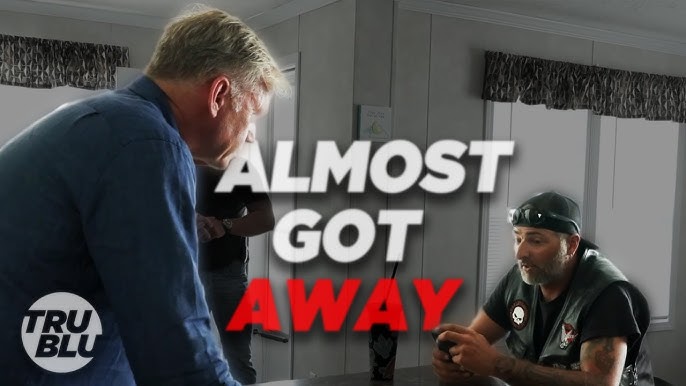
In the relentless landscape of online child predator investigations, Genesee County, Michigan has become a focal point for the high-stakes work of Sheriff Chris Swanson and his “Ghost Team.” In Season 9, Episode 5 of “Takedown with Chris Hansen,” we witness the capture of Brian, a 39-year-old construction worker and avid biker.
This case is a “High-Value” study in Premeditation and Mitigation Strategies. Brian did not just arrive at the sting house; he circled the block multiple times, demanded photo verification with “today’s date,” and attempted to pivot the conversation from an illegal sexual encounter to a “benign” smoking session.
The Sting: The Digital Footprint of “Bad Turn Brian”
The investigation into Brian revealed a “Compounding Effect” of suspicious behavior. According to Lieutenant Andy Snyder, Brian had surfaced in previous sting operations as early as April but had never followed through—until now.
-
The Negotiation: The chat transcripts and phone calls revealed a clear agreement: $100 for sexual services with a decoy posing as a 15-year-old girl.
-
The Verification: Wary of a “set up,” Brian demanded the decoy send a photo holding up the current date to prove she was real and not law enforcement.
-
The Arrival: Brian arrived on his Harley-Davidson Street Glide, circling the trailer park three times before finally entering.
Video Timestamps
-
[01:30] – The Ghost Team: Introduction to the Genesee County operation and Sheriff Chris Swanson’s team.
-
[01:55] – The “Price” Call: The recorded phone call where Brian negotiates $100 for sex.
-
[03:52] – Photo Proof: Brian demands a new photo with “today’s date” to verify the decoy.
-
[05:08] – The Arrival: Brian rolls up on his Harley and calls the decoy to meet on the porch.
-
[06:22] – The Takedown: Chris Hansen steps out, and Brian is told to take a seat.
-
[08:23] – The Alibi: Brian explains his job in road construction and his love for Harley-Davidsons.
-
[10:35] – The Denial: Brian claims he never sent the sexual texts, despite the evidence on his phone.
-
[12:57] – The “Blunt” Evidence: Brian shows Hansen his weed and blunt wraps, claiming he only came to smoke.
-
[16:08] – The Daughter Question: Hansen asks Brian how he would feel if a 39-year-old met his 13-year-old daughter to smoke weed.
-
[21:02] – The Charges: A breakdown of the three felony counts Brian faces.
-
[23:02] – The “Puke” Factor: Sheriff Swanson explains the psychology of “mitigation” during a takedown.
The Profile: The “Marijuana Defense”
Brian’s “Architecture of Deception” was centered on what he believed was a lesser offense. Throughout the interview, he insisted he was only there to “smoke a blunt” and bring the girl a “pop.” He attempted to use the legality of marijuana in Michigan as a shield, even going as far as to say he wouldn’t mind if his own daughters smoked weed.
However, as Chris Hansen pointed out, the “Absolute Strength” of the case lies in the intent.
-
Financial Transaction: He discussed a $100 price for sex.
-
Age Acknowledgement: He was explicitly told the girl was 15.
-
Physical Presence: He brought a blunt specifically to share with a minor, which itself is a crime (distributing to a minor).
Legal Consequences: The Genesee County Jail
The “Information Gain” for the prosecution in this case was massive, thanks to the Ghost Team’s meticulous logging of Brian’s previous near-misses in other stings. Following his arrest, Brian was charged with:
-
Child Sexually Abusive Activity (Felony)
-
Accosting and Soliciting a Minor (Felony)
-
Using a Computer to Commit a Crime (Felony)
Sheriff Chris Swanson noted that Brian’s repeated appearances in stings indicated a “premeditated build-up.” He was “testing the waters” until his curiosity—and his predatory intent—overtook his caution.
Frequently Asked Questions (FAQ)
Q1: Why did Brian circle the house three times? A: This is a classic “Counter-Surveillance” tactic. Brian was checking for unmarked police cars or signs of a sting operation, showing he was fully aware of the risk he was taking.
Q2: What kind of motorcycle did Brian ride? A: He arrived on a Harley-Davidson Street Glide, which he spoke about at length before the conversation turned to his criminal charges.
Q3: Did Brian bring any “gifts”? A: He brought a bottle of Faygo Redpop and two blunts, which he claimed were his “good deed” for the day.
Editor’s Opinion: The Mitigation Trap
In my analysis of Crisis Management and Human Behavior, Brian’s interview is a textbook example of what Sheriff Swanson calls “puking out an excuse.” When caught, the “Fight or Flight” response (the sympathetic nervous system) takes over. Brian’s brain immediately tried to “mitigate” the damage by pivoting to a “social” excuse—smoking weed.
He failed to realize that even his “best-case scenario” (smoking weed with a 15-year-old) is a high-value crime in the eyes of the law. His attempt to normalize predatory behavior by mentioning his own daughters was the final “Bad Turn” in an already disastrous defense. For Brian, the “Compounding Effect” of his digital history finally met the “Absolute Strength” of Genesee County’s justice system.
The Profile of the “High-Potential” Offender
The case of “Bad Turn Brian” is part of a broader, more troubling trend across Michigan’s law enforcement operations—one where professional success and technical intelligence fail to act as a deterrent for predatory behavior. While Brian represented the blue-collar, “road construction” sector, we have seen similar dynamics play out in the academic and professional spheres. This contrast is explored in our investigative feature, The Engineering of an Exit: The Chris Hansen Takedown of Dylan the Engineer. In that case, an aerospace engineering student’s promising future was dismantled by the same “Curiosity Defense” and digital tracking that ultimately led to Brian’s downfall in Genesee County. Both reports serve as a “High-Value” study in how the “Architecture of Modern Stardom”—or infamy—is built upon the permanent digital footprints left behind by those who believe they are smart enough to outrun the law.

