

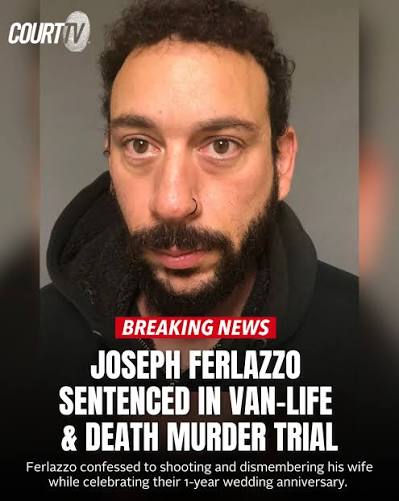
In October 2021, 22-year-old nurse Emily Schwarz (Ferlazzo) embarked on what was supposed to be a celebratory milestone [1.1.2, 1.1.4]. She and her husband of one year, 41-year-old tattoo artist Joseph Ferlazzo Jr., traveled from New Hampshire to a scenic vacation spot in Bolton, Vermont [1.1.2, 1.1.4, 1.2.3]. The trip was planned to commemorate their first wedding anniversary and attend a small family gathering [1.1.2, 1.1.4]. Travelling in their custom-converted camper bus, the journey was framed outward as a romantic getaway [1.1.2, 1.1.5].
Instead, the trip exposed the horrific reality of deep-seated domestic violence [1.1.2]. Within hours of arriving in the Vermont wilderness, Emily vanished [1.1.2, 1.1.3]. What followed was a complex missing persons investigation that quickly escalated into an industrial-scale forensic investigation, ultimately exposing a calculation of absolute brutality hidden behind the mask of a grieving spouse [1.1.3, 1.1.4].
The Disappearance and the Web of Deceit
The alarm was raised when Joseph Ferlazzo returned from the Vermont trip completely alone [1.1.2]. When questioned by Emily’s panicked family, Ferlazzo spun a elaborate web of lies [1.1.3, 1.1.4]. He claimed that he and Emily had engaged in a severe argument inside their camper van while parked in Bolton [1.1.2, 1.1.3]. According to his initial story, Emily had suddenly stormed out of the vehicle, walked away down a road, and hopped into a stranger’s car, never to return [1.1.2].
For four agonizing days, law enforcement agencies and search teams combed the Vermont wilderness, hunting for the missing 22-year-old nurse [1.1.4]. Meanwhile, Ferlazzo actively played the role of a cooperative, concerned partner while systematically moving the camper van to alter the geographic crime scene [1.1.3, 1.1.4]. The breakthrough in the case came when a sharp-eyed Vermont State Trooper spotted Ferlazzo at a convenience store in St. Albans [1.1.3, 1.1.4]. Taken in for official police interrogation, the structural integrity of Ferlazzo’s cover story completely collapsed [1.1.3, 1.1.4].
Anatomy of the Crime: Dismantling the Self-Defense Alibi
During the subsequent trial at the Chittenden County Superior criminal court, the defense attempted to paint Joseph Ferlazzo as a victim of sudden physical aggression [1.1.3, 1.1.4]. Taking the stand in his own defense, Ferlazzo claimed that during an intense argument in the van’s bed, Emily had allegedly gone “berserk,” brandishing a handgun and threatening his life [1.1.2, 1.1.4]. He claimed his subsequent actions were a split-second, panicked response driven purely by self-defense [1.1.2, 1.1.4].
However, the state’s prosecution team systematically dismantled this narrative utilizing hard forensic evidence:
Key Evidence Exposed at Trial
-
The Execution Mechanics: Ballistics and medical examiners testified that Emily had been shot twice in the head at close range [1.1.2, 1.1.4]. Forensic evidence proved that Ferlazzo had physically jumped on top of his wife, pinned a red throw pillow over her face to stifle the sound, and executed her [1.1.2].
-
Post-Mortem Brutality: Rather than calling 911 or seeking emergency help—which a legitimate actor of self-defense would do—Ferlazzo sat down, had another alcoholic drink, and calmly formulated a cover-up [1.1.4]. He then proceeded to brutally dismember Emily’s body inside the vehicle’s small bathroom, wrapping her remains in eight separate garbage bags [1.1.2, 1.1.5].
-
The Muted Timeline: Toxicology reports directly shattered Ferlazzo’s claims that the couple had been heavily drinking together, proving Emily had zero alcohol in her system at her time of death [1.1.2]. Furthermore, after committing the murder and hiding the remains in the shower, Ferlazzo left the van to have a casual breakfast with his sister [1.1.2, 1.1.5].
The Verdict and the Weight of Justice
In December 2024, after listening to hours of harrowing forensic testimony and reviewing the digital confessions, a 12-person jury completely rejected Ferlazzo’s self-defense strategy [1.1.4]. It took the panel just five hours of deliberation to return a unanimous verdict: Guilty of First-Degree Murder [1.1.4].
[The Judicial Breakdown]
- Statutory Minimum: 35 Years to Life for First-Degree Murder in Vermont.
- Prosecution Request: 50 Years to Life, citing extreme post-mortem depravity.
- Final Sentence: 42.5 Years to Life, handed down by Judge John Pacht.
At the emotional sentencing hearing in April 2025, Judge John Pacht emphasized that Emily’s life was cut short by a calculated act of domestic terror [1.1.2, 1.2.3]. Emily’s family filled the courtroom wearing red shirts emblazoned with the words, “Love Shouldn’t Hurt,” delivering crushing victim impact statements that recalled a vibrant young nurse who loved animals, music, and possessed a voice that deserved a long, happy life [1.1.3, 1.2.3].
Ferlazzo’s attempts to read a statement continuing to suggest self-defense prompted Emily’s grieving mother to walk out of the courtroom entirely [1.1.3, 1.2.3]. Ultimately, the judge’s sentence of 42.5 years to life ensures that the 45-year-old killer will remain behind bars well into his 80s before ever becoming eligible to whisper the word parole [1.1.2, 1.2.3].
Understanding the Broad Patterns of Intimate Partner Violence
The tragic fate of Emily Schwarz highlights a lethal pattern frequently recognized by behavioral analysts: the extreme escalation of control within domestic partnerships. Predators and abusers often isolate their victims geographically—using vacations, remote camping trips, or “van life” lifestyles—to sever the victim’s immediate access to their support networks, leaving them entirely vulnerable behind closed doors.
Video Timeline & Structural Analysis
-
00:00 – 05:00 | The Vanishing at Bolton: Host Sierra Gillespie details the timeline of the October 2021 anniversary trip and the initial missing persons reports launched by Emily’s family.
-
05:01 – 15:00 | The Forensic Discovery: An exploration of how the Vermont State Police discovered the eight garbage bags hidden in the custom bus’s bathroom.
-
15:01 – End | The Courtroom Breakdown: A deep look at the trial footage, Ferlazzo’s widely criticized testimony, and the final sentencing structure.
This Law&Crime Network analysis of the Ferlazzo trial provides direct courtroom footage, police interrogation playbacks, and forensic investigator testimonies that secured the first-degree murder conviction.

