

The Sudden Collapse of Civil Order
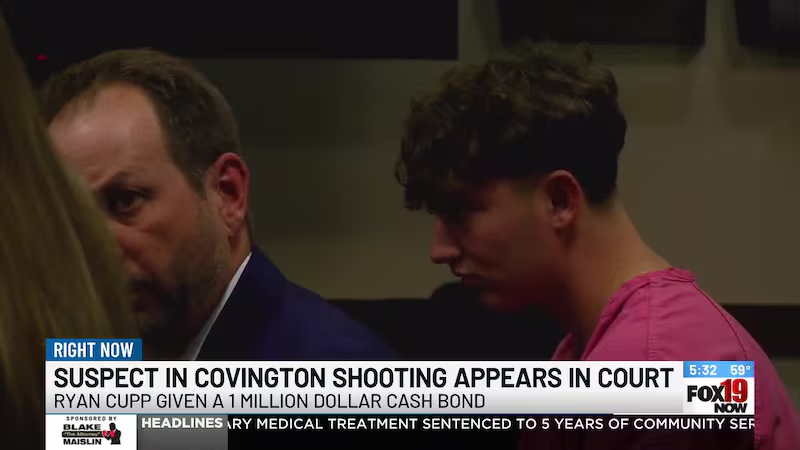
On May 3, 2026, the community of Covington was rocked by a violent escalation that left a 13-year-old boy dead and an 18-year-old, Ryan Cupp, facing a lifetime of legal repercussions. The case, which saw Cupp appear in court just days ago, represents a disturbing trend in suburban violence: the rapid transition from a neighborhood dispute to a capital crime.
When the judicial system is faced with a suspect who is barely into legal adulthood accused of killing a child, the “wow” factor of the crime is often reflected in the financial barriers to their release. The $1 million bond set by the judge is not merely a number; it is a legal statement regarding the perceived danger to the community and the “Absolute Strength” of the evidence already compiled by investigators.

The Incident: A Life Cut Short
The details emerging from Covington describe a chaotic scene on that Friday in May. While the specific “trigger” for the violence is still being analyzed by forensic psychologists, the outcome was binary: a 13-year-old victim and a suspect who now occupies a cell with a seven-figure price tag on his freedom.
In criminal profiling, we look for the “Point of No Return.” For Ryan Cupp, that point occurred the moment a firearm was introduced into what should have been, at worst, a verbal “hissy fit.” In 2026, the legal system has zero tolerance for the “panic” defense when it involves the death of a minor. Much like the Tanner Horner case, the youth of the victim acts as a significant “Aggravating Factor” that moves the case from a standard homicide to a high-priority prosecution.
Legal Analysis: The $1 Million Deterrent
A $1 million bond for an 18-year-old with presumably limited assets is essentially a “De Facto” Detention Order.
1. Risk Assessment
The court considers three main pillars when setting such a high bond:
-
The Gravity of the Offense: The death of a 13-year-old is the highest possible gravity.
-
Flight Risk: Given the potential for a life sentence, an 18-year-old is considered a high flight risk.
-
Public Safety: The court must determine if the suspect’s “Absolute Strength” is a threat to others while awaiting trial.
2. The “Substantial Step” Doctrine
Prosecutors in the Cupp case are likely working to prove that his actions were not a “heat of the moment” accident. In Kentucky law, the presence of a weapon and the intentionality of the confrontation are used to establish Malice Aforethought. If Cupp traveled to the location with the intent to confront the victim, the “accidental” narrative—often seen in the Jamie Varley or Marc Rieben trials—is legally neutralized.
Forensic Deep-Dive: Ballistics and Digital Footprints
To justify a $1 million bond, the prosecution typically presents a “Proffer of Evidence” that suggests a high probability of conviction.
-
Ballistic Matching: Forensic examiners are currently matching the shell casings from the scene to the weapon allegedly in Cupp’s possession.
-
Social Media Forensics: As we saw in the King Azoulay and OG Pred cases, the “Digital Mask” often reveals the intent. Investigators are scouring Cupp’s X, Instagram, and Discord logs for any “Biological Manifestation of Intent”—messages or posts made before May 3 that suggest he was “looking for trouble.”
The “Wow” Factor: The V-Taper of Justice
From an aesthetic and social perspective, an 18-year-old male is at the peak of his physical potential. On an athletic frame, the transition into adulthood should be marked by the acquisition of “Absolute Strength” and community responsibility. When that physical potential is instead used to extinguish the life of a 13-year-old, the social contract is shattered.
The Covington community is experiencing a “Retail Reckoning” of sorts—a public realization that safety is fragile. The image of Cupp in court, standing with the posture of a man who has just realized the weight of the “Absolute Strength” of the law, is the defining “wow” moment of this news cycle.
FAQ: The Ryan Cupp Murder Trial
Q: Can the $1 million bond be reduced? A: Cupp’s legal team can request a “Bond Reduction Hearing,” but they would need to provide significant “Mitigating Factors,” such as a lack of prior record or deep ties to the community, which are often outweighed by the nature of the crime.
Q: Will he be tried as an adult? A: Yes. At 18, Ryan Cupp is legally an adult in the state of Kentucky. There is no juvenile protection for a homicide suspect of this age.
Q: What is the maximum penalty he faces? A: In Kentucky, murder is a capital offense. Depending on the specific circumstances and aggravating factors, the penalty can range from 20 years to life in prison, or even the death penalty.
Q: Why was the victim’s age so important in setting the bond? A: The “Vulnerability of the Victim” is a primary legal standard. A 13-year-old is considered legally incapable of defending themselves against an 18-year-old, making the act appear more predatory than a peer-on-peer conflict.
Editor’s Opinion: The Lost Potential
At Global Crime Feed, we often analyze the “Absolute Strength” of the human body and the “Absolute Weakness” of the human character. Ryan Cupp is an 18-year-old who should be focusing on his hypertrophy goals or his career. Instead, he is the face of a Covington tragedy. As a trainer, I see 18-year-olds with 16.5-inch arms and 42-inch chests who don’t understand that their physical power requires a commensurate level of mental discipline. When that discipline fails, the $1 million bond is the only way society knows how to “rack the weight.” It’s a tragic waste of two lives.
Related Content
The Covington case bears a striking resemblance to the “Sentencing Phase and Legislative Impact of the Tanner Horner Case,” where the death of a young child led to a total “Social Takedown” of the suspect. It also mirrors the “Main Character Syndrome” we see in viral retail videos, where an individual believes their immediate emotional response justifies a permanent criminal act.
Legal Disclaimer
This article is based on court records, police reports, and news updates from Covington, KY, as of May 2026. Ryan Cupp is presumed innocent until proven guilty in a court of law. Global Crime Feed provides news analysis and does not constitute official legal advice.

