

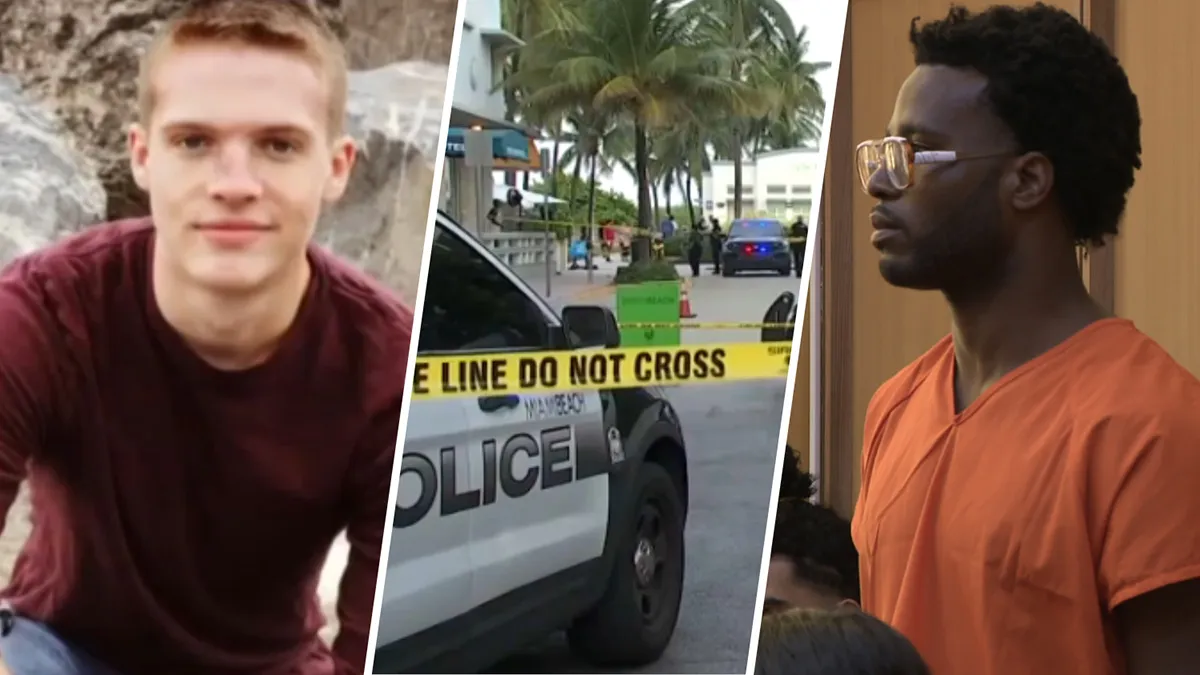
The streets of South Beach, typically defined by their vibrant “High-Value” tourism and neon aesthetics, became the scene of a harrowing tragedy that has sparked a nationwide conversation on drug-induced violence and legal accountability. The case of Tamarius Davis, a 22-year-old accused of the unprovoked killing of Dustin Wakefield, has entered a critical new phase with the entry of a not guilty plea.
Click here to watch his dramatic arrest footage
This case is a somber study in the “Architecture of a Legal Defense,” where the “Absolute Strength” of the prosecution’s evidence—including video footage and eyewitness testimony—meets the complex, often controversial “Involuntary Intoxication” strategy.
1. The Incident: A Tragedy at La Cerveceria
The facts of the case, as outlined by the Miami Beach Police Department, describe an event that defies logic and human empathy.
-
The Scene: Dustin Wakefield, a 21-year-old father from Colorado, was dining with his family at La Cerveceria de Barrio on Ocean Drive.
-
The Confrontation: Authorities allege that Davis approached the table and pointed a firearm at Wakefield’s 1-year-old son.


-
The Heroism: In an act of “Absolute Strength” and paternal instinct, Wakefield stood between the gunman and his child, reportedly saying, “He’s only a baby.”
-
The Act: Davis allegedly shot Wakefield multiple times. Following the shooting, video captured the suspect performing a celebratory dance over the victim, a detail that has added a layer of “Metabolic Stress” to the public outcry surrounding the case.
2. The Defense Strategy: “High on Mushrooms”
The entry of a “Not Guilty” plea is a standard procedural step, but the narrative provided by Davis during his initial interrogation has set the stage for a complex trial. Davis reportedly told investigators that he was “high on mushrooms,” which made him feel “empowered.”
Voluntary vs. Involuntary Intoxication
In the Florida legal system, the Architecture of Intent is paramount.
-
The Prosecution’s View: Florida law generally holds that “Voluntary Intoxication” is not a valid defense for a crime. If an individual chooses to ingest a substance, they are held accountable for the “Compounding Effect” of their actions while under the influence.
-
The Defense’s Angle: By pleading not guilty, the defense may attempt to argue “Insanity” or “Temporary Psychosis,” suggesting that the reaction to the psilocybin (magic mushrooms) was so extreme and unpredictable that the suspect lacked the mens rea (guilty mind) required for a first-degree murder conviction.
3. The Digital and Social Echo: Public Safety in 2026
The Davis case has become a “Key Performance Indicator” for the ongoing debate regarding South Beach security and the “New Era” of drug-induced crime in tourist hubs.
-
Institutional Impact: This shooting was a primary catalyst for Miami Beach officials to implement stricter “Last Call” laws and increased “Structural Efficiency” in police patrolling.
-
The Victim’s Legacy: The Wakefield family has become a symbol of resilience. Their story has driven a “High-Value” movement focused on supporting victims of random violence, emphasizing that “Absolute Strength” is found in protection and sacrifice.
4. Frequently Asked Questions (FAQ)
Q: What is Tamarius Davis specifically charged with?
A: Davis is charged with first-degree murder with a deadly weapon. Under Florida law, this is a capital offense which can carry the death penalty or life imprisonment without parole.
Q: Can being “high on mushrooms” actually be a legal defense?
A: In Florida, voluntary intoxication is extremely difficult to use as a defense. The defense would likely have to prove that Davis suffered from a “pre-existing mental defect” that was triggered by the substance, rather than the substance being the sole cause.
Q: Where is Tamarius Davis currently?
A: Since his arrest, Davis has been held without bond in the Miami-Dade County jail system, reflecting the “Absolute Strength” of the state’s case regarding the danger he poses to the community.
Q: What happened to the victim’s family?
A: Dustin Wakefield’s son and wife were physically unharmed in the incident, but the family has relocated and continues to seek justice through the Florida judicial “Architecture.”
5. The “Compounding Effect” of Substance Abuse and Violence
From a physiological standpoint, psilocybin interacts with serotonin receptors in the brain, often leading to a “dissociation” from reality. However, the transition from hallucination to targeted violence is rare. Forensic psychologists will likely analyze Davis’s “Baseline Behavior” versus his “Intoxicated State” to determine if there were underlying “Power Leaks” in his mental health prior to the ingestion of the mushrooms.
| Variable | Prosecution’s Argument | Defense’s Argument |
| Intent | Premeditated (bringing a gun to a restaurant). | Lack of capacity due to drug-induced psychosis. |
| Action | Celebratory dance shows awareness and “Empowerment.” | The dance proves a total detachment from reality. |
| History | Davis chose to take the drug (Voluntary). | The reaction was an unforeseen “Metabolic Crash.” |
Editor’s Opinion: The Failure of the “Chemical Alibi”
In my analysis of Structural Authority and Social Contracts, the Tamarius Davis case represents a total collapse of the “Individual Autonomy” we expect in a civilized society. While the defense may plead “Not Guilty” to leverage a plea deal or a lesser charge of manslaughter, the “Information Gain” from the video evidence is devastating.
The “Absolute Strength” of Dustin Wakefield’s final act—protecting his child—stands in stark contrast to the “Metabolic Weakness” of a man blaming a fungus for a cold-blooded execution. In the 2026 legal landscape, we must be careful not to allow “Chemical Alibis” to erode the “Structural Integrity” of our laws. If the “Mushrooms Defense” succeeds in mitigating a first-degree murder charge, it sets a dangerous “Compounding Precedent” that potentially incentivizes the use of intoxicants as a legal shield for heinous acts.
Justice, in this case, is not just about punishing the offender; it is about reinforcing the “Architecture of Accountability” that keeps our “Safe Zones” actually safe.
The Patterns of Public Violence: A Legal Intersection
The unprovoked nature of the South Beach shooting reflects a disturbing trend in high-profile violent crimes where “Metabolic Stress” and mental instability lead to sudden, catastrophic escalations in public spaces. This intersection of mental health and public safety is further explored in our analysis, The Brailen Weaver Case: Inside the Kentucky Bank Murders and 130-MPH Manhunt. Much like the Davis incident, the Weaver case demonstrates the “Compounding Effect” of a suspect’s psychological state colliding with the “Structural Efficiency” of law enforcement. Both cases serve as “Key Performance Indicators” for how the 2026 judicial system must grapple with unpredictable violence and the “Absolute Strength” required to maintain order in the wake of such tragedies.

