

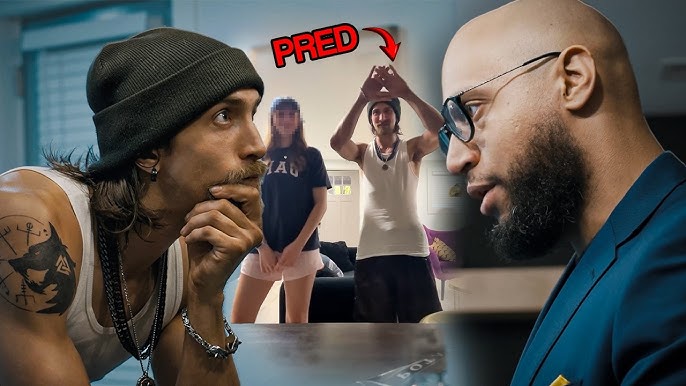
In a striking confrontation broadcast by independent investigator Skeeter Jean, the dark realities of online child grooming collided with bizarre internet culture in Hillsboro, North Carolina. The target of Day 2 of the North Carolina operations was a 28-year-old married man named Tyrone, who legally changed his name to “Loki” and operated online under the self-proclaimed title of a modern-day Viking.
Click here to watch the predator attempt to flee from police before being detained
Tyrone traveled over an hour and a half under the guise of working as a DoorDash delivery driver to meet who he believed was an underage girl—a person he referred to in text messages as his “enchantress.” The digital trail he left behind was laden with explicit, aggressive propositions, alongside highly explicit images used to verify his physical anatomy, peculiarly framed next to a 16-ounce bottle of store-brand antiseptic mouthwash.
However, instead of an isolated encounter away from public view, Tyrone walked directly into a heavily monitored hotel room sting operation, complete with hidden cameras, defensive security detail, and a highly rehearsed undercover decoy.
Chronological Breakdown: Key Video Timestamps
To analyze how this sting operation developed from an awkward social interaction into a definitive felony arrest, the critical moments of the encounter are tracked chronologically below:
Editor’s Opinion: The Absurdity of the Performative Predator
The standout element of this sting isn’t just the successful arrest—it is the unsettling ease with which the suspect transitioned from highly aggressive, explicit digital grooming to participating in a casual TikTok dance. This behavior highlights a terrifying psychological disconnect common among modern online predators.
Tyrone compartmentalized his predatory intent behind a shield of internet subcultures (“Vikings,” “Enchantresses,” and viral dances), treating a high-stakes felony rendezvous like a casual afternoon hang-out. By allowing the suspect to fully play out this delusion on camera, the investigation completely shattered any future legal defense of entrapment. When a grown man is caught on camera happily performing social media choreography with a decoy while carrying a pocket full of protection, the narrative of “accidental meetup” is permanently destroyed.
Frequently Asked Questions (FAQ)
What charges does the suspect face after this sting?
While exact arraignments vary by county jurisdiction, suspects caught in these specific parameters are typically booked by local North Carolina police departments for felony solicitation of a minor using electronic devices and attempted statutory offenses.
Did the suspect know he was walking into a trap?
During the post-confrontation interview with Skeeter Jean, Tyrone claimed he “halfway expected” a setup due to the increasing public awareness of civilian sting groups. Despite this suspicion, his compulsion overrode his caution, causing him to complete the drive anyway.
How did the investigator find out his real identity?
Although the suspect used the alias “Loki” on his dating and communication platforms, digital forensics and cross-referencing of his public profile photos allowed the production team to identify his legal name as Tyrone prior to his arrival at the hotel.
Safety Warning: Independent digital stings carry extreme logistical risks. The production team utilizes armed professional security personnel and works in direct, immediate communication with local municipal law enforcement to ensure all chain-of-custody rules and personal protection guidelines are strictly maintained. Do not attempt to recreate these operations independently.
The Anatomy of Post-Apprehension Deflection
This manifestation of compartmentalized guilt and immediate narrative shifting is far from an isolated incident in the digital true-crime space. When caught red-handed, suspects frequently pivot to elaborate, altruistic alternate realities to mask their true motives. This tactical desperation is analyzed extensively in our deeper psychological review, Deconstructing the Vigilante Sting: The Psychological and Tactical Breakdown of “Innocent Good Hearted Man Comes to Check on Underage Girl Before Calling CPS”.
While Tyrone attempted to minimize his actions by leaning into an internet-born “Viking” persona and playing along with lighthearted social media trends, other cornered suspects completely invert their identity. They try to convince investigators that they only arrived to serve as a guardian or a grassroots informant for Child Protective Services. Understanding these predictable defensive strategies reveals how civilian sting networks systematically strip away psychological deflections, turning a suspect’s sudden pivot into a textbook admission of guilt.

 did a TikTok dance with a decoy before being arrested.)