

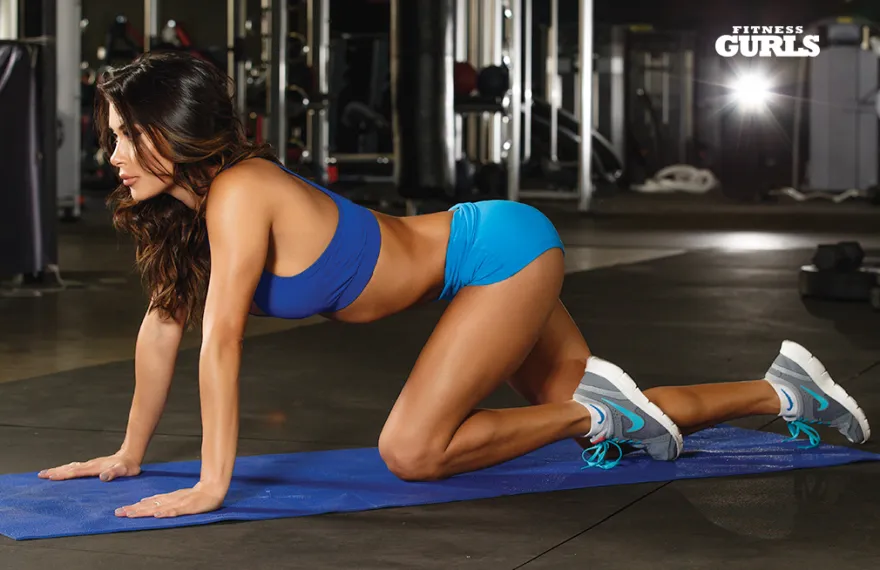
For decades, the dominant fitness narrative surrounding women’s health was heavily restricted to a single, exhausting directive: do more cardio. Gym floors were culturally divided, with women directed toward rows of treadmills, ellipticals, and light pink studio dumbbells, while the heavy barbell racks remained an exclusively male domain.
Click the image below to watch this sexy workout video

Today, a massive paradigm shift is occurring. Sports science, labor market data, and metabolic research have completely rewritten the rules of female conditioning. We now know that resistance training is not an optional accessory for women—it is the foundational pillar of long-term health, physical capital, and metabolic independence.
1. Shattering the Ultimate Misconception: “Lifting Makes Women Bulky”
The most prominent barrier preventing women from picking up a barbell is the persistent fear of waking up one morning looking “bulky” or overly muscular. This misconception stems from a fundamental misunderstanding of human endocrinology and muscle hypertrophy.
[Heavy Weight Lifting] ➔ [Lean Muscle Density] ➔ [Elevated BMR] ➔ [Toned/Sculpted Aesthetic]
The Testosterone Barrier
Building massive, masculine muscle bulk requires a specific hormonal environment heavily dominated by high baseline levels of testosterone. On average, women possess roughly 10% to 15% of the testosterone levels that men do. Without this distinct hormonal gas pedal, your body physically lacks the chemical infrastructure to build excessive, bulky muscle mass simply by lifting heavy weights.
The Caloric Surplus Reality
When you see professional female bodybuilders who exhibit extreme muscle size, you are looking at the result of years of hyper-specific variables: a relentless, multi-year caloric surplus (eating significantly more food than their body burns), elite athletic genetics, and often exogenous hormonal protocols.
When a woman begins a structured weight lifting program while eating at maintenance or a slight caloric deficit, her body does not expand. Instead, she experiences body recombination. The muscles become dense, firm, and compact, while the body fat covering those muscles begins to melt away. The “toned,” “sculpted,” or “snatched” look that millions of women chase through endless hours of cardio is actually achieved by building the underlying lean muscle tissue through resistance training.
This exact metabolic and structural reality is why elite fitness models entirely reject the outdated cardio-only blueprint. In our comprehensive breakdown, Sculpt Your Ultimate Lower Body: Bruna Lima Shares Her Exact Secret Glute Workout Routine, we look directly at how one of the world’s premier influencers built a multi-million-dollar global fitness empire. Bruna Lima didn’t build her world-famous, athletic lower body by fearing heavy iron; she built it by aggressively moving hundreds of pounds on barbell hip thrusts and squats. Her elite, highly sought-after shape stands as living, physical proof that when a woman stops lifting to “shrink” herself and starts lifting to build absolute strength, she doesn’t become bulky—she unlocks a dense, high-performing, and deeply sculpted aesthetic.
2. The Metabolic Engine: Burn Fat While You Sleep
One of the greatest benefits of weight lifting for women is its unparalleled impact on your Basal Metabolic Rate (BMR)—the number of calories your body burns simply to stay alive.
-
Cardio vs. Weights: When you spend 60 minutes on a treadmill, you burn calories only during that active hour. The moment you step off, your caloric expenditure drops back to baseline.
-
The EPOC Effect: Heavy resistance training triggers Excess Post-Exercise Oxygen Consumption (EPOC). Because lifting creates microscopic tears in the muscle fibers, your body has to work aggressively for the next 24 to 48 hours to repair that tissue. This recovery process requires a massive amount of energy, turning your body into a fat-burning furnace long after your workout is over.
-
The Cost of Muscle: Muscle tissue is metabolically active capital; it takes energy for your body to maintain it. Fat tissue, on the other hand, is completely sedentary energy storage. Every pound of lean muscle mass you build acts as an internal engine that permanently increases your daily caloric ceiling.
3. Skeletal Armor: Preventing Osteoporosis
Beyond aesthetics and fat loss, weight lifting is a medical necessity for the female skeletal system. Women are biologically at a much higher risk for developing osteoporosis and osteopenia than men, particularly as they age and experience the hormonal shifts of menopause.
[Mechanical Load on Barbell] ➔ [Bone Compression] ➔ [Osteoblast Activation] ➔ [Increased Bone Density]When you perform compound axial movements—such as a barbell squat, a deadlift, or an overhead press—you place a safe, mechanical load on your skeletal frame. Your bones respond to this stress exactly like your muscles do: by adapting and growing stronger. This structural loading stimulates osteoblasts (the cells responsible for synthesizing new bone tissue), effectively building a physical suit of armor that prevents fractures and preserves mobility well into your later years.
4. Absolute Strength and Psychological Power
The physical benefits of weight lifting are undeniable, but the psychological transformation is often what creates lifelong lifting habits.
For generations, women have been taught by societal messaging to focus entirely on subtraction: how can I weigh less, take up less space, and shrink myself?
Weight lifting completely flips this script, changing the focus to addition: how much weight can I add to the bar, how much space can I confidently occupy, and how strong can my frame become?
Transitioning your fitness focus from a number on a scale to a performance metric on a barbell fosters profound outcome independence. Realizing that your body can lift its own body weight off the floor or squat a heavy load changes how you carry yourself outside the gym walls. It builds a deep, unshakeable self-esteem that directly translates into higher professional confidence, assertive boundaries, and elevated mental resilience.
🏋️♀️ The Ideal Weekly Blueprint for Women
To maximize your results without spending five hours a day in the gym, structure your training around a 3-to-4-day Full Body or Upper/Lower split. Focus on mastering foundational compound movements:
🏷️ Exercise Category 🎯 Primary Muscle Target 🧠 Why It Matters Squat Variations Quads, Glutes, Core Builds total lower-body structural strength and pelvic stability. Hinge Movements (Deadlifts) Hamstrings, Glutes, Lower Back Clears up posture issues, strengthens the posterior chain, and prevents back pain. Push Movements (Presses) Chest, Shoulders, Triceps Sculpts the upper body and eliminates the fear of upper-body weakness. Pull Movements (Rows/Pull-downs) Upper Back, Lats, Biceps Reverses the forward-slouching damage caused by sitting at desks and computers. ❓ Frequently Asked Questions
Q1: Will lifting weights cause the number on the scale to go up?
It might initially, but context matters. Muscle tissue is significantly denser than fat tissue. A pound of muscle occupies a fraction of the physical space of a pound of fat. You may stay the exact same weight—or even gain a few pounds—while your clothing sizes drop drastically and your waist becomes visibly smaller. Focus on measurements, photos, and strength gains rather than the scale.
Q2: Do I need to lift heavy, or are light weights and high reps better for toning?
To trigger bone density adaptations and true muscle definition, you must challenge the body. Lifting ultra-light weights for 30 or 40 repetitions primarily builds muscular endurance, not muscle shape. Do not be afraid to lift in the 8 to 12 repetition range with a weight that actually challenges you by the final few reps.
Q3: How long does it take to see visible results from a lifting program?
With consistent training and a protein-sufficient nutrition layout, you will typically feel an increase in neurological strength and daily energy within the first 2 to 3 weeks. Visible physical changes, such as enhanced shoulder definition or a lifted lower body, usually become distinctly clear around the 8 to 12-week mark.

