

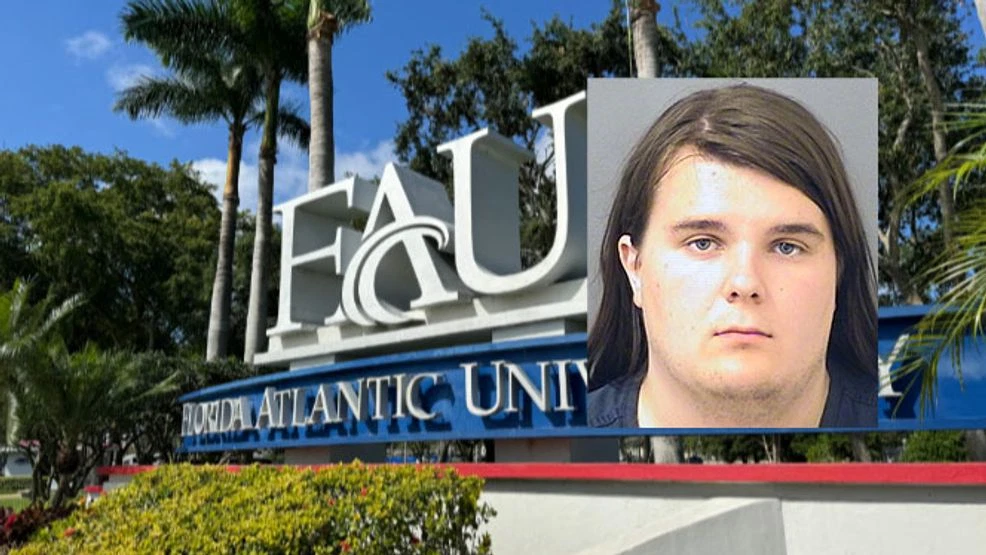
The landscape of higher education student politics is often viewed as a training ground for future public servants—a arena defined by constitutional bylaws, legislative debate, and community advocacy. However, Florida Atlantic University (FAU) found its student body thrust into a severe public relations and ethical crisis following the arrest of a high-ranking student leader in an online predator sting.
Click here to watch the arrest footage
The intersection of student governance, grassroots digital vigilantism, and the criminal justice system has sparked a rapid political and institutional fallout on the Boca Raton campus.
The Arrest: From Grindr to a Delray Beach Parking Lot
On Tuesday, May 26, 2026, the Delray Beach Police Department arrested 21-year-old Christian “CJ” Walden of Boynton Beach. Walden was a prominent figure within FAU’s Student Government, recently elected in March to serve as the Boca Raton House of Representatives Ways and Means Chair.
According to the probable cause affidavit released by the Palm Beach County Clerk of Courts, Walden’s arrest was the direct result of an operation orchestrated by “561 Predator Catchers,” an independent social media group that focuses on identifying and confronting alleged online predators.
Suspect: Christian “CJ” Walden, 21
Charges: Traveling to meet a minor for an unlawful sex act / Use of a two-way device to facilitate a felony
Arrest Location: Home Depot parking lot, 1400 Waterford Place, Delray Beach, FL
Bail Amount: $5,000
The operation began on Grindr, an LGBTQ+ social networking application. A civilian decoy working with the group operated an account under the pseudonym “Justin”. Chat logs reviewed by local authorities and student journalists showed a sequence where Walden asked the decoy his age. While the profile bio initially indicated the user was 18, the decoy explicitly stated during the chat that he was actually 13 years old.
Despite this disclosure, the affidavit notes that the digital conversation continued and turned highly explicit, with Walden allegedly soliciting the minor for sexual acts and arranging an in-person meeting. Walden drove to a Home Depot parking lot located at 1400 Waterford Place in Delray Beach, expecting to meet the teenager. Instead, he was ambushed by Dustin Lampros and other members of the 561 Predator Catchers team, who recorded the confrontation, obtained a verbal confession, and flagged down nearby Delray Beach police officers to secure a formal arrest.
The Legislative Backlash: Emergency Impeachment
The institutional reaction within Florida Atlantic University’s student government was near-instantaneous. Because student government leaders oversee significant portions of university activity fees and represent the collective voice of the student body, the presence of a felony suspect in a leadership chair was deemed an immediate emergency.
Boca House Speaker Jack Nixon immediately bypassed standard legislative timelines to call an emergency House meeting. Behind the scenes, student representatives scrambled to distance the organization from Walden’s actions and protect campus safety. Two distinct pieces of legislation were fast-tracked to the floor:
-
The Removal Resolution: A bill explicitly stripped Walden of his executive title as the Ways and Means Chair.
-
The Impeachment Article: A constitutional filing designed to permanently expel Walden from his elected seat within the House of Representatives.
Enrique Toro Mendez, a House Secretary and member of the campus’s Paradise Party, authored the impeachment articles and co-sponsored the removal bill. In statements given to the FAU University Press, student leaders expressed shock that someone deeply embedded in the local political structure could be tied to such behavior. Representatives stressed that keeping the student body safe and maintaining the ethical integrity of student governance made swift accountability their only logical path forward.
The Legal and Societal Reality of “Predator Catchers”
Walden’s booking record with the Palm Beach County Sheriff’s Office confirmed that his bond was set at $5,000. While he was able to secure release, the long-term legal consequences are steep. Under Florida state statutes, the combination of traveling to meet a minor for illegal sexual conduct and utilizing a computer or two-way communication device to facilitate a felony carries heavy penalties. If convicted, Walden faces a statutory baseline of up to 21 months in state prison, followed by mandatory, lifelong registration as a sex offender.
This case highlights the growing reliance of local law enforcement on digital vigilante networks like the 561 Predator Catchers. Run by local figures like Dustin Lampros, these civilian groups use undercover baiting techniques to draw suspects into public spaces before handing the communication evidence over to uniform police officers. While legal experts historically debate the boundaries of entrapment and due process regarding civilian-led stings, Florida courts have frequently validated arrests where the suspect willingly traveled to a location with the explicit intent of exploiting a child.
The Broader Impact on the Campus Community
For the student body at FAU, the arrest hits a sensitive nerve. The university has dealt with high-profile student criminal issues in the past, making the modern student senate highly sensitive to public optics and student safety. The fact that the suspect was the gatekeeper of the Ways and Means committee—the group responsible for managing financial allocations and checking fiscal policies—adds a layer of institutional betrayal to an already sensitive situation.
As the emergency legislative session approaches, student politicians are using the moment to call for stricter vetting processes for those running for university office. While a background check cannot predict digital behavior, the consensus among the FAU student house is that holding public office, even at the collegiate level, requires an absolute commitment to public safety and moral clarity. For Walden, his aspirations within local community leadership have effectively ended, replaced by an impending trial in a Palm Beach County courtroom.
For a visual breakdown of the scene at the Delray Beach parking lot and local news coverage of the arrest, FAU Student Government Member Charged in Predator Sting provides the immediate broadcast footage and arrest details.
Editor’s Opinion: The Dangerous Intersect of Student Power and Vigilante Justice
The swift moves by the FAU Student Government to isolate and impeach Christian “CJ” Walden are both structurally necessary and ethically correct. When an elected official—even at the collegiate level—is accused of traveling to exploit a child, the institution must wield its constitutional bylaws as a shield to protect the student body and its fiscal assets.
However, this case forces a glare onto a broader societal shift: the growing reliance on civilian “predator catching” groups. While the outcome here led to a formal police arrest based on damning digital evidence, the methods of grassroots internet vigilantes operate in a legal gray area that constantly flirts with the boundaries of due process and entrapment.
For universities nationwide, this is a wake-up call. The digital lives of student leaders are no longer separate from their public roles, and the vetting processes for those handling student funds must adapt to an era where a single sting operation can dismantle an entire administration overnight.
Frequently Asked Questions (FAQ)
Who is Christian “CJ” Walden? Christian “CJ” Walden is a 21-year-old student at Florida Atlantic University who served as the Boca Raton House of Representatives Ways and Means Chair within the student government.
What are the charges against the FAU student leader? Walden was arrested by the Delray Beach Police Department and charged with traveling to meet a minor for an unlawful sex act and the use of a two-way device to facilitate a felony.
How was the undercover sting conducted? The operation was orchestrated by a civilian group known as “561 Predator Catchers.” A decoy interacted with Walden on the dating app Grindr, explicitly stating they were 13 years old before arranging an in-person meeting at a local parking lot where police were waiting.
What is happening with his position at FAU? Following his arrest, the FAU Student Government fast-tracked emergency legislation, including a removal resolution to strip him of his executive chairmanship and articles of impeachment to permanently expel him from the House of Representatives.
What penalties does he face if convicted? Under Florida law, these felony charges carry a statutory baseline of prison time and would require mandatory, lifelong registration as a sex offender.
A Parallel Crisis: The National Epidemic of Institutional Betrayal
The disturbing details emerging from the FAU investigation are not an isolated phenomenon; rather, they reflect a broader, more systemic crisis of institutional betrayal occurring across the country. Just days prior to Walden’s arrest, a federal court in Michigan finalized a similarly shocking case that underscores how predators can mask their illicit behavior behind highly respected public profiles.
On May 20, 2026, Lincoln Erickson—a 32-year-old former medical resident at the Detroit Medical Center’s Rehabilitation Institute of Michigan—pleaded guilty to federal charges of receiving child pornography following an intensive FBI investigation. Much like the FAU case, Erickson’s capture unraveled through a multi-state digital dragnet that exposed explicit, predatory communications on encrypted messaging apps.
The structural parallels between a university financial chair and a trusted medical professional are stark, prompting federal prosecutors to note that these predators frequently “lurk among our most trusted professionals” while quietly feeding their illicit impulses. Whether navigating the halls of student government or the wards of a major metropolitan hospital, the modern digital landscape has made it clear that institutional titles no longer guarantee moral clarity.

