

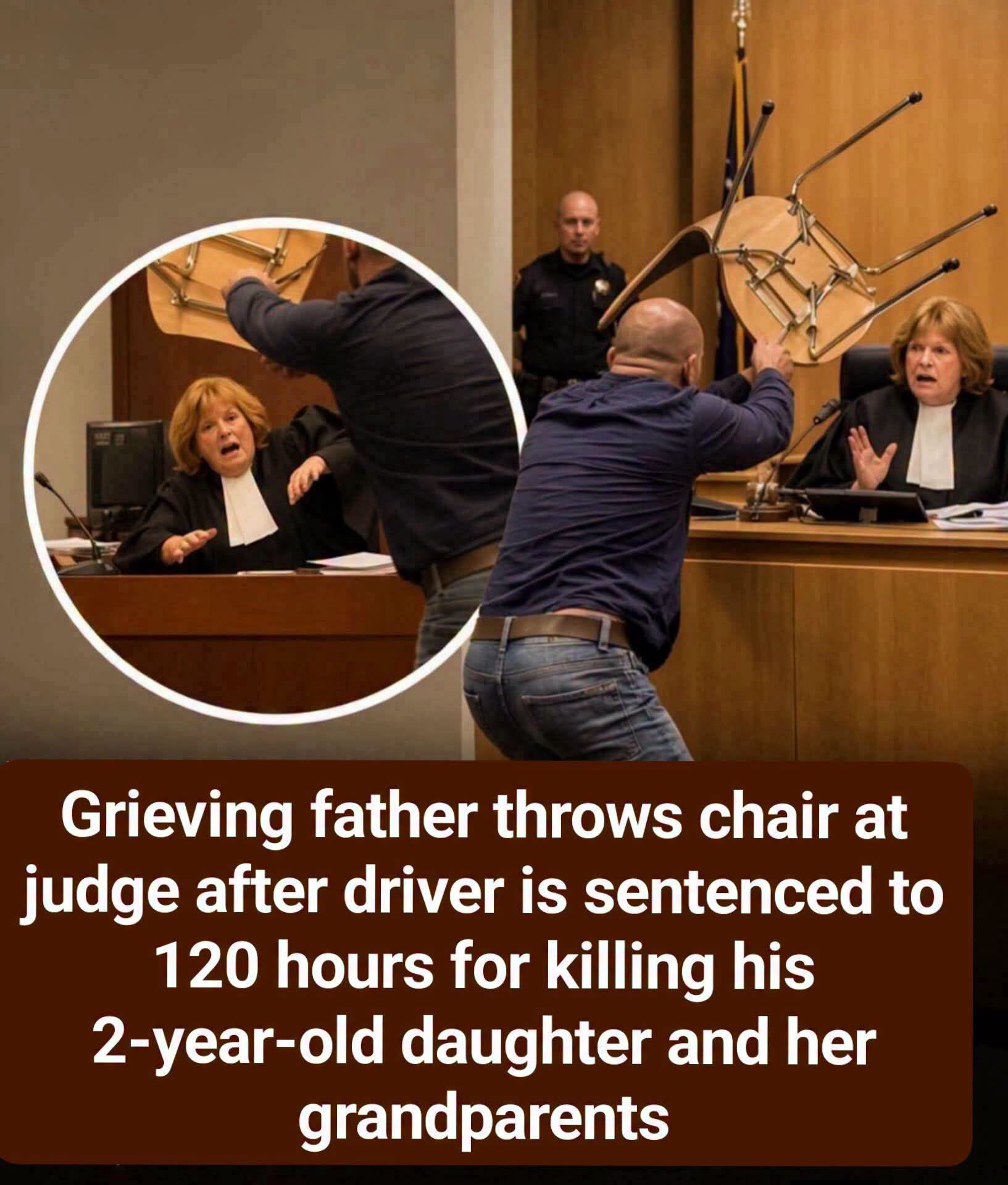
When a courtroom turns into a theater of raw, unfiltered grief, the world takes notice. Recently, a video capturing a father throwing a chair at a judge after a sentencing hearing has gone viral, accumulating nearly 2 million views and igniting a fierce international conversation about the boundaries of judicial leniency and the limits of human endurance.
Father throws chair at judge after the driver that killed his 2-year-old daughter and her grandparents in a car accident only got 120 hours of community service
by invideos
The Incident: A Breaking Point
The footage, which has circulated widely on platforms like YouTube, shows the harrowing moments following a court decision in the Netherlands. A grieving father, mourning the tragic loss of his two-year-old daughter and her grandparents to a fatal traffic collision, reacted with explosive anger when the driver responsible was handed a sentence of 120 hours of community service.
As the judge concluded her remarks, the father, overcome by what he perceived as a profound injustice, grabbed a courtroom chair and hurled it toward the bench. The outburst was immediate and violent, requiring court security to intervene. The video—a raw snapshot of agony—has since become the focal point of a debate regarding sentencing guidelines, victim rights, and the sanctity of the courtroom.
The Legal Context: Why the “Lenient” Sentence?
To many observers, 120 hours of community service for three lives lost seems staggeringly inadequate. However, understanding the Dutch legal framework is essential to grasping how such a judgment is reached.
In the Dutch criminal justice system, sentencing is governed by strict guidelines that prioritize proportionality and rehabilitation. Traffic offenses that result in death are complex. Prosecutors and judges must weigh factors such as the degree of recklessness, the offender’s prior record, and their level of remorse.
Critics argue that these systems often prioritize the offender’s reintegration over the victim’s search for justice. Conversely, legal experts note that sentencing judges are bound by statute and precedent. The 120-hour sentence, while appearing “lenient” to the public, is often the result of established legal mandates for non-premeditated criminal negligence.
https://www.facebook.com/photo?fbid=1335695222012252&set=a.534272155487900
The Consequences of Courtroom Outbursts
While the father’s pain is visceral and sympathetic, his actions carry legal consequences. Courts have the power to punish “contempt in the face of the court”—conduct that disrupts proceedings or undermines the administration of justice.
Throwing a chair at a judge is a serious offense that can lead to additional criminal charges, including assault or battery of a public official. Beyond the immediate legal trouble, such outbursts can have unintended consequences for the victim’s family:
-
Undermining Appeals: Disruptive behavior can sometimes be used by the defense to paint a victim’s family as unstable or volatile.
-
Court Security: Such incidents lead to tighter courtroom security, which can further isolate families from the judicial process.
-
Media Distraction: The focus shifts from the original crime to the outburst, potentially overshadowing the memory of the victims.
Balancing Mercy and Justice
The incident has reignited calls for “Victim Rights” reform in the Netherlands and beyond. Families of victims often feel sidelined by a system that views their tragedy as a “case file.” The demand for stiffer penalties in cases of gross negligence remains a point of contention between the public’s sense of moral justice and the judiciary’s technical application of the law.
As this story continues to circulate, it serves as a stark reminder of the emotional toll of the justice system. For the family of the little girl and her grandparents, the courtroom remains a place of profound trauma—where they are forced to relive their loss, only to feel that the system has failed to provide the closure they so desperately seek.
The deep-seated public anger regarding judicial outcomes is further highlighted by the recent verdict in the case of Aaron John McLeod. On July 20, 2026, a jury in the New South Wales Supreme Court found McLeod guilty of murdering the two-year-old son of a woman he had been dating for only two months. The trial revealed a pattern of frustration McLeod held toward the toddler’s behavior, culminating in the child’s death from catastrophic injuries, including a brain haemorrhage, while the mother slept. As the community reels from the details of the crime, the legal system now shifts its focus toward the sentencing phase; McLeod has been taken into custody and is scheduled to be sentenced in October, with the presiding judge noting the inevitability of a full-time custodial term.
Frequently Asked Questions (FAQ)
Why was the sentence only 120 hours of community service? Under Dutch law, sentencing for fatal traffic accidents depends on the classification of the driver’s behavior. If it is not classified as “reckless” in a way that meets specific thresholds for prison time, community service is often the standard, albeit controversial, penalty.
What happens to the father who threw the chair? While the exact legal fallout for the father is often kept private, such acts typically lead to charges of contempt of court or assault. He may face fines, probation, or even jail time for the outburst.
Is there a path to appeal the driver’s sentence? In many jurisdictions, the prosecution can appeal a sentence if they believe it is “manifestly inadequate.” However, victims’ families often have limited direct standing to appeal the length of a sentence themselves.
Why does this video have so many views? The video taps into a universal human response: the desire for justice in the face of senseless tragedy. The “viral” nature of the clip highlights the growing disconnect between judicial rulings and public expectations.

