

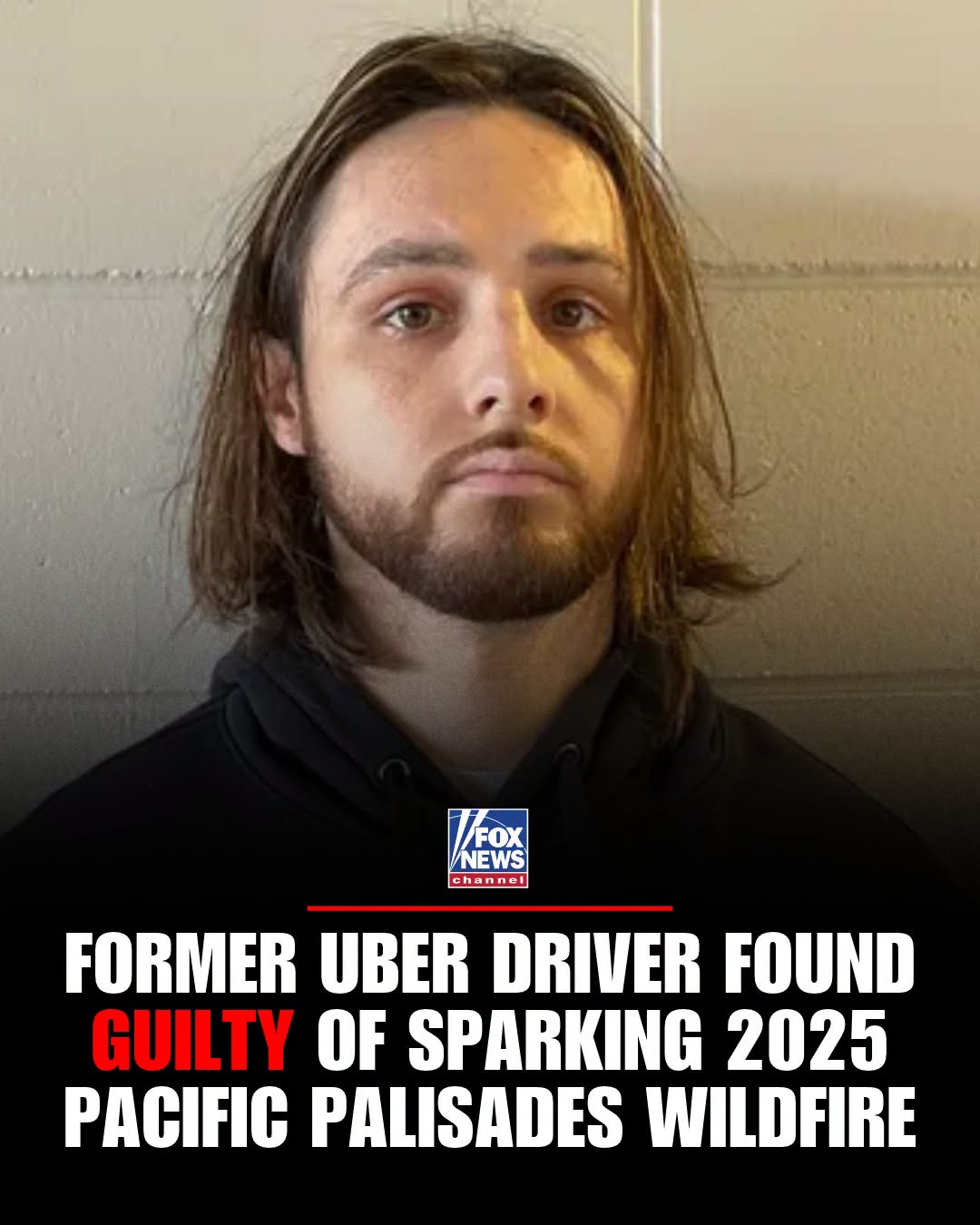
Jonathan Rinderknecht Convicted of Deliberately Sparking Deadly 2025 Palisades Fire That Killed 12 People
Nearly two years after walls of flame tore through Pacific Palisades, Malibu, and the Santa Monica Mountains, federal jurors in Los Angeles have delivered a decisive verdict. On November 20, 2026, 30-year-old Jonathan Rinderknecht was convicted of federal arson and destruction of property by means of fire for deliberately igniting the blaze that evolved into the catastrophic January 2025 Palisades Fire.
Click this link or image below for a chance to win

The verdict comes roughly five months after Rinderknecht’s first federal trial ended in a dramatic mistrial when jurors deadlocked 10–2 in favor of acquittal. In the retrial, federal prosecutors streamlined their case around irrefutable digital forensics, cell tower geolocation records, and Rinderknecht’s own damaging testimony—convincing the jury after two to three days of deliberations that the fire was neither an accident nor an act of nature.
For thousands of displaced residents and the families of the 12 people who lost their lives, the guilty verdict marks a pivotal milestone in one of the darkest chapters in California wildfire history.
https://www.facebook.com/photo/?fbid=1467410468937144&set=a.388378473507021
https://www.facebook.com/photo/?fbid=1657071209616068&set=a.641843761138823
https://www.facebook.com/photo/?fbid=1181536150889722&set=a.294278009615545
https://www.facebook.com/photo/?fbid=122144878929247860&set=a.122101096047247860
https://www.facebook.com/photo/?fbid=1952090040295989&set=a.653642573474082
https://www.facebook.com/photo/?fbid=10134145858976830&set=a.10100384317766050
What should his sentence be? Lots say death
https://www.facebook.com/photo/?fbid=1153040517483525&set=a.135922629195324
https://www.facebook.com/photo/?fbid=1586843060145557&set=a.609159864580553
https://www.facebook.com/photo/?fbid=29187400024214144&set=a.466390420075154
https://www.facebook.com/photo/?fbid=1576372624631366&set=a.334066472195327
https://www.facebook.com/photo/?fbid=1481525334156255&set=a.534301392211992
https://www.facebook.com/photo/?fbid=2098363458528851&set=a.397492538615960
https://www.facebook.com/photo/?fbid=1684466239717101&set=a.581702756660127
https://www.facebook.com/photo/?fbid=1591870216306908&set=a.358015623025713
https://www.facebook.com/photo/?fbid=1603103621860777&set=a.596594819178334
https://www.facebook.com/photo/?fbid=122216000270393249&set=a.122103601310393249
https://www.facebook.com/photo/?fbid=1136030682388373&set=a.163394706318647
 Was the 2025 Palisades Fire Started Deliberately?
Yes—federal investigators and a unanimous jury concluded that the 2025 Palisades Fire was intentionally set, rather than triggered by fireworks, downed power lines, or careless recreation.
According to evidence presented by the Bureau of Alcohol, Tobacco, Firearms and Explosives (ATF), the Los Angeles Police Department (LAPD), and the U.S. Forest Service, the disaster unfolded in two distinct phases:
-
The Initial Ignition (January 1, 2025): Just after midnight on New Year’s Day, after dropping off his final Uber passenger in the Pacific Palisades neighborhood, Rinderknecht parked his car at the base of a hillside trail. Cellphone tower data and nearby security cameras tracked him ascending the trail to a secluded mountainside clearing—an area familiar to him—where he deliberately lit dry brush on fire. Crucially, thousands of camera images captured across the area that night confirmed there were no fireworks in the sky above the ridge, eliminating every accidental ignition theory.
-
The Underground “Holdover” Fire (January 1–7, 2025): Although firefighters responded to the initial New Year’s Day blaze—known as the Lachman Fire—embers burned undetected deep within the subterranean root systems of the chaparral. Six days later, on January 7, 2025, hurricane-force Santa Ana winds swept across Southern California, fanning those hidden subterranean embers back to the surface and igniting an unstoppable firestorm.
By the time the Palisades Fire was fully contained on January 31, 2025—24 days after flaring back up—it had scorched more than 23,000 acres, obliterated 6,837 structures, caused an estimated $25 billion in property damage, and killed 12 people.
Click image below for a chance to win 2k a week for 1 week

What Was Jonathan Rinderknecht’s Motive?
Subtitle: Inside the digital footprint of rage, personal rejection, and a staged 911 alibi.
Throughout the investigation and two federal trials, prosecutors painted a disturbing portrait of a man consumed by generalized fury, personal frustration, and hostility toward wealthy communities.
-
Acute Anger and Personal Frustration: Testimony from Uber passengers who rode with Rinderknecht in the hours before midnight described him as visibly agitated, erratic, and “mad at everything.” Digital records from his phone further revealed that earlier that evening, he had been rejected by a woman he invited to spend New Year’s Eve with him—prompting him to send her abusive messages from a secondary phone number.
-
Resentment Over Wealth Inequality: During his first trial, prosecutors and an arson behavior expert testified that Rinderknecht exhibited the classic traits of a “societal revenge-motivated” arsonist. His online search history and AI chat logs included queries such as “Why am I so angry all the time?”, Reddit searches reading “lets kill all the billionaires,” and disturbing lookups regarding high-profile corporate executives. Weeks later, during an eight-hour interview with an ATF agent before he was officially named a suspect, Rinderknecht even speculated aloud that someone frustrated by wealth inequality might deliberately start a fire in an affluent enclave like Pacific Palisades.
-
A Calculated Attempt to Stage an Alibi: Perhaps the most incriminating evidence came from Rinderknecht’s own phone. Immediately after igniting the brush, he walked down the trail and called 911 more than a dozen times to report the blaze—while simultaneously screen-recording his phone. In the middle of calling emergency dispatchers, he opened ChatGPT and typed: “Are you at fault if a fire is lit because of your cigarettes?” Prosecutors demonstrated that Rinderknecht manufactured those recordings to cast himself as a helpful bystander and create a plausible accidental excuse in case investigators traced him to the trailhead.
In the retrial, Rinderknecht took the witness stand in his own defense, claiming he had walked up the hill, smelled no smoke, seen no one else, and noticed fireworks. His testimony directly contradicted camera footage and geolocation data, becoming the final nail in the prosecution’s case.
How Long Will Jonathan Rinderknecht Likely Be Jailed?
Subtitle: Federal sentencing guidelines, mandatory minimums, and what happens next in March 2027.
Rinderknecht, who has remained in federal custody since his arrest in October 2025, is scheduled to be sentenced by U.S. District Judge Anne Hwang on March 17, 2027.
Under federal statutes governing arson and malicious destruction of property by fire resulting in death or massive destruction, Rinderknecht faces:
-
Mandatory Minimum Sentence: 5 years in federal prison.
-
Statutory Maximum Sentence: 40 years in federal prison.
Legal analysts note that while federal judges weigh numerous factors under the U.S. Sentencing Guidelines—including a defendant’s lack of prior felony convictions and mental health history—the catastrophic scale of the Palisades Fire weighs heavily toward the upper end of the sentencing spectrum. Given the loss of 12 human lives, the destruction of nearly 7,000 homes and businesses, and the fact that Rinderknecht took the stand and offered testimony the jury rejected as false (which can trigger an obstruction-of-justice enhancement), prosecutors are widely expected to push for a sentence spanning multiple decades—potentially keeping him behind bars until he is in his 50s or 60s.
Why Is the Public Outraged Over the Palisades Fire Case?
Subtitle: Beyond the arsonist’s actions, anger spans systemic firefighting failures, delayed alerts, and a near-miss in court.
While public fury is overwhelmingly directed at Rinderknecht for casually igniting a hillside in tinder-dry Southern California, the outrage surrounding the Palisades Fire runs much deeper across Los Angeles and the nation:
-
Shock Over the First Trial’s 10–2 Mistrial: Many survivors and observers were stunned in June 2026 when Rinderknecht’s first jury deadlocked 10–2 in favor of acquitting him. Federal prosecutors later noted that the first jury appeared to consider outside factors beyond the courtroom evidence—prompting immense relief when the retrial finally secured accountability.
-
Anger Over Preventable Emergency Breakdowns: Throughout both trials, Rinderknecht’s defense attorneys argued he was being used as a “scapegoat” for the Los Angeles Fire Department’s failure to fully extinguish the January 1 Lachman Fire. While Judge Hwang instructed jurors not to let municipal firefighting shortcomings excuse the person who lit the match, residents remain furious over documented communication breakdowns, inconsistent firefighter testimonies, and delayed evacuation alerts that left gridlocked drivers fleeing on foot as flames closed in.
-
The Unbearable Toll on Families Still Displaced: Nearly two years after the blaze, thousands of Pacific Palisades and Malibu families are still navigating insurance battles, permitting delays, and toxic ash cleanup. As Los Angeles Mayor Karen Bass noted following the verdict, for communities still struggling to rebuild from scratch, the devastation is not a closed courtroom chapter—it remains an exhausting daily reality.
Frequently Asked Questions (FAQ)
1. How many people died in the 2025 Palisades Fire?
According to Cal Fire and the U.S. Department of Justice, 12 people were killed in the January 2025 Palisades Fire. In addition to the 12 fatalities, the blaze burned over 23,000 acres and destroyed 6,837 structures.
2. Why was Jonathan Rinderknecht tried twice for the Palisades Fire?
Rinderknecht’s first federal trial in June 2026 ended in a mistrial after the jury deadlocked 10 to 2 in favor of acquittal. Federal prosecutors filed a superseding indictment that narrowed the charges to two counts—arson and destruction of property by means of fire—and secured a unanimous guilty conviction in his November 2026 retrial.
3. How did a fire started on January 1 cause the Palisades Fire on January 7?
Investigators determined that the blaze Rinderknecht lit on January 1, 2025, burned deep inside underground plant root systems without being fully extinguished. Six days later, on January 7, powerful Santa Ana winds surfaced those smoldering subterranean embers, sparking the massive wildfire.
4. What role did ChatGPT play in convicting Jonathan Rinderknecht?
Digital forensics revealed that while walking down the hillside and calling 911 on January 1, Rinderknecht screen-recorded himself asking ChatGPT: “Are you at fault if a fire is lit because of your cigarettes?” Prosecutors used this timestamped record to prove he was consciously attempting to fabricate an accidental cover story.
5. When will Jonathan Rinderknecht be sentenced, and what is the maximum penalty?
U.S. District Judge Anne Hwang scheduled Rinderknecht’s sentencing hearing for March 17, 2027. He faces a mandatory minimum sentence of 5 years and a statutory maximum of 40 years in federal prison.

