

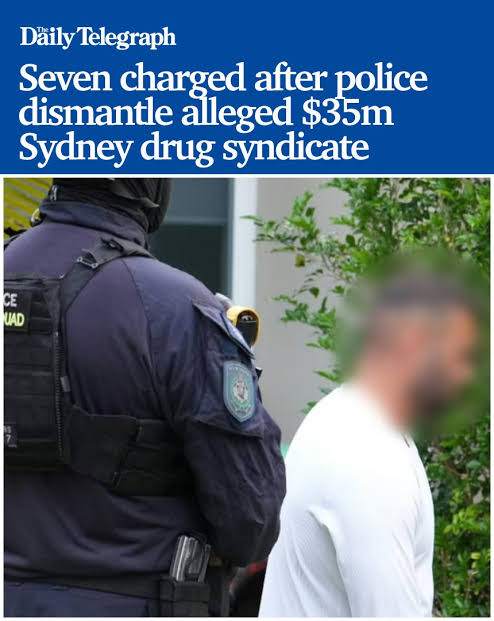
Strike Force Andrews Dismantles $35 Million Interstate Drug Supply Syndicate After Ingleburn Raid
A year-long investigation targeting a major transnational criminal enterprise has culminated in seven arrests after New South Wales Police uncovered an alleged $35 million drug supply and money laundering syndicate stretching across Sydney, Queensland, and Western Australia.
Click image below for a chance to win 2k a week for 1 week

Detectives from the State Crime Command’s Organised Crime Squad, working alongside the NSW Crime Commission under Strike Force Andrews, confirmed on November 25, 2026, that seven individuals have now been charged following a coordinated series of raids, interstate intelligence operations, and major narcotics seizures—including nearly $500,000 in cash and massive quantities of cocaine, methylamphetamine, and MDMA.

Inside Strike Force Andrews: Targeting a Transnational Organised Crime Network
Strike Force Andrews was established by the Organised Crime Squad and the NSW Crime Commission to investigate large-scale drug distribution and sophisticated money laundering activity allegedly orchestrated by a transnational Organised Crime Network (OCN) operating between Sydney, Queensland, and Western Australia.
Between December 2025 and November 2026, investigators tracked the movement of wholesale illicit drugs and illicit cash across state borders. Over the course of the operation, strike force detectives seized a combined haul estimated at $35 million in street value, comprising:
-
60 kilograms of cocaine
-
30 kilograms of methylamphetamine (ice)
-
15 kilograms of MDMA
-
Almost $500,000 in suspected proceeds of crime
Click this link or the image below for a chance to win this $350,000 Lamborghini Murcielago

Legal Breakdown: Large Commercial Quantity Thresholds in NSW
Under the Drug Misuse and Trafficking Act 1985 (NSW), prosecutors classify drug supply offences strictly by weight, regardless of whether an accused person was caught physically selling the drugs or holding them for onward distribution.
In New South Wales, the threshold for a large commercial quantity is:
-
Cocaine: 1 kilogram (1,000 grams)
-
MDMA: 500 grams (0.5 kilograms)
The quantities allegedly seized at the Ingleburn property alone—3.9kg of cocaine and 2.7kg of MDMA—are nearly four times the large commercial threshold for cocaine and more than five times the large commercial threshold for MDMA. Across the broader Strike Force Andrews investigation, the total seizures of 60kg of cocaine, 30kg of methylamphetamine, and 15kg of MDMA sit dozens of times above the statutory ceiling.
Furthermore, under Section 29 of the Act (deemed supply), any person found in possession of an indictable quantity or higher is legally presumed to hold the drugs for the purpose of supply unless they can prove on the balance of probabilities that the substances were strictly for personal consumption—a defence that is virtually impossible when dealing with multi-kilogram syndicate hauls.
What Are Their Most Likely Jail Sentences?
Anyone convicted of supplying a large commercial quantity of a prohibited drug under Section 25(2) of the Drug Misuse and Trafficking Act 1985 (NSW) faces the harshest sentencing regime in Australian criminal law.
1. Statutory Maximum Penalty and Standard Non-Parole Period
-
Maximum Penalty: Life imprisonment and/or a fine of 5,000 penalty units ($550,000).
-
Standard Non-Parole Period (SNPP): 15 years’ imprisonment. While an SNPP is a legislative guidepost rather than a mandatory minimum, NSW District and Supreme Court judges use 15 years as the benchmark for an offence sitting in the middle of the range of objective seriousness.
2. Realistic Sentencing Outcomes Based on Syndicate Role
In NSW sentencing practice, judges assess objective seriousness primarily by examining what the offender actually did within the syndicate rather than drug weight alone. Based on NSW Court of Criminal Appeal (NSWCCA) sentencing benchmarks for multi-kilogram cocaine and MDMA cases:
-
High-Level Organisers, Financiers, or Principals: Individuals proven to have directed interstate logistics, financed shipments, or coordinated syndicate cells typically receive head sentences of 14 to 22+ years’ imprisonment, with non-parole periods of 9 to 15 years. Where multiple counts are accumulated (such as separate multi-kilogram counts of both cocaine and MDMA), total effective sentences frequently exceed 15 to 18 years.
-
Mid-Level Brokers, Warehouse Custodians, or Interstate Couriers: Offenders who stored multi-kilogram stash houses (such as the Ingleburn property), acted as trusted intermediaries, or transported wholesale quantities across state lines generally face head sentences of 8 to 14 years’ imprisonment, with non-parole periods ranging between 5 and 9 years.
-
Early Guilty Plea Discounts: Under NSW law, an offender who enters an early guilty plea in the Local Court before committal is entitled to a mandatory 25% statutory discount on their sentence. Even with a full 25% discount and strong subjective factors (such as no prior criminal record), multi-kilogram large commercial supply convictions almost universally result in substantial full-time custody.
-
Additional Money Laundering Penalties: Those also charged with knowingly dealing with the proceeds of crime—relating to the nearly $500,000 in seized cash—face cumulative or partially accumulated prison terms carrying maximum penalties of 15 to 20 years under NSW and Commonwealth anti-money laundering statutes.

Bail Hurdles Under the NSW “Show Cause” Regime
Because supplying a commercial or large commercial quantity of a prohibited drug is classified as a “show cause” offence under Section 16B of the Bail Act 2013 (NSW), none of the seven accused are entitled to automatic bail. Each defendant must proactively convince the court why their ongoing detention is unjustified. Given the alleged transnational links, interstate travel between NSW, Queensland, and Western Australia, and the multi-million-dollar scale of the syndicate, prosecutors routinely oppose bail on the grounds of unacceptable flight risk and the likelihood of further offending.
The scale of the Strike Force Andrews operation—while massive at $35 million—is still dwarfed by the record-breaking Australian Federal Police 2.7-tonne cocaine seizure uncovered in June 2026 at a Londonderry property on Sydney’s outskirts, where detectives allegedly found $816 million worth of cocaine hidden in underground bunkers after being moved overland from North Queensland. As coverage of that historic raid highlighted, “Australians pay some of the world’s highest prices for cocaine, which makes Australia a lucrative market for drug traffickers”—a financial reality that continues to drive major interstate syndicates like the one targeted under Strike Force Andrews and exposes participants to life-imprisonment penalties.
Frequently Asked Questions (FAQ)
What was Strike Force Andrews investigating?
Strike Force Andrews was a joint operation established by the NSW Police State Crime Command’s Organised Crime Squad and the NSW Crime Commission to dismantle an alleged $35 million drug supply and money laundering syndicate run by a transnational Organised Crime Network across Sydney, Queensland, and Western Australia.
What did police seize during the Ingleburn raid?
During a search warrant executed at a property in Ingleburn on Thursday, September 24, 2026, detectives seized 3.9 kilograms of cocaine and 2.7 kilograms of MDMA, leading to charges against a 45-year-old man from Perth.
How much drugs and cash were seized in total under Strike Force Andrews?
Across the broader investigation between December 2025 and November 2026, police seized 60kg of cocaine, 30kg of methylamphetamine, and 15kg of MDMA—with an estimated combined street value of $35 million—alongside nearly $500,000 in cash.
What is the maximum jail sentence for supplying a large commercial quantity of drugs in NSW?
In New South Wales, supplying a large commercial quantity of cocaine (1kg or more) or MDMA (500g or more) carries a maximum penalty of life imprisonment and/or a $550,000 fine, with a Standard Non-Parole Period of 15 years.
How many years in prison do offenders typically serve for multi-kilogram cocaine and MDMA supply in NSW?
Depending on their role in the syndicate and whether they enter an early guilty plea, mid-level stash-house custodians and couriers typically receive 8 to 14 years (with 5 to 9 years non-parole), while syndicate organisers and principals regularly receive 14 to 22+ years in full-time custody.

