

Introduction: The Collision of Two Worlds
In the landscape of modern combat sports, few moments transcend the boundaries of the octagon to become global cultural phenomena. The showdown between Ireland’s Conor “The Notorious” McGregor and Russia’s Khabib “The Eagle” Nurmagomedov at UFC 229 remains the definitive benchmark for the sport. Drawing a record-breaking 2.4 million pay-per-view buys, it sits in an elite echelon of viewership occupied only by boxing titans like Mayweather and Pacquiao.
This wasn’t merely a contest for the UFC Lightweight Championship; it was a clash of ideologies, coaching philosophies, and deeply personal animosities. From the infamous “bus incident” in Brooklyn to the relentless verbal assaults on religion and family, the fight was fueled by a level of “bad blood” rarely seen in professional athletics. Below, we provide an analytical deep-dive into the tactical execution of the four rounds that defined a generation of MMA.
1. Tactical Blueprint: The Grappler vs. The Sniper
Entering the T-Mobile Arena on October 6, 2018, the tension was palpable. The refusal to touch gloves set the tone for a match where professional respect had been entirely replaced by a survivalist instinct.
Round 1: The Illusion of Control
McGregor opened in his signature wide, bladed stance, attempting to utilize his reach to apply pressure. However, Nurmagomedov—a master of Sambo and freestyle wrestling—demonstrated elite tactical patience. Within the first sixty seconds, Khabib executed a low-level single-leg takedown.
Analytical Insight: While McGregor’s takedown defense showed marked improvement compared to his earlier career, he was unable to neutralize Khabib’s “Chain Wrestling.” The Russian phenom used the first five minutes to sap McGregor’s explosive energy, prioritizing positional control over damage. By the end of the round, McGregor had spent four minutes on his back, a strategic “theft of breath” that would haunt him in the later frames.
2. The Iconic Pivot: The Right Hand That Changed History
Round 2: The Shock of the Striking
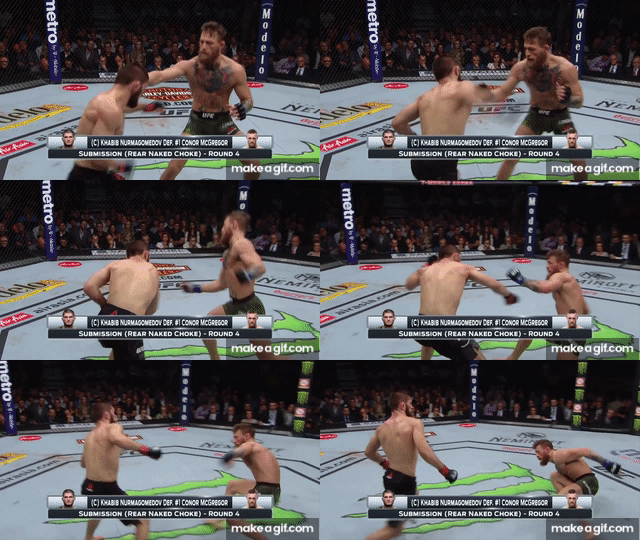
Round 2 is often cited by analysts as one of the most significant rounds in MMA history. Known almost exclusively for his grappling, Nurmagomedov utilized a “level-change feint.” By dipping his head as if to shoot for a takedown, he forced McGregor to drop his hands in anticipation. Instead, Khabib launched a devastating overhand right that dropped the Irishman.
The Psychological War: As the fight hit the canvas, Khabib unleashed a barrage of ground-and-pound. Microphones captured the haunting exchange as Khabib told McGregor, “Let’s talk now,” mocking the Irishman’s pre-fight bravado.
The Controversy: As Khabib transitioned toward a Kimura submission, McGregor utilized what many referees later criticized as “illegal” tactics—including an illegal knee from the bottom and multiple instances of grabbing the cage fence. Despite these maneuvers, the round was a clear 10-8 for Nurmagomedov, leaving McGregor bloodied, exhausted, and visibly demoralized.
3. The Glimmer of Hope and the Final Descent
Round 3: The Stand-Up Equilibrium
In a surprising turn of events, Nurmagomedov chose to stand with McGregor for the majority of the third round. Whether this was due to fatigue or a desire to “prove” his striking prowess remains a point of debate. McGregor found his rhythm, landing stiff left hands and body kicks. For the first time in his UFC career, Khabib lost a round on the official scorecards (10-9), providing a brief moment of hope for the “Logang” and Irish supporters.
Round 4: The Submission of a King
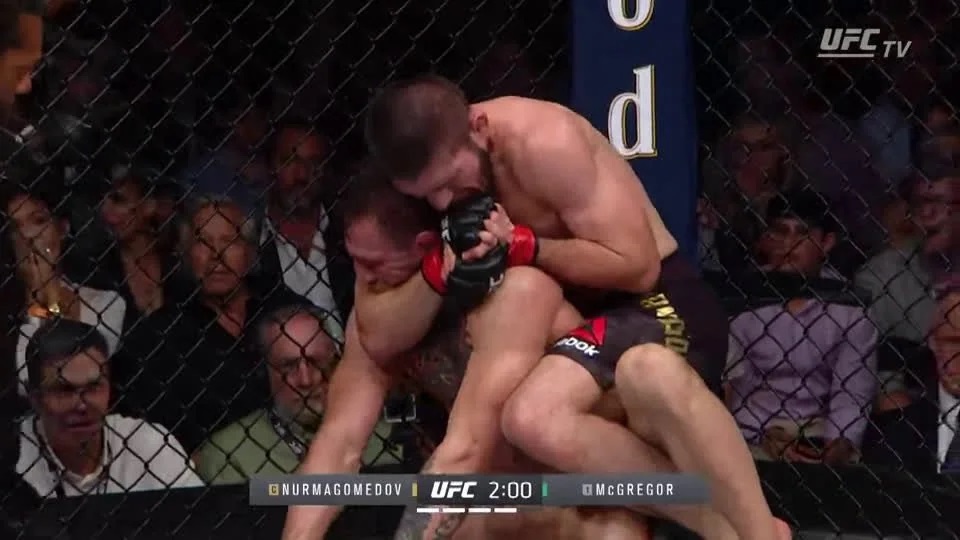
The hope was short-lived. By the fourth round, McGregor’s notorious cardio issues—exacerbated by the heavy grappling of the early rounds—rendered him sluggish. Nurmagomedov timed a perfect double-leg takedown against the fence and seamlessly transitioned to the back.
At 3:03 of the fourth round, Khabib locked in a brutal neck crank. McGregor, broken by the physical and psychological pressure, tapped out. The king of the “double-champ” era had been dethroned by the relentless pressure of the Dagestani “Sambo” machine.
4. The Aftermath: A Legal and Ethical Analysis
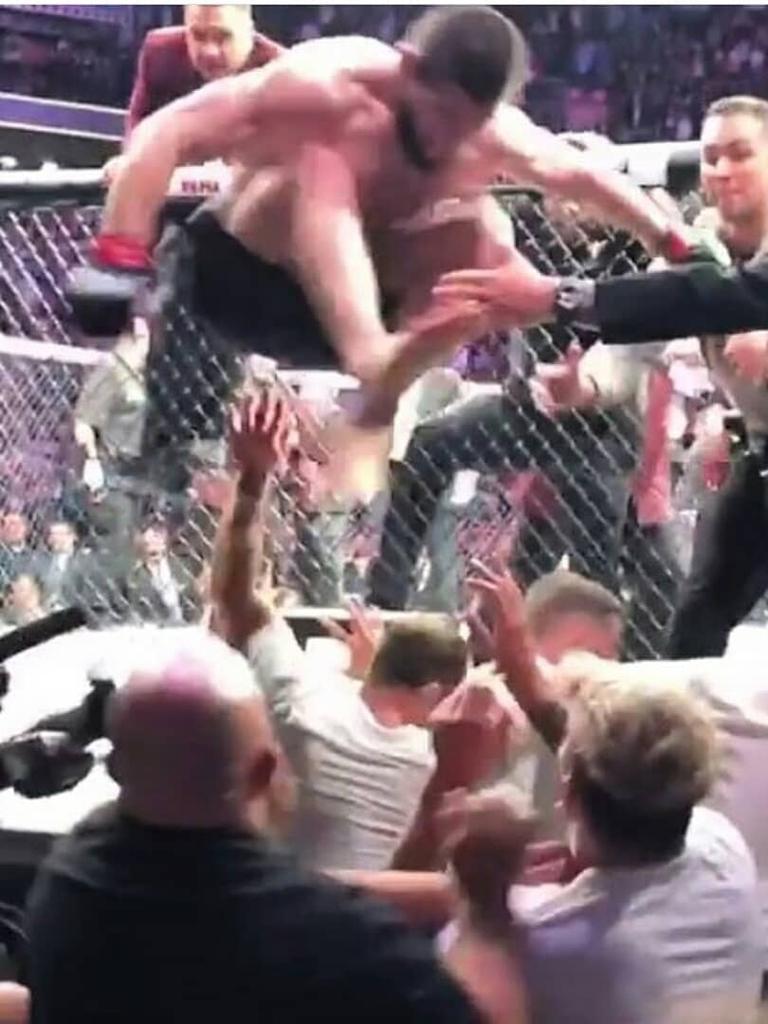
The conclusion of the fight was not the conclusion of the event. In a moment that shocked the sporting world, Nurmagomedov leaped over the cage to attack McGregor’s cornerman, Dillon Danis, triggering a multi-person brawl both inside and outside the Octagon.
Legal & Compliance Analysis
- State Athletic Commission Sanctions: The Nevada State Athletic Commission (NSAC) acted swiftly. Khabib Nurmagomedov was issued a 9-month suspension and a massive $500,000 fine. Conor McGregor received a 6-month suspension and a $50,000 fine.
- The “Unexplained Wealth” of Pay-Per-View: Legally, the UFC had to navigate the withholding of Khabib’s purse during the investigation. This case highlighted the immense liability platforms face when individual “brand ambassadors” engage in unsanctioned violence.
- Duty of Care: The incident forced the UFC to overhaul its security protocols for “high-animosity” fights, creating a precedent for increased police presence and separated arrival times for rival camps.
5. Cultural Legacy: The Fall from Grace
For Conor McGregor, UFC 229 was a “Fall from Grace” of epic proportions. Having previously dethroned Jose Aldo in 13 seconds and dominated Eddie Alvarez, McGregor was the undisputed face of the sport. His venture into boxing against Floyd Mayweather had made him arguably the wealthiest athlete in MMA history, yet the Khabib defeat proved that money could not buy the “intrinsic drive” required to overcome a specialist who viewed the fight as a holy war.
For Khabib, the win solidified his status as the P4P (Pound-for-Pound) king and turned him into a hero across the Muslim world and Russia. It was a victory for “discipline over ego.”
FAQ: Frequently Asked Questions
Q: Why was the post-fight brawl so significant? A: It was the first time a major UFC event descended into a multi-man riot involving both the winners and losers’ camps. It threatened the UFC’s licensing in Nevada and highlighted the dangers of using “personal trauma” to sell fights.
Q: Did McGregor really say “It’s only business”? A: At the end of the second round, audio appears to show McGregor speaking to Khabib. Many interpreted this as a realization that he had underestimated Khabib’s personal offense and was attempting to de-escalate the situation.
Q: Is there a chance for a rematch? A: While fans have clamored for it for years, Khabib Nurmagomedov officially retired in 2020 following the passing of his father, Abdulmanap. He has stated that “business” with McGregor is finished.
Q: What was the exact submission used? A: It is technically classified as a neck crank (a variant of the rear-naked choke that focuses on the jaw and cervical spine) rather than a clean blood-choke.
Conclusion: A Lesson in Hubris
The legacy of UFC 229 is a cautionary tale of hubris. It proves that in the highest levels of professional sport, talent without temperament is a liability. Conor McGregor built an empire on his mouth, but Khabib Nurmagomedov built a legacy on his silence. Nearly a decade later, the echoes of that night in Las Vegas still resonate as the ultimate example of what happens when the “unstoppable force” of marketing meets the “immovable object” of technical mastery.
Editorial Note: This analysis is based on official UFC fight data, NSAC public records, and contemporary sports journalism. The views expressed are for analytical purposes regarding sports history and digital ethics. For more information on MMA regulations, visit the Association of Boxing Commissions.

