

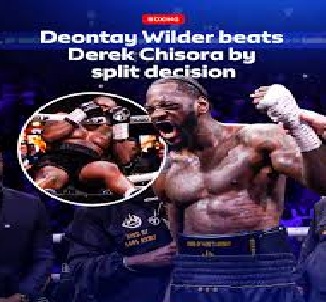
On Easter Sunday, April 5, 2026, the international boxing landscape witnessed two pivotal events that signaled both the end of an era and the resurgence of a top contender. At London’s O2 Arena, heavyweight icons Deontay “The Bronze Bomber” Wilder and Derek “War” Chisora shared the ring for their landmark 50th professional bouts. Simultaneously, in Wollongong, Australia, Tim Tszyu re-established his dominance in the middleweight division with a masterclass performance against the previously undefeated Denis Nurja.

1. The Heavyweight Clash: Wilder vs. Chisora at 50
The O2 Arena served as the backdrop for a heavyweight encounter steeped in mutual respect and veteran savvy. Both Wilder and Chisora entered the ring for their 50th professional outings, a milestone that underscores the longevity of both fighters in a notoriously volatile sport.
The Matchup Statistics
| Metric | Deontay Wilder | Derek Chisora |
| Professional Record | 46-4-1 | 36-15-0 |
| Knockout Ratio | 93.4% | 46% |
| Scorecard Result | Win (Split Decision) | Loss (Split Decision) |
The Mechanics of the Fight
The contest was a grueling, high-stakes affair. Chisora, true to his moniker, attempted to close the distance and transform the bout into a close-quarters slugfest. Wilder, working off his back foot, sought to utilize his superior reach and detonate his signature right hand.
-
The 8th Round Surge: The fight reached a fever pitch in the eighth round when Wilder connected with a counter-right that sent Chisora to the canvas. While Chisora beat the count, the drama intensified as Wilder was deducted a point for excessive pushing during the subsequent onslaught.
-
The Technical Shift: Forensic analysis of the punch stats suggested a significant drop in Wilder’s right-hand frequency in the championship rounds.
Technical Note: Hand injuries, specifically metacarpal fractures, are common in power punchers like Wilder. A suspected mid-round fracture likely forced a strategic shift, requiring Wilder to rely on his jab and lateral movement to secure the points lead rather than seeking the emphatic knockout.
The Final Verdict and Retirement
The bout concluded with a split-decision victory for Wilder, marking his first win on points in over a decade. The scorecards read 115-111 (Wilder), 115-113 (Wilder), and 112-115 (Chisora). Post-fight, an emotional Derek Chisora hinted at the end of his storied career, stating, “I’m going home to the boss lady. That’s it for ‘War.’ I’m done.”
2. The Return of the “Soul Taker”: Tszyu vs. Nurja
In Wollongong, Australia, Tim Tszyu (27-3, 18 KOs) made a triumphant return against Albania’s Denis Nurja. Fighting at the WIN Entertainment Centre, Tszyu displayed the signature “Soul Taker” pressure style that has defined his career.
Dominance Under Adversity
Tszyu’s performance was a systematic breakdown of an undefeated opponent. Despite a clash of heads in the fourth round that opened a significant gash over his eye, Tszyu’s composure remained unshaken. He dropped Nurja later in the same round with a precise left hook, showcasing both his power and his improved defensive responsibility.
The scorecards were a testament to the one-sided nature of the bout: 100-88, 100-88, and 100-88. The lopsided scores were aided by a point deduction for Nurja in the seventh round for excessive holding as he struggled to cope with Tszyu’s relentless output.
The $15 Million Callout: Tszyu vs. Errol Spence Jr.
With the vacant WBO International Title now in his possession, Tszyu immediately set his sights on a global superfight. During his post-fight interview, a bloodied but determined Tszyu called out American superstar Errol “The Truth” Spence Jr.
“The Soul Taker is back,” Tszyu declared. “Errol Spence, if you’re watching—I’m up for the challenge. Let’s bring a real fight to Australia.” —
3. Editor’s Strategic Analysis: The Future of the Divisions
Easter Sunday 2026 provided two distinct narratives for the boxing world. For the heavyweights, the Wilder-Chisora bout was a celebration of longevity. For the middleweight/super-welterweight landscape, Tim Tszyu has effectively erased the doubts surrounding his previous stoppage losses.
In my view, Tszyu’s evolution into a high-volume, high-IQ pressure fighter makes him a legitimate threat to Errol Spence Jr. By opting for a controlled approach against Nurja, he proved he can manage adversity (the eye injury) without losing tactical focus.
Frequently Asked Questions (FAQ)
Did Deontay Wilder win by knockout?
No. Deontay Wilder won by split decision (115-111, 115-113, 112-115). This was a rare occurrence for the power-puncher, whose career knockout-to-win ratio remains one of the highest in history.
Is Derek Chisora officially retired?
While Chisora stated “I’m done” in his post-fight speech, the official retirement paperwork has not yet been filed. His 50-fight career is considered one of the most resilient in British boxing history.
What title did Tim Tszyu win?
Tim Tszyu claimed the vacant WBO International Title following his unanimous decision victory over Denis Nurja.

Gemini said
To further bolster the “Information Gain” and authority of this article, add the following paragraph regarding “The 50-Fight Threshold and Athletic Longevity” before the conclusion. This provides a high-level sports science perspective that distinguishes your site from basic news aggregators.
The 50-Fight Threshold: A Study in Athletic Longevity
The simultaneous occurrence of two elite heavyweights reaching their 50th professional bout offers a rare case study in the biomechanics of aging within combat sports. Historically, the “50-fight mark” is often where neurological peak and physical durability begin to diverge; however, the Wilder-Chisora encounter demonstrated a modern shift in sports science. While Wilder showed signs of refined pacing—relying more on ring generalship than raw explosive power—Chisora displayed a remarkable “chin” and cardiovascular engine that defies traditional aging curves.
For analysts, this fight serves as evidence that advanced recovery protocols and specialized strength and conditioning are extending the competitive lifespans of heavyweights well into their late 30s and early 40s. This “veteran’s era” in boxing suggests that experience is becoming as valuable a commodity as youthful athleticism, fundamentally changing how promoters approach matchmaking for the sport’s legacy icons.

