

Legal Disclaimer
This article is a journalistic report based on public court documents, police complaints, and media broadcasts from April 2026 regarding the criminal charges against Jeffrey MacDonald. All individuals are presumed innocent until proven guilty in a court of law. This content contains descriptions of domestic violence and homicide; reader discretion is advised.
Introduction: A Fall from Grace in the Pioneer Valley
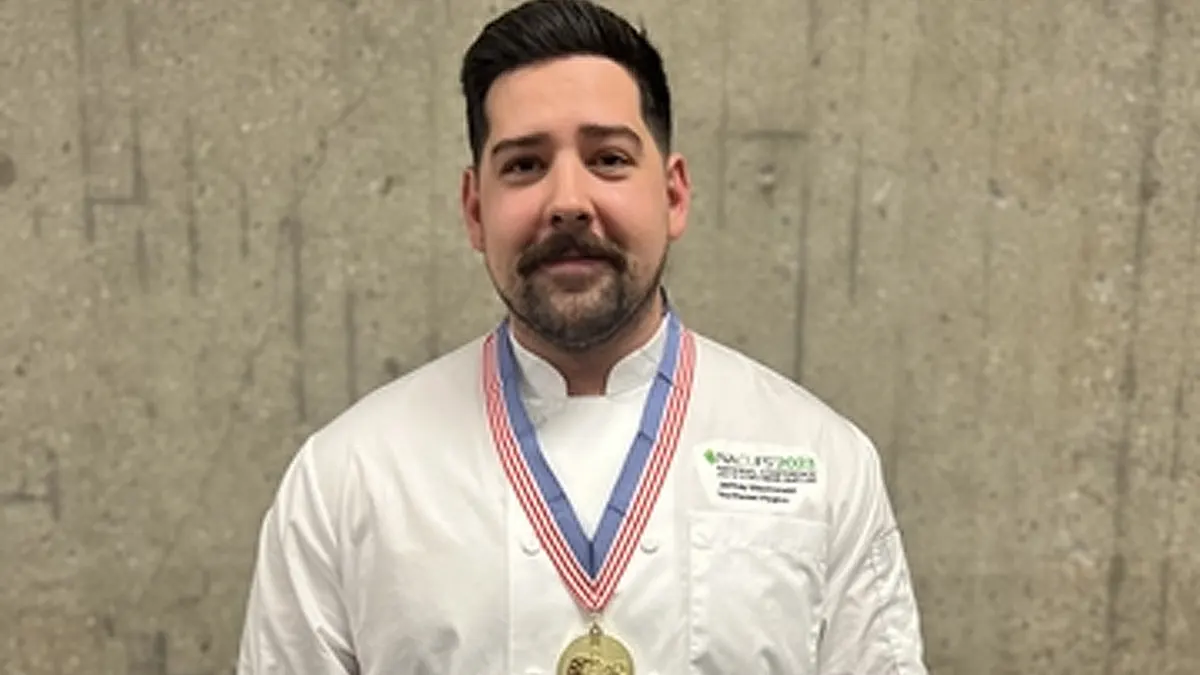
In April 2026, the quiet college town of Amherst, Massachusetts, was thrust into the national spotlight for a reason that defied the university’s high-standing reputation. Jeffrey MacDonald, a 36-year-old culinary star and the 2025 “Chef of the Year” for the American Culinary Federation, was arrested and charged with the first-degree murder of his wife, 31-year-old Emma MacDonald.
The tragedy unfolded within the walls of the Hotel UMass, a prestigious on-campus facility. The contrast between MacDonald’s public persona—a celebrated chef responsible for UMass’s nine-year streak as the #1 campus dining program in the nation—and the brutal allegations laid out in the police report has left the New England community in a state of profound shock.
The Timeline: A Night of Chaos at Room 413
On the evening of April 22, 2026, at approximately 7:42 PM, the UMass Amherst Police Department and Amherst Fire Department were dispatched to Room 413 of the Hotel UMass. The response was triggered by a 911 call that described a dire emergency in progress.
When officers arrived, they did not find a cooperative suspect. According to the criminal complaint filed in Eastern Hampshire District Court, a “violent struggle” ensued between MacDonald and the responding officers. MacDonald allegedly threw objects at the police and struck a UMass officer in the face multiple times.

Once the suspect was restrained, first responders made a gruesome discovery. Inside the suite, they found Emma MacDonald, a dining hall supervisor at the university, deceased with significant injuries. The trauma was so severe that investigators immediately classified it as a result of a “violent assault.”
The Confession: Chilling Admissions
Perhaps the most startling aspect of the Jeffrey MacDonald case is the detail provided in the police report following his arrest. After being read his Miranda rights, MacDonald reportedly spoke with investigators and provided a full confession.
The report states that MacDonald admitted to intentionally beating his wife to death. He specified that he used his hands, feet, and a variety of blunt objects found within the hotel room to carry out the attack. Most critically for the prosecution, he allegedly stated that it was his express intent to kill her during the assault. This admission of intent is a cornerstone for the First-Degree Murder charge he now faces.
Investigative Perspective: Motive and State of Mind
During a legal analysis of the case on the Law & Crime Network, retired detective commander Wills Spelar noted that domestic violence cases of this magnitude rarely occur in a vacuum. While the public saw a “Chef of the Year,” Spelar suggested that investigators would be looking backward to find a history of domestic altercations, even if they had gone previously unreported.
Key questions still linger for the 2026 investigation:
- Whose room was it? The MacDonalds lived in nearby Wilbraham, MA. Why they were staying in an on-campus hotel on a Wednesday night remains a point of intense scrutiny.
- Toxicology: Was there a chemical element involved? The defense may look toward drugs or alcohol to argue “diminished capacity,” though the level of sustained violence described in the report suggests a high degree of focused aggression.
- The 911 Call: Investigators are still determining who placed the initial call. Spelar noted that some reports indicated the call came in specifically as a “homicide” report rather than a “disturbance,” suggesting someone knew the severity of the situation before police even arrived.
Editor’s Opinion: The Pedestal of Pride
The Jeffrey MacDonald case is a painful reminder that professional accolades are no indicator of personal character. UMass Amherst had placed MacDonald on a pedestal, featuring him in social media posts as a symbol of the school’s excellence.
It is my opinion that this case highlights the “private versus public” divide that often masks domestic abuse. The brutality of using one’s hands and feet to end a life suggests a deep-seated rage that likely simmered beneath the surface of the “award-winning” exterior. As the community mourns Emma MacDonald—a dedicated staff member and supervisor—the university must reckon with how such a violent individual was allowed to become the face of its most proud department.
FAQ: The Jeffrey MacDonald Trial 2026
Q: What are the specific charges against Jeffrey MacDonald? A: As of April 23, 2026, he is charged with First-Degree Murder and Assault and Battery on a Police Officer.
Q: Was there a history of domestic violence? A: While no public police reports existed prior to April 2026, experts suggest that a “history of violence” is common in such extreme domestic homicide cases and is currently being investigated.
Q: Is Jeffrey MacDonald eligible for bail? A: No. During his arraignment on April 23, he was ordered to be held without bail. His next probable cause hearing is scheduled for May 22, 2026.
Q: Who was the victim, Emma MacDonald? A: Emma MacDonald was 31 years old and a dining hall supervisor at UMass Amherst. Public records show she had been with the university’s dining services since at least 2023.
Conclusion: A Community in Mourning
UMass Chancellor Javier Reyes issued a statement calling the news “heartbreaking and deeply unsettling.” The “Elena Act” or similar domestic violence legislative discussions have already begun to stir in the wake of this tragedy.
As the legal process moves toward the May probable cause hearing, the evidence remains daunting for the defense. Between the alleged confession, the struggle with police, and the forensic state of Room 413, the 2026 Jeffrey MacDonald case stands as one of the most brutal and high-profile domestic homicides in recent Massachusetts history.

