

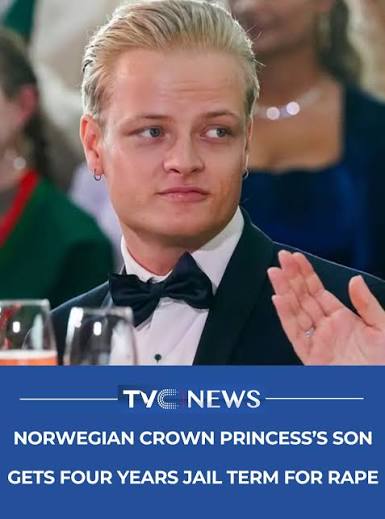
In a landmark decision that has resonated far beyond the borders of Scandinavia, the Oslo District Court has handed down a four-year prison sentence to Marius Borg Høiby, the eldest son of Norway’s Crown Princess Mette-Marit. This verdict, delivered in June 2026, marks the conclusion of a high-profile legal battle that has tested the integrity of Norway’s legal system and placed immense strain on the Norwegian monarchy.
https://www.facebook.com/reel/27130929026560790
The Charges and the Trial
Marius Borg Høiby, 29, faced a staggering 40 criminal charges, ranging from rape to assault, drug possession, and traffic violations. The core of the case rested on four counts of rape, which allegedly occurred between 2018 and 2024. Throughout the intense seven-week trial, the prosecution presented a pattern of behavior characterized by violence and intimidation directed toward former partners.
Prosecutors argued that the sexual assaults occurred while the victims were asleep or otherwise unable to resist. While the court ultimately acquitted Høiby of two of the four rape charges, the conviction on two counts of rape, along with 32 other offences—including domestic abuse and assault—resulted in the four-year prison term. This sentence serves as a stark reminder that in the eyes of the law, no individual—regardless of their proximity to the royal household—is beyond the reach of justice.
A Legacy of Controversy
For years, Marius Borg Høiby has occupied a complex and often debated position in the public eye. As the son of Crown Princess Mette-Marit from a relationship prior to her 2001 marriage to Crown Prince Haakon, he grew up within the royal household but held no formal titles, succession rights, or official public duties. Despite his lack of an official role, his actions have frequently been the subject of intense media scrutiny, often perceived as a point of friction for the monarchy.
The current scandal is, however, of a far more grave nature than the public controversies of his youth. The revelation of systematic abuse and criminal activity has left the Norwegian public—and the royal family itself—grappling with the fallout. Polling conducted during the trial suggested that the scandal contributed to a notable decline in public support for the monarchy, highlighting how the actions of an individual can have profound consequences for institutional perception.
The Question of Accountability
The trial of Marius Borg Høiby was not merely a criminal proceeding; it was a societal litmus test. The prosecution’s demand for a seven-year sentence, contrasted with the defense’s argument for 18 months, illustrated the divide over how to punish someone who sits on the periphery of the “ruling class.” The final sentence of four years suggests a middle ground, a firm rejection of impunity that sends a clear message: status provides no protection against the consequences of violence.
The inclusion of compensation orders for the victims, totaling hundreds of thousands of kroner, further emphasizes the court’s commitment to restoring a measure of agency and justice to those who suffered. As the case moves toward a potential appeal, the focus remains on the judiciary’s ability to remain impartial in the face of immense public and international interest.
https://www.facebook.com/photo/?fbid=1476749631147428&set=a.589604276528639
Structural Integrity and Moral Responsibility
In the context of personal development and societal health, the case of Marius Borg Høiby represents a fundamental failure of personal accountability. We often speak of “architectural control”—the ability to govern one’s impulses and adhere to a code of conduct—as a requirement for those who exert influence in society. When an individual, shielded by the prestige of their environment, chooses to violate the bodily autonomy of others, it exposes a rot within their personal “chassis.”
True resilience is not found in the ability to escape consequence through connections or status; it is found in the transparency of one’s actions and the willingness to accept the weight of one’s choices. For the victims in this case, the legal process has been a necessary step toward validation. For the public, it serves as a sobering lesson on the necessity of holding every individual to the same standard of moral and legal conduct.
Frequently Asked Questions (FAQ)
Q: Who is Marius Borg Høiby? A: He is the eldest son of Norway’s Crown Princess Mette-Marit. He is not a member of the royal household, holds no royal titles, and has no official duties.
Q: Why was Marius Borg Høiby sentenced to prison? A: He was convicted of two counts of rape and 32 other criminal offenses, including assault, domestic violence, and drug-related charges.
Q: What was the maximum sentence he could have faced? A: He faced a total of 40 charges, which carried a maximum potential sentence of 16 years in prison.
Q: Was Marius Borg Høiby present for the verdict? A: No, he did not attend the sentencing in person due to health reasons; he followed the reading via a video link from prison.
https://www.facebook.com/photo/?fbid=1548472510255830&set=a.597235125379578
Q: Is the four-year sentence final? A: No, the sentence is not final. His legal team has indicated that they intend to appeal the convictions for rape and abuse in close relationships.
https://www.facebook.com/photo/?fbid=122225440916048273&set=a.122176776518048273
Q: What is the impact of this case on the Norwegian royal family? A: The case has caused significant embarrassment for the royal family and contributed to a decline in public support for the monarchy during the trial period.

The legal fallout from the Høiby case mirrors other high-profile efforts to navigate the justice system through the lens of privilege and influence. This is sharply echoed in the recent actions of R. Kelly, who has filed a petition seeking presidential clemency to commute his 31-year sentence for sex trafficking and racketeering. In both instances, the public is forced to confront a recurring pattern: individuals with significant social or cultural capital attempting to bypass the established penal consequences of their predatory behavior. Whether it is a figure associated with European royalty or a global music icon, these desperate bids for freedom highlight a fundamental tension between institutional accountability and the belief—whether held by the perpetrator or their supporters—that their status warrants an exception to the rule of law. These maneuvers are not merely legal strategies; they are tests of a society’s resolve to apply a uniform standard of justice, regardless of the perpetrator’s notoriety.

