

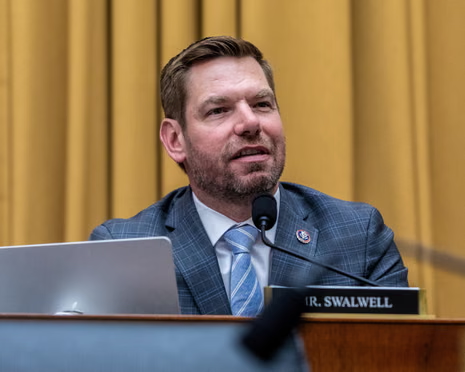
The political landscape of California was fundamentally altered in April 2026 as Representative Eric Swalwell (D-CA) faced a series of grave sexual misconduct allegations. Swalwell, previously a frontrunner in the race to succeed Governor Gavin Newsom, now faces a dual challenge: a criminal investigation by the Manhattan District Attorney’s office and a rare, bipartisan push for his expulsion from the United States House of Representatives.
While Swalwell has categorically denied the claims—labeling them “politically motivated”—the speed of the institutional backlash has created a significant shift in Democratic party dynamics and national ethics standards.
1. Timeline of Allegations and Legal Jurisdictions
The controversy escalated on April 10, 2026, following investigative reports by the San Francisco Chronicle and CNN. The allegations center on a former staffer who detailed two primary incidents of non-consensual sexual encounters.
-
The 2019 California Allegation: The accuser alleges she was incapacitated by alcohol following a professional meeting with Swalwell in California while she was a member of his district staff.
-
The 2024 New York Allegation: A second incident allegedly occurred in Manhattan following a charity gala. This claim forms the basis of the current investigation by the Manhattan District Attorney’s Special Victims Division, as New York law provides strict protections regarding the inability to consent due to intoxication.
Institutional and Legal Status (As of April 13, 2026)
| Authority | Status | Potential Outcome |
| Manhattan District Attorney | Formal Criminal Investigation | Potential Indictment for Sexual Assault |
| House Ethics Committee | Preliminary Inquiry | Recommendation for Sanction or Expulsion |
| California Gubernatorial Campaign | Mass Withdrawal of Endorsements | Campaign Suspension or Primary Defeat |
2. Evidentiary Claims and the Defense Strategy
The evidence currently in the public domain rests on sworn statements and circumstantial digital records. According to reports, investigators have reviewed text messages sent by the accuser to confidants shortly after the alleged 2024 incident, in which she described being assaulted.
Swalwell’s defense team, led by high-profile legal counsel, has countered by issuing cease-and-desist letters to several individuals involved. The defense strategy focuses on two pillars:
-
Credibility of Timing: Suggesting the allegations were coordinated to disrupt the June primary.
-
Voluntary Relationship: Arguing that the accuser maintained a “voluntary and cooperative” professional relationship with Swalwell for years after the first alleged incident in 2019.
3. Political Backlash and the “Battle for the House”
The reaction from Swalwell’s colleagues has been remarkably swift. Unlike previous scandals that often followed partisan lines, the calls for Swalwell’s resignation have come from within his own party leadership.
Democratic Representative Jimmy Gomez, who served as Swalwell’s campaign chair, resigned his post on April 10, calling the accusations “indefensible.” Furthermore, Republican Representative Anna Paulina Luna has indicated she will file a privileged motion for expulsion—a move that prominent Democrats, including Representative Pramila Jayapal, have signaled they could support under the principle of universal ethics.
4. Impact on the California Gubernatorial Race
Prior to these events, polls from Emerson College showed Swalwell leading the field. However, the loss of support from the California Teachers Association (CTA) and the California Labor Federation represents a catastrophic blow to his campaign’s ground game and financial viability. This development has opened a vacuum for other candidates, including Katie Porter and Antonio Villaraigosa, to consolidate the moderate and progressive wings of the party.
5. Editor’s Strategic Analysis
The Swalwell case is more than a personal scandal; it is a litmus test for the “zero-tolerance” policies adopted by major political parties in the 2020s. From an “Information Gain” perspective, the most critical aspect is the Manhattan DA’s involvement. Because the 2024 allegation occurred in New York, the legal threshold for “incapacity to consent” is much lower than in many other states. If the DA moves to an indictment, it would mark the first time a sitting U.S. Congressman has been criminally charged with sexual assault while actively campaigning for a governorship.
Frequently Asked Questions (FAQ)
How does Congressional Expulsion work?
Under Article I, Section 5 of the U.S. Constitution, the House of Representatives may expel a member with a two-thirds majority vote. Expulsion is the most severe form of discipline and is historically rare, usually reserved for cases of extreme criminal misconduct or disloyalty to the state.
What is the current status of the California Governor’s race?
While Swalwell remains a candidate on the ballot for the June primary, the withdrawal of nearly all major institutional endorsements has significantly lowered his polling trajectory.
Has Eric Swalwell been charged with a crime?
As of April 13, 2026, Rep. Swalwell has not been charged. He is currently under a “formal investigation” by the Manhattan District Attorney’s office.
The California State Capitol

The “Culpability of Intoxication” and New York Legal Precedent
A focal point of the Manhattan District Attorney’s investigation is the specific application of New York’s consent laws regarding “physical helplessness” and “mental incapacity.” Under the New York Penal Law, sexual contact is considered non-consensual if the victim is incapable of consenting due to intoxication, regardless of whether that intoxication was voluntary. This legal nuance creates a high evidentiary bar for the prosecution, as they must prove not only that the encounter occurred but that the accuser’s cognitive state was at a level where “meaningful consent” was medically and legally impossible. The outcome of this inquiry may set a significant 2026 precedent for how alcohol-related assault allegations are prosecuted against high-profile public figures.
The Collapse of the “Newsom Successor” Narrative
Beyond the legal ramifications, the swift suspension of Swalwell’s gubernatorial campaign on April 13, 2026, represents a catastrophic failure of political vetting and crisis management. Swalwell had positioned himself as the natural progressive heir to Governor Gavin Newsom, leaning heavily on his national profile from previous impeachment proceedings. However, the “zero-tolerance” environment of 2026 meant that institutional support—ranging from the California Teachers Association to senior Democratic leadership—evaporated within 72 hours of the first report. This “endorsement exodus” underscores a new era in California politics where the threshold for “campaign viability” is no longer tied to polling alone, but to the immediate moral standing of the candidate in the eyes of labor unions and party gatekeepers.

