
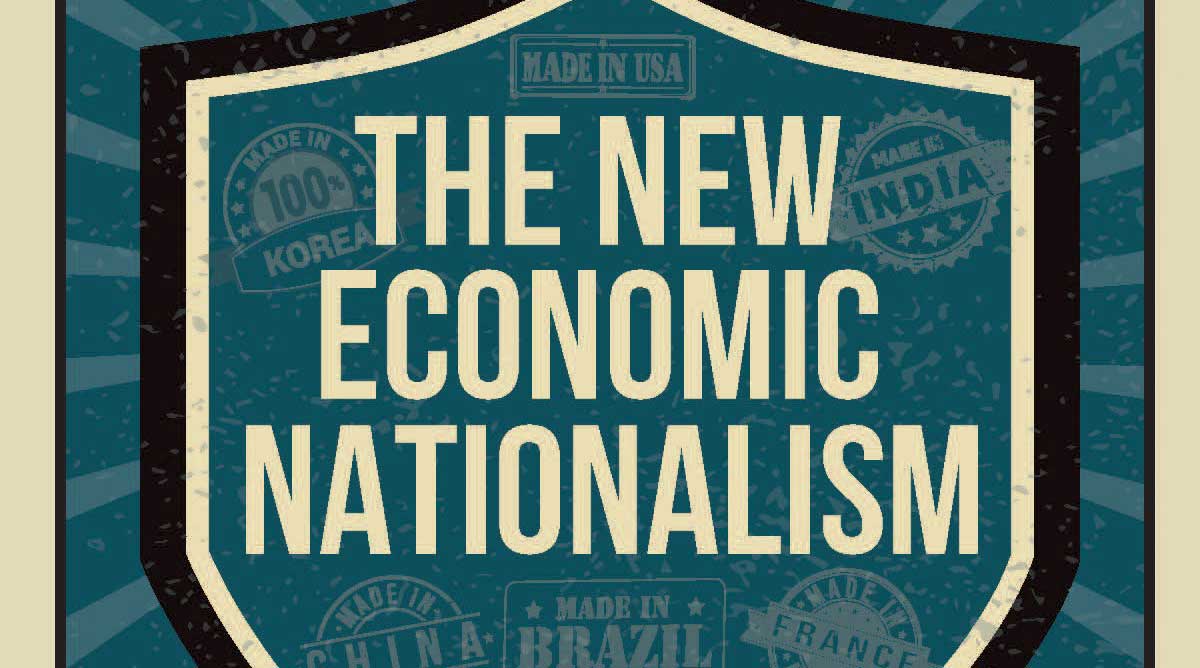
The geopolitical landscape of 2026 is no longer a collection of isolated regional skirmishes; it has evolved into a fundamental restructuring of how nations interact with markets, technology, and each other. As we move through the second quarter of the year, the “Age of Laissez-Faire” has officially been replaced by a “New Economic Nationalism.”
Governments are no longer content to sit on the sidelines as mere referees of trade. Instead, they have become the primary architects of industrial capacity, using regulation, subsidies, and trade controls as high-stakes instruments of diplomatic strategy.
:max_bytes(150000):strip_icc()/laissez-faire-definition-4159781-V2-828107953ee443f1bdeaaaba9b35759b.jpg)
The Rise of the Market-Shaping State
In 2026, the most significant shift is the fusion of economic policy with national security. Following the trends set in motion during 2025, the United States, the European Union, and China have all adopted “muscular interventionism.” This involves heavy state spending to secure domestic supply chains, particularly in semiconductors, AI infrastructure, and green energy.
For global businesses, this means the “neutral” marketplace is a thing of the past. Success in 2026 depends less on pure efficiency and more on navigating the specific industrial “playbooks” of major capitals. We are seeing a world where data centers and battery factories are treated as strategic military assets rather than simple commercial real estate.
The Polycentric World Order
The traditional unipolar world, once anchored by American leadership, has fractured into what experts call a polycentric order. While the U.S. remains a formidable power, its influence is increasingly transactional and selective.
This power vacuum has allowed “middle powers”—such as India, Brazil, and Indonesia—to assert themselves as crucial power brokers. These nations are no longer choosing sides in a binary Cold War; instead, they are forming fluid coalitions based on specific interests like digital sovereignty or food security.
Critical Mineral Alliances: The New Oil
As the world accelerates its transition to a high-tech economy, the struggle for territory has been replaced by the struggle for “traceable supply.” Critical minerals like lithium, cobalt, and rare earth elements are the “new oil” of 2026.
The year has seen the formation of exclusive “mineral clubs”—alliances between resource-rich nations in Africa and Latin America and the manufacturing giants of the West and East. These alliances are designed to bypass “choke points” controlled by geopolitical rivals. If a nation lacks a secure supply of minerals for its EV batteries or AI chips, its economic sovereignty is effectively compromised.
The AI Frontier and Digital Sovereignty
Digital policy has reached a boiling point. In 2026, we see five distinct regulatory regimes for AI:
-
United States: An innovation-first model fragmented by state-level privacy laws.
-
European Union: Strict enforcement of the AI Act, prioritizing human rights and data transparency.
-
China: State-controlled AI focused on social stability and industrial automation.
-
The Global South: Emerging frameworks focused on “digital decolonization” and infrastructure independence.
-
The Corporate Sovereigns: Tech giants that operate with budgets and influences exceeding that of mid-sized nations.
Democracy’s Performance-Based Legitimacy
Perhaps the most sobering trend of 2026 is the changing definition of democratic legitimacy. In many parts of the world, voters are moving away from abstract ideals of “liberal democracy” and toward “performance-based legitimacy.”
The core question for citizens in 2026 is: Can the government deliver on the cost of living, safety, and opportunity? This shift has led to a rise in populist movements that promise efficiency and security at the cost of traditional democratic norms. Whether democracy survives this era depends on whether its institutions can adapt to the rapid economic pressures of the 21st century.
Frequently Asked Questions (FAQ)
Q1: What is “Economic Nationalism” in the context of 2026? It refers to the trend where governments prioritize domestic industry and national security over global free trade. This includes using subsidies (like the US CHIPS Act or EU Green Deal) to “on-shore” manufacturing.
Q2: How is AI affecting global politics this year? AI is now a marker of strategic power. Nations are treating AI compute power and data sets as sovereign assets, leading to “tech-protectionism” where countries limit the export of high-end chips and AI models.
Q3: Why are “Middle Powers” becoming more influential? Because the major powers (US and China) are more focused on their bilateral rivalry, middle powers like India and Indonesia can act as “swing states,” leverage their resources, and set international norms in niche areas like digital trade and climate finance.
Q4: Is the world moving toward a new Cold War? Not exactly. Unlike the Cold War, today’s economies are deeply interconnected. Instead of two clear “blocs,” we have a “polycentric” world where countries might partner with the US on security but with China on trade.
Editor’s Opinion: The High Cost of the “Safety-First” Economy
The shifts we are witnessing in 2026 are often framed by policymakers as “resilience” and “strategic autonomy.” From a distance, this sounds like a prudent evolution of the state—a way to protect citizens from the volatile shocks of global pandemics or supply chain collapses. However, if we look beneath the surface of this new economic nationalism, the view is far more complicated and, frankly, concerning.
For decades, the globalized world operated on the principle of comparative advantage: do what you do best, and trade for the rest. While that system certainly left many behind and created fragile dependencies, it also drove down the cost of living for billions. In 2026, we are watching that efficiency be traded for security. The result? A world that is arguably “safer” in terms of supply chain redundancy, but significantly more expensive.
The “Tax” on Geopolitics Every time a government subsidizes a domestic semiconductor plant or mandates that batteries be sourced from “friendly” nations, the consumer pays a hidden tax. We are effectively paying a premium for the peace of mind that our gadgets aren’t built by a rival power. While this may be a necessary geopolitical move, we must be honest about its inflationary nature. In 2026, the “peace dividend” is gone, replaced by a “security surcharge” on everything from smartphones to electric vehicles.
The Danger of the “Performance” Trap Perhaps most worrying is the trend toward performance-based legitimacy. When we judge a political system solely on its ability to provide immediate economic comfort or security, we risk devaluing the messy, slow, but vital processes of democratic debate. If the public becomes conditioned to value the output of the state over the input of the citizen, we open the door to a more authoritarian style of governance that justifies any means so long as the “ends” (cheaper gas, faster internet, domestic jobs) are met.
A Way Forward The challenge for 2026 and beyond isn’t to return to the hyper-globalization of the 1990s—that ship has sailed. Instead, the goal should be “Open Autonomy.” Nations must secure their critical needs without turning into closed fortresses. If the new economic nationalism becomes a race to the bottom where every nation tries to build everything itself, we will end up in a global stagflation that no amount of industrial policy can fix.
In my view, the winners of this era won’t be the countries that build the highest walls, but those that build the most reliable and transparent bridges with like-minded partners.

