

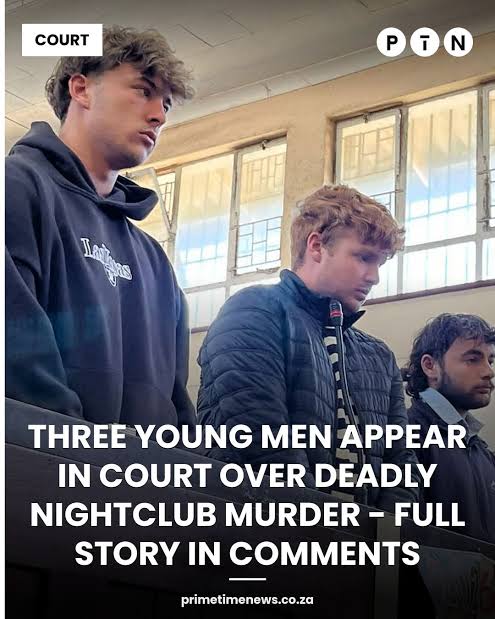
A night out in the coastal town of Jeffreys Bay turned fatal on Saturday, 21 November 2026, leaving a family in mourning and four young men facing the full weight of the South African criminal justice system.
According to Eastern Cape police spokesperson Captain Marius McCarthy, 25-year-old Daniël Stevens was standing outside a local establishment at approximately 21:50 when he was alerted that four men were assaulting his friend inside. When Stevens stepped in to assist, the group allegedly turned their aggression onto him. Despite attempts by a bystander to intervene, the assault continued outside. While attempting to flee his attackers, Stevens fell against the rails of a passing bakkie, striking his head. Police reports further indicate that one of the suspects allegedly punched him again, causing him to collapse and strike the back of his head on the ground.
Stevens suffered catastrophic head trauma and was placed on life support before doctors declared him brain dead. On Monday, 23 November, his family made the agonizing decision to switch off the machines keeping him alive. By Wednesday, 25 November, South African Police Service (SAPS) investigators had tracked down and arrested four suspects aged 16, 19, 19, and 21 across Jeffreys Bay, Kariega, and Humansdorp. The three adult suspects—Damien le Roux (19), Jayden Pieterse (19), and Bernard Heyns (21)—have since appeared in the Humansdorp Magistrate’s Court, while the 16-year-old minor was referred for mandatory assessment by the Department of Social Development.
https://www.facebook.com/reel/1176980778359914
https://www.facebook.com/reel/1124851340457108
https://www.facebook.com/groups/884098876005161/posts/1777701256644914/
https://www.facebook.com/reel/1419040006662332
16 year old fatty
https://www.facebook.com/photo/?fbid=1566789172134351&set=gm.1777701256644914&idorvanity=884098876005161
https://www.facebook.com/photo/?fbid=1181152704447345&set=a.245868271309131
https://www.facebook.com/photo/?fbid=4641130192768892&set=a.1436491956566081
https://www.facebook.com/photo?fbid=4641130192768892&set=a.1436491956566081
tribute post from deceased’ brother
https://www.facebook.com/photo/?fbid=1724847862304909&set=a.207121257410918
The Criminal Charges: Murder and the Doctrine of Common Purpose
All four suspects have been formally charged with murder. In high-profile group assaults where a victim dies after striking a vehicle or the pavement, the public often asks how all four individuals can be charged with murder if only one or two delivered the final blows.
In South African law, the prosecution relies heavily on two foundational legal principles:
-
Dolus Eventualis (Legal Intention): Under South African criminal law, murder does not require premeditation or a specific desire to kill (dolus directus). Instead, the State can prove dolus eventualis—meaning the accused subjectively foresaw the possibility that a sustained, violent assault could result in death, yet reconciled themselves to that risk and continued attacking anyway.
-
The Doctrine of Common Purpose: When multiple individuals act together in an unlawful attack, the actions of one participant are imputed to the others. Even if only one suspect threw the punch after Stevens hit the bakkie’s rails, the prosecution will argue that all four shared a common purpose to severely assault him, making each equally liable for the fatal outcome.
Because the three adult suspects are charged with Schedule 5 or Schedule 6 murder (depending on whether the State argues common purpose to commit a fatal assault), the burden shifts onto the defense during their bail hearing in the Humansdorp Regional Court to prove that exceptional circumstances or the interests of justice permit their release. The State has already indicated its intention to oppose bail.
Will They Likely Be Found Guilty? Analyzing the Legal Outlook
Determining whether the four suspects will be convicted of murder or the lesser competent verdict of culpable homicide (the unlawful, negligent killing of another human being) will be the central battleground of the trial.
-
The Case for a Murder Conviction: Witness statements and circulating video footage of the assault give the National Prosecuting Authority (NPA) strong evidentiary footing. The fact that the attackers ignored a bystander’s intervention, pursued Stevens as he fled, and allegedly struck him again after his head impacted a passing vehicle demonstrates sustained aggression. Prosecutors will argue any reasonable person—and specifically these accused—foresaw that beating someone near moving traffic and hard surfaces could be fatal.
-
The Defense’s Counter-Argument (Culpable Homicide): Defense attorneys will almost certainly argue that the suspects lacked the subjective foresight required for murder. They will contend that the passing bakkie was an unforeseen intervening factor, and that while the group intended to commit Assault with Intent to do Grievous Bodily Harm (Assault GBH), Stevens’ death was a tragic, negligent accident rather than an intentional killing.
-
Differentiated Liability: If video evidence clearly shows one or two suspects hanging back while others pursued Stevens toward the road, the court could convict the primary aggressors of murder or culpable homicide while finding peripheral participants guilty of Assault GBH. However, if all four actively participated in chasing and beating him outside, a joint conviction on either murder or culpable homicide is highly probable.
Understanding the Motive Behind Nightlife Group Violence
Unlike premeditated crimes driven by financial gain or long-standing feuds, fatal nightlife altercations rarely stem from a rational motive. Criminologists and forensic psychologists categorize incidents like the Jeffreys Bay tragedy as expressive, situational violence.
Several psychological and environmental triggers typically converge in these scenarios:
-
Hyper-Masculine Ego and Status Defense: Inside crowded social venues, minor friction—such as a bumped shoulder, a perceived insult, or a dispute over space—can rapidly escalate when young men feel compelled to project dominance in front of peers.
-
Group Polarization and Deindividuation: When operating in a pack of four, individual moral inhibitions drop. Pack mentality creates a feedback loop where each member escalates the violence to match the group’s energy, explaining why the suspects turned on Stevens immediately when he tried to pull his friend out of harm’s way.
-
Alcohol and Impulsivity: Intoxication impairs the prefrontal cortex—the part of the brain responsible for impulse control and consequence evaluation—causing attackers to ignore a bystander’s intervention and continue beating a fleeing victim.

Inside the Accused’s Minds: The Psychological Aftermath
Following rapid arrests between Wednesday evening and Thursday morning, suspects aged 16 to 21 typically experience a severe psychological crash once the adrenaline of the weekend wears off and the reality of holding cells sets in.
-
Acute Shock and Denial: Most young suspects in spontaneous brawl cases do not view themselves as “murderers.” Initially, their minds rely on cognitive distortion—blaming alcohol, claiming self-defense, or insisting that the passing bakkie—not their fists—caused the fatal injury.
-
Panic and Hyper-Vigilance: Transitioning abruptly from a beach-town night out to police holding cells and the Humansdorp Regional Court induces intense anxiety. For the 16-year-old minor, who cannot be named publicly and is subject to the Child Justice Act, separation from family and placement in secure youth care triggers acute fear and disorientation.
-
Shame and Social Ostracization: Jeffreys Bay is a tight-knit community where news and social media footage travel fast. As the faces and names of the adult accused circulate publicly, suspects confront the reality that their reputations, careers, and family standing have been permanently shattered. Genuine remorse often arrives much later, once legal counsel explains the severity of the prison terms they face.
 Click image below for a chance to win 2k a week for 1 week

Expected Timeline and Likely Sentencing Range
When Will Sentencing Happen?
South African criminal trials involving multiple accused, forensic post-mortem reports, video authentication, and social worker assessments move deliberately through the courts. Following the November 2026 bail proceedings in Humansdorp:
-
Investigation and Remand (3 to 6 months): Police must finalize the post-mortem report, obtain witness affidavits, and verify CCTV or cellphone footage.
-
Pre-Trial and Trial Phase (6 to 14 months): Depending on court roll congestion in the Eastern Cape—and whether the matter remains in the Regional Court or is transferred to the High Court—a full trial typically concludes within 12 to 20 months of arrest.
-
Most Likely Sentencing Date: Assuming a standard contested trial without extraordinary delays, sentencing is most likely to occur between late 2027 and mid-2028. (A guilty plea via a Section 105A plea bargain could bring sentencing forward to mid-2027.)
Likely Jail Sentence Range
If convicted, sentences will vary sharply depending on the final verdict and the age of each offender:
-
For the Three Adult Suspects (Ages 19, 19, and 21):
-
If Convicted of Murder: Under the Criminal Law Amendment Act, unplanned murder carries a prescribed minimum sentence of 15 years’ direct imprisonment for a first-time offender. Because the offenders are youthful (19 to 21) and the death involved an unintentional collision with a passing vehicle rather than a lethal weapon, defense counsel will argue for “substantial and compelling circumstances” to deviate downward. A realistic sentencing range for the adults on a murder conviction is 10 to 15 years’ imprisonment.
-
If Convicted of Culpable Homicide: Culpable homicide does not carry a statutory minimum sentence. For a violent group assault resulting in death, South African courts typically impose between 5 and 10 years’ direct imprisonment, sometimes with a portion suspended.
-
-
For the 16-Year-Old Minor:
-
Under the Child Justice Act 75 of 2008, mandatory minimum sentences do not automatically apply to offenders under 18, and imprisonment is treated strictly as a measure of last resort. If convicted of murder or culpable homicide, the court will weigh a probation officer’s pre-sentencing report heavily. The minor faces either detention in a Child and Youth Care Centre or a reduced custodial sentence—typically ranging from 3 to 8 years—served in a juvenile correctional facility.
-
Frequently Asked Questions (FAQ)
1. Why can all four suspects be charged with murder if only one person threw the final punch? Under South Africa’s legal doctrine of common purpose, when a group acts together in a coordinated violent assault, the law holds every active participant equally responsible for the collective outcome, regardless of who delivered the fatal blow.
2. Why hasn’t the 16-year-old suspect been named in the media? Section 154(3) of the Criminal Procedure Act and the Child Justice Act strictly prohibit publishing the name, photograph, or identifying details of any accused person under the age of 18 to protect their constitutional rights and prospects for rehabilitation.
3. Does the fact that Daniël Stevens hit a passing bakkie help the defense? Defense lawyers will argue that the passing vehicle breaks the direct chain of causation or proves the attackers did not intend to kill him. However, because the suspects chased him toward a roadway and allegedly punched him again after he struck the vehicle’s rails, prosecutors have strong grounds to argue the attackers foresaw and accepted the risk of fatal injury.
4. Will the suspects get bail in the Humansdorp Magistrate’s Court?In serious murder cases, the State routinely opposes bail. The adult suspects must convince the magistrate that they are not flight risks, will not interfere with witnesses, and that releasing them will not undermine public peace or the justice system. Even if granted, bail would come with strict reporting conditions and non-contact orders.
5. What is the difference between murder and culpable homicide in this case? The difference comes down to state of mind. Murder requires proving the attackers foresaw that their beating could kill Stevens and proceeded anyway (dolus eventualis). Culpable homicide applies if the court finds they did not subjectively foresee his death, but a reasonable person in their shoes would have recognized the fatal danger.
Did the parents release a formal Victim Impact Statement? No. A formal is only submitted during the sentencing phase of a criminal trial after a guilty verdict is reached. Because the suspects were arrested just days ago in November 2026 and the trial has not yet begun, a formal court statement does not exist yet. However, the family has spoken publicly to the media and shared tributes on social media expressing their devastation over losing Daniël while he was simply trying to protect a friend.
Did they really have to turn off his life support? Yes. Following the assault outside the Jeffreys Bay establishment on Saturday, 21 November 2026, Daniël Stevens was rushed to the hospital with catastrophic head trauma. Doctors placed him on life support, but after medical assessments confirmed he was brain dead, his parents and family had to make the agonizing decision to switch off the machines on Monday, 23 November 2026.
Why did switching off life support change the police investigation to murder? Under South African law, a person is legally dead when brain stem death occurs. Because the severe head injuries inflicted during the assault directly caused his brain death—making life support necessary in the first place—turning off the machines does not break the legal chain of causation. Once life support was withdrawn and he passed away, police immediately upgraded the docket from attempted murder and assault to a full murder investigation.
Will his parents get to address the court directly later? Yes. If the accused plead guilty or are convicted at the end of the trial, the National Prosecuting Authority (NPA) will work with Daniël’s parents to compile formal Victim Impact Statements. They will have the right to either read those statements aloud in the Humansdorp court or submit them to the presiding magistrate or judge to help determine the severity of the sentences.
Who started the attack?
According to South African Police Service (SAPS) reports and witness accounts, the group of four young men (aged 16, 19, 19, and 21) initiated the violence:
-
The Initial Altercation: At approximately 21:50 on Saturday, 21 November 2026, the four suspects were allegedly assaulting Daniël Stevens’ friend inside Je’Vista Social Café in Jeffreys Bay. Police have not publicly disclosed what sparked that initial scuffle inside the venue.
-
Turning on Daniël Stevens: Stevens was standing outside the establishment when someone alerted him that his friend was being beaten inside. When Stevens stepped in to break up the altercation and protect his friend, the four suspects allegedly turned their aggression onto him, confronting and assaulting him outside the club.
-
Escalation of the Attack: Even after a bystander attempted to intervene and Stevens tried to flee the scene, the group continued pursuing and striking him—leading to his fall against the rails of a passing bakkie and the subsequent punch that caused him to hit his head on the ground.
The State has since indicated in the Humansdorp Magistrate’s Court that it intends to pursue premeditated murder charges against the four accused—Damien le Roux (19), Jayden Pieterse (19), Bernard Heyns (21), and the 16-year-old minor—alleging they acted with common purpose.
Public Opinion on the Four Defendants
Public reaction across Jeffreys Bay and South Africa has been overwhelmingly condemning, fueled by viral cellphone footage of the attack circulating on social media. Sentiment generally breaks down into three main themes:
-
Widespread Outrage and Calls for Strict Justice: Social media platforms have been flooded with
#JusticeForDaniëlmessages. Community members view the attack as senseless and cowardly—emphasizing that four young men ganged up on a 25-year-old who was simply trying to protect a friend, and continued striking him even after he tried to flee and hit a passing vehicle. -
Shock Over the Suspects’ Ages: The public has expressed deep alarm that the accused are aged between 16 and 21. Rather than generating sympathy for their youth, the presence of a 16-year-old in a fatal late-night bar brawl has sparked intense public debate around youth violence, underage drinking, and accountability.
-
Frustration Over Bystander Inaction and Venue Security: Alongside anger directed at the defendants, many commenters have criticized onlookers who filmed the assault instead of stepping in to stop it, as well as management at Je’Vista Social Café for allegedly lacking adequate security and allowing a minor onto the premises.
Are Their Careers and Reputations Permanently Ruined?
For the three adult defendants (Damien le Roux, Jayden Pieterse, and Bernard Heyns), the short answer is yes, in the foreseeable future—and very likely permanently for traditional career paths. For the 16-year-old minor, the long-term impact depends heavily on the trial outcome and South African privacy protections.
1. Permanent Digital Footprint (The Adult Accused)
Because the three adult suspects are over 18, their full names and photographs have been published across major South African news outlets and shared thousands of times on Facebook, TikTok, and X.
-
Even if they are eventually acquitted or convicted of a lesser charge like culpable homicide, any future employer, client, or university running a basic Google search on their names will immediately find coverage linking them to a high-profile murder trial.
-
In tightly connected communities like Jeffreys Bay, Kariega, and Humansdorp, social ostracization is immediate and long-lasting.
2. Criminal Record Barriers
-
If Convicted of Murder or Culpable Homicide: A violent felony conviction in South Africa carries severe statutory consequences. It permanently disqualifies them from careers in law enforcement, private security, finance, healthcare, education, government service, and most corporate roles requiring background clearances. It also restricts international travel and work visas.
-
Lost Formative Years: At ages 19 to 21, young adults are typically completing tertiary studies, apprenticeships, or entry-level jobs. Spending even 5 to 15 years in correctional facilities removes them from the workforce during their critical career-building decade.
3. Different Legal Shield for the 16-Year-Old Minor
-
Under South Africa’s Child Justice Act and Criminal Procedure Act, the media is legally barred from naming the 16-year-old or publishing his image.
-
While he faces severe social stigma among peers who know his identity locally, his anonymity in the public press means his broader public reputation is shielded. Furthermore, if he avoids a custodial adult prison sentence and completes rehabilitation programs, South African law provides mechanisms to expunge certain youth records later in adulthood—giving him a realistic chance at rebuilding a career if he reforms.
What would have likely happened had the final few blows was not delivered?
If the suspects had stopped attacking Daniël Stevens before delivering the final blows—specifically before chasing him toward the road, causing him to collide with the passing bakkie, and punching him again while he was already compromised—the medical, legal, and personal outcomes would have been dramatically different:
1. Medical Survival
-
Prevention of Fatal Brain Trauma: According to medical and police reports, Stevens suffered fatal head trauma from hitting the rails of the passing bakkie and subsequently being punched, causing his head to strike the pavement.
-
Non-Life-Threatening Injuries: Had the altercation ended inside the establishment or immediately outside before he fled into traffic, Stevens likely would have sustained typical brawl injuries—such as facial bruising, lacerations, a broken nose, or a mild concussion—rather than catastrophic brain-stem death. He almost certainly would have survived.
2. Dramatically Lower Criminal Charges
Without a fatality, the case would never have escalated to the High Court or involved Schedule 5/6 murder provisions:
-
Common Assault or Assault GBH: The four suspects would likely have been charged with Common Assault or Assault with Intent to do Grievous Bodily Harm (Assault GBH), depending on the severity of the bruises or fractures Stevens and his friend sustained.
-
Routine Police Bail: Instead of being held in custody for days and facing an opposed bail hearing in the Humansdorp Regional Court, the suspects likely would have been released on a police warning or nominal bail (often R500 to R1,500) within 48 hours of their arrest.
3. Lighter Sentencing (No Prison Time)
-
Non-Custodial Sentences: For young first-time offenders aged 16 to 21 convicted of Common Assault or minor Assault GBH in a bar fight, South African magistrates rarely impose direct prison sentences.
-
Alternative Punishments: The court most likely would have imposed a wholly suspended sentence, a fine, community service hours, or anger-management diversion programs—especially for the 16-year-old under the Child Justice Act.
4. Privacy and Reputation Intact
-
No Media Coverage: A non-fatal bar brawl in Jeffreys Bay would not have attracted national media attention or viral social media outrage.
-
Anonymity Preserved: Because formal murder charges would not have been brought in open court under high public scrutiny, the names and faces of Damien le Roux, Jayden Pieterse, and Bernard Heyns would never have been broadcast across South Africa, leaving their futures and reputations largely intact.
-

