

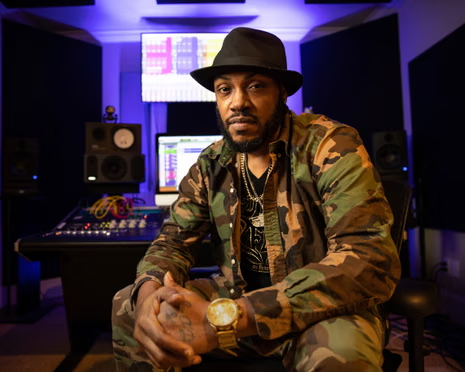
In the late 1990s and early 2000s, few voices in hip-hop possessed the explosive, gravelly energy of Michael Lawrence Tyler—known globally as Mystikal. With a distinct, military-style delivery and a chaotic, high-octane flow, the New Orleans-born rapper became the crown jewel of Master P’s No Limit Records and later a mainstream solo superstar. Hits like “Shake Ya Ass” and “Danger” cemented him as a multi-platinum powerhouse.
Yet, beneath the chart-topping success lay a dark, repeating pattern of violence and legal crises. Over a career spanning three decades, Mystikal’s musical achievements have been entirely overshadowed by severe criminal offenses, leading to a cumulative total of roughly 20 years spent in and out of the prison system. It is a stark, cautionary tale of a generational talent whose career was systematically dismantled by his own criminal conduct.
Rapper Mystikal Sentenced to 20 Years in Rape Case
byu/MarvelsGrantMan136 inhiphopheads
The Rise: The Combat Soldier of Southern Hip-Hop
Before the courtroom battles, Mystikal was an undeniable pioneer of the Southern rap boom. Born in the 12th Ward of New Orleans, his early life was marked by tragedy, including the horrific 1994 murder of his sister, Michelle Tyler—an event that deeply influenced his emotional, raw delivery.
After a brief stint in the United States Army, where he served as a combat engineer during the Gulf War, Tyler channeled his discipline and aggression into music. His 1995 independent debut, Mind of Mystikal, caught the attention of Master P, the architect of No Limit Records. Joining No Limit during its golden era, Mystikal became the label’s most technically gifted lyricist.
His contribution to tracks like “Make ‘Em Say Uhh!” propelled No Limit to the top of the Billboard charts. His solo albums under the label, including Unpredictable (1997) and Ghetto Fabulous (1998), achieved platinum status. However, his peak arrived after departing No Limit. In 2000, he released Let’s Get Ready via Jive Records. Powered by the Neptunes-produced smash “Shake Ya Ass” and the infectious “Danger,” the album went triple-platinum, earning him Grammy nominations and establishing him as a global pop-culture fixture.
The Pivot Point: The 2003 Sexual Assault Conviction
At the absolute zenith of his commercial viability, Mystikal’s career hit a brick wall due to a severe criminal indictment. In 2003, Tyler was accused of forcing his resident hairstylist to perform sexual acts after accusing her of stealing $80,000 worth of checks. The incident, which was recorded on video by Tyler’s bodyguards, led to a high-profile legal battle.
Faced with overwhelming evidence, including the videotape, Tyler struck a plea bargain. In January 2004, he pleaded guilty to sexual battery and extortion.
[2004 Sentencing] ➔ Mandated 6-Year Prison Term ➔ Total Loss of Mainstream Endorsements & Recording Contracts
He served the entirety of his six-year sentence at the Louisiana State Penitentiary (Anglite), gaining release in January 2010. Upon his exit, he was registered as a tier-three sex offender. While he attempted a musical comeback—signing briefly with Cash Money Records in 2011 and collaborating with Mark Ronson on the 2015 track “Feel Right”—the mainstream landscape had fundamentally shifted. The music industry was no longer willing to unconditionally celebrate an artist with a violent felony record.
A Timeline of Escalating Controversies
Mystikal’s legal troubles did not begin or end with his 2004 imprisonment. His rap sheet outlines a pattern of domestic volatility, substance dependency, and institutional non-compliance:
-
2012 Domestic Abuse Arrest: Just two years after his release from state prison, Tyler was arrested in East Baton Rouge for domestic abuse battery following a violent altercation with a partner. He was sentenced to three months in jail for violating his probation.
-
2017 First-Degree Rape Indictment: In August 2017, Tyler turned himself in to authorities after being indicted by a Caddo Parish grand jury on charges of first-degree rape and second-degree kidnapping, stemming from an incident at a Shreveport casino. He spent nearly 18 months in maximum-security custody before posting a massive $3 million bond in 2019. The charges were ultimately dropped in 2020 after a second grand jury declined to bring an indictment based on new evidence.
-
2022 Felony Charges: The definitive end of his freedom came in July 2022. Tyler was arrested at his home in Prairieville, Louisiana, and hit with an array of severe charges, including first-degree rape, simple robbery, domestic abuse battery by strangulation, and possession of Schedule II controlled substances.
The Reality of His 20-Year Legal Sentence History
When calculating Mystikal’s footprint in the criminal justice system, the numbers add up to a tragic reality. Between his initial six-year stint in the 2000s, his multi-year pre-trial detentions, his probation violations, and his current ongoing legal battles where he faces potential life imprisonment without parole, Tyler has effectively spent nearly two decades behind bars or under strict state supervision.
Louisiana state prosecutors have continuously pointed to his status as a repeat offender to argue against bond leniency. For a man who once commanded audiences of tens of thousands on stadium tours, his reality has devolved into grey concrete blocks, orange jumpsuits, and continuous appeals to judges.
Editor’s Opinion: The Erasure of Talent Through Self-Destruction
There is a profound tragedy in the story of Mystikal, but we must be careful not to misplace our sympathy. It is easy to look at his career and mourn the loss of what could have been an elder-statesman legacy in hip-hop, akin to Busta Rhymes or Missy Elliott. His artistic impact during the late ’90s was undeniable; he possessed a kinetic, raw showmanship that modernized the sound of Louisiana bounce and rap.
However, Mystikal’s legacy is not a tragedy of bad luck or institutional targeting—it is a tragedy of self-inflicted devastation. The music industry frequently forgives artistic eccentricities and minor legal infractions, but it cannot, and should not, overlook repeated patterns of sexual violence and domestic abuse.
Every time Tyler stood on the precipice of a successful redemption arc, his actions dragged him back into a courtroom. Ultimately, when we look back at the history of Southern rap, Mystikal will not be remembered primarily for his triple-platinum plaques or his raspy brilliance. He will be remembered as an artist who possessed every tool necessary to rule the genre, but instead chose a path that traded the stage for a lifetime inside a prison cell.
Frequently Asked Questions (FAQ)
What was Mystikal’s biggest hit song?
Mystikal’s biggest commercial hits were “Shake Ya Ass” (often censored to “Shake It Fast”) and “Danger,” both released in 2000 on his triple-platinum album Let’s Get Ready.
Why did Mystikal go to prison the first time?
In 2004, Mystikal was sentenced to six years in prison after pleading guilty to sexual battery and extortion involving his former hairstylist. He served his full sentence and was released in 2010.
What are the 2022 charges against Mystikal?
In July 2022, Mystikal was arrested in Ascension Parish, Louisiana, and charged with first-degree rape, simple robbery, domestic abuse battery by strangulation, and multiple drug possession charges.
Was Mystikal on No Limit Records?
Yes, Mystikal was one of the flagship artists on Master P’s No Limit Records from 1996 to 2000, releasing multi-platinum group tracks and solo albums under the label.
Accountability and the Shield of Celebrity: The Broader Institutional Failure
The intersection of extreme talent and violent crime often exposes a troubling pattern across the entire entertainment and sporting landscape: the tendency of powerful institutions to shield profitable figures from accountability. Mystikal’s ability to maintain industry backing and secure a massive $3 million bond during his later legal battles echoes the systemic moral compromises examined in The Ultimate Institutional Failure: Football Player Back on Field Months After Rape Charge.
In the athletic world, franchise owners, leagues, and universities frequently look the other way, rushing indicted stars back into active play to protect their financial investments. Whether it is a record label funding a comeback album or a multi-million dollar athletic department rushing a player back onto the field just months after a sexual assault charge, the underlying enabling mechanism remains identical. When institutions value generating revenue over victim safety and ethical baseline standards, they become complicit, ensuring that predators remain empowered until the legal system completely steps in.

