


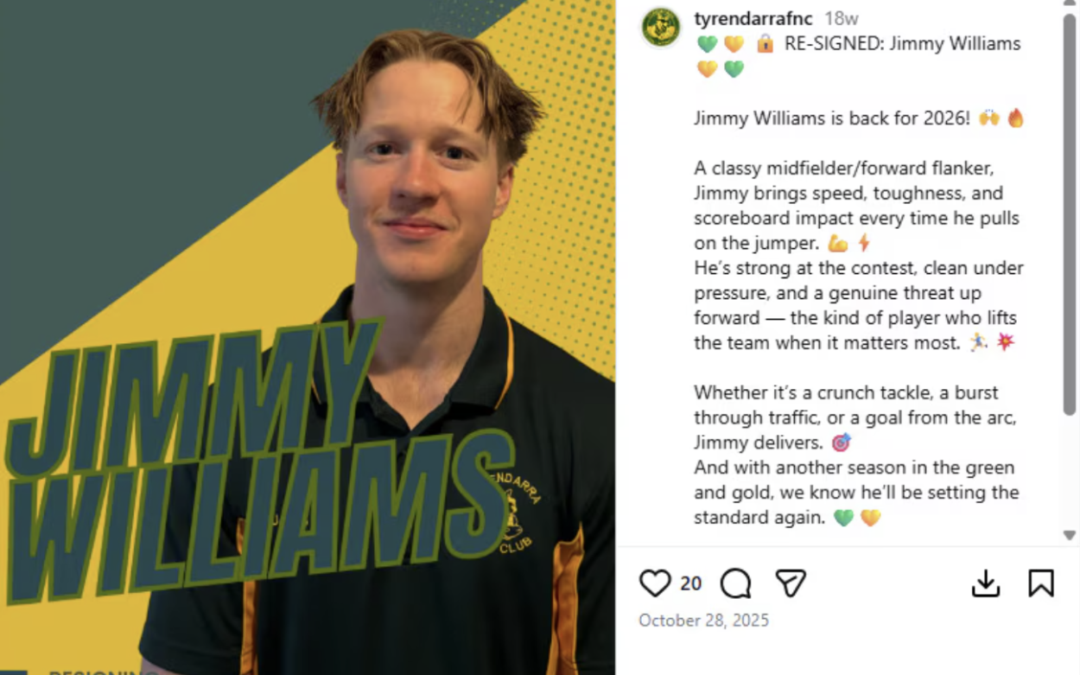
The intersection of community sports culture and institutional accountability has been thrust into the national spotlight following the disturbing criminal case involving James Williams, a member of the Tyrendarra Football Netball Club. The case has ignited a fierce public debate regarding the moral obligations of local athletic organizations when their players commit serious felonies during club-sanctioned events.
Click here to watch his dad’s sickening rant to a woman who complained
When Williams, then 20 years old, was charged with the sexual assault of a 15-year-old minor during an end-of-year football trip in Adelaide’s Central Business District (CBD), the community expected a swift, decisive institutional response. Instead, the subsequent legal handling and the club’s decision to allow Williams back onto the field just months later sparked widespread outrage, exposing deep systemic flaws in how amateur sporting leagues handle off-field criminal violence.
https://www.facebook.com/reel/1989327401692676
📅 The Incident: An End-of-Year Trip Turns Criminal
The foundations of the case date back to a club-organized celebration designed to mark the end of the football season. End-of-year “footy trips” are an entrenched tradition in regional sports culture, often characterized by heavy alcohol consumption and a collective sense of insularity. However, during this specific excursion to Adelaide, the boundary between celebratory rowdiness and egregious criminal conduct was entirely obliterated.
[Timeline of the Structural Breakdown]
September: Williams travels to Adelaide CBD on a Tyrendarra club-sanctioned trip.
Incident: Williams sexually assaults a 15-year-old minor attending a concert.
Day 2: Police charge Williams with rape; he is immediately granted bail.
Months Later: Williams returns to active competition with Tyrendarra teammates.
The victim, a 15-year-old girl, was in the Adelaide CBD attending a concert with her mother—a standard, safe family outing. It was within this public space that Williams targeted the minor, committing a sexual assault that resulted in immediate police intervention. Following a swift initial investigation, South Australia Police formally charged Williams with rape, a first-degree felony carrying severe statutory maximum penalties.
https://www.facebook.com/sherelemoodyfemicidewatch/posts/pfbid02HvbS8anatNvjS7n5fq9AogRYK6RR5k5BHyXyFme8w6CCMgWaADHRfVW3sbpc3bMtl
“I think they’re saying there’s no consequences, or, ‘Sorry, we’re not responsible for giving out consequences based on what you did on our football trip.'” — Ms. Latham, Mother of the Victim
The sight of an accused rapist receiving public camaraderie and competing in a community-funded league completely undermined the gravity of the crime. Critics argued that by failing to issue a formal suspension pending the outcome of the trial, the club effectively signaled that athletic utility outweighed ethical responsibility and victim safety.
🏛️ The Institutional Blindspot of Community Clubs
The James Williams case exposes a broader, structural blindspot prevalent in regional and amateur sporting clubs. These organizations often operate like micro-societies, where internal loyalty and competitive success create a protective bubble around players. When a player commits a violent act outside the context of the game, clubs frequently suffer from organizational paralysis, treating the crisis as an external “legal matter” rather than an internal cultural emergency.
[The Risk Architecture of Sports Culture]
Loyalty Dynamics ──> Prioritizing team cohesion over external ethical accountability.
Liability Shield ──> Labeling off-field felonies as individual legal matters.
Cultural Enablers ─> Normalizing high-risk behaviors on club-sanctioned travel trips.
By taking a passive stance and waiting for the slow-moving wheels of the judicial system to grind to a conclusion, the management of the Tyrendarra Football Netball Club inadvertently created a culture of perceived impunity. For local families who attend these weekend games, the inclusion of an indicted offender on the roster transformed the local footy oval from a safe community hub into a highly contentious space.
## 🏛️ The Institutional Blindspot of Community Clubs
The James Williams case exposes a broader, structural blindspot prevalent in regional and amateur sporting clubs. These organizations often operate like micro-societies, where internal loyalty and competitive success create a protective bubble around players. When a player commits a violent act outside the context of the game, clubs frequently suffer from organizational paralysis, treating the crisis as an external “legal matter” rather than an internal cultural emergency.
This failure to police internal authority and protect minors is a recurring crisis across community institutions. The structural blindness that allowed a sports club to welcome back an indicted player mirrors the disturbing grooming dynamics explored in *From Trusted Teacher to Real-Life Villain: The Coded Messages That Brought Down a High School Predator*. In that case, an individual weaponized a position of absolute community trust, using encrypted channels to target vulnerable youth while hidden behind an institutional shield. Whether in the classroom or on the football field, when local organizations choose to protect their own reputations over enforcing immediate, severe consequences, they become complicit in a systemic culture of impunity.
https://www.instagram.com/p/DY_f5eUGgVg/
By taking a passive stance and waiting for the slow-moving wheels of the judicial system to grind to a conclusion, the management of the Tyrendarra Football Netball Club inadvertently created a culture of perceived impunity. For local families who attend these weekend games, the inclusion of an indicted offender on the roster transformed the local footy oval from a safe community hub into a highly contentious space.
🔗 The Demand for Cultural Reform in Regional Leagues
In the wake of public statements by Ms. Latham, sports governance experts and domestic violence advocates are demanding a sweeping overhaul of code-of-conduct frameworks for amateur athletic associations. The consensus is clear: local clubs can no longer hide behind their status as volunteer-run organizations to avoid taking definitive disciplinary action.
True structural reform requires the implementation of mandatory, league-wide safeguarding policies, including:
-
Automatic Stand-Down Policies: Any registered player formally charged with an indictable violent or sexual offense must face an immediate, mandatory suspension from all club activities, training, and match selections until the legal process concludes.
-
Independent Integrity Units: Regional leagues must establish objective, third-party boards to review off-field misconduct, removing the decision-making power from local club presidents who may suffer from personal conflicts of interest or bias toward their players.
-
Overhauling Club Excursions: End-of-year trips must be subjected to strict code-of-conduct monitoring, with clear organizational liability clauses that hold the club executive accountable if team travel facilitates illegal behavior.
The narrative surrounding the James Williams case is no longer just about a single criminal trial in Adelaide; it has become a benchmark case for institutional accountability. For local sports leagues to retain their position as trusted pillars of community life, they must demonstrate an unyielding willingness to enforce consequences, proving that the protection of the vulnerable will always take precedence over the outcome of a football game.
❓ Frequently Asked Questions (FAQ)
Q: What are the criminal charges against James Williams?
A: James Williams was formally charged with rape by police following a sexual assault on a 15-year-old girl in the Adelaide CBD.
Q: When and where did the incident involving the Tyrendarra player occur?
A: The assault took place in the Adelaide Central Business District during a concert event, while the Tyrendarra Football Netball Club was on its official end-of-year footy trip.
Q: Why is there public controversy surrounding the club’s response?
A: The controversy stems from the fact that after being bailed, Williams was allowed to return to the club and play football with his teammates just months later. The victim’s family argued this demonstrated a total lack of consequences and accountability from the organization.
Q: What reforms are advocates calling for in regional sports leagues?
A: Advocates are demanding mandatory “stand-down” clauses that automatically suspend any player facing active charges for violent or sexual offenses, alongside greater accountability for club-sanctioned travel and trips.

