

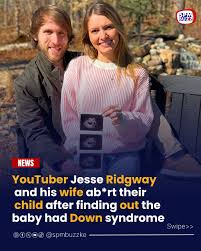

The boundary between public entertainment and deeply private medical trauma has completely dissolved for internet personality Jesse Ridgway—known to millions as “McJuggerNuggets”—and his wife, Ashley Ridgway. Following the couple’s public disclosure that they made the agonizing decision to terminate their pregnancy after a prenatal screening returned a positive result for Trisomy 21 (Down syndrome), they have been met with a wave of intense digital hostility.
Click here to watch their video breaking the news to the internet while crying
The ensuing fallout highlights a cultural flashpoint: the intersection of creator transparency, reproductive healthcare decisions, and the volatile nature of internet commentary when deeply personal grief is subjected to public scrutiny.
🛑 The Announcement and the Immediate “Vitriol”
On June 3, Jesse Ridgway confirmed to his audience that he and Ashley had chosen to end their pregnancy. The diagnosis of Trisomy 21—a genetic chromosomal disorder that causes developmental delays and mild-to-moderate intellectual disability—led the couple to what they described as an “impossible decision.”
Rather than receiving universal empathy for a wanted pregnancy that ended in medical loss, the Ridgways were immediately targeted by an intense wave of online condemnation. The backlash became so severe that by June 4, Jesse took to his Instagram Stories to address the aggressive commentary directly.
“I’ve never seen such hate and vitriol for two people grieving the loss of their unborn child and making an impossible decision. Many of the people throwing stones don’t even have children, let alone one with a condition, and most likely will never do the things they say they’re going to do.” — Jesse Ridgway
Ridgway’s defensive response cuts to the core of the issue: the stark disconnect between online moral posturing and the complex reality of raising a child with severe, lifelong medical vulnerabilities.
🧬 Understanding Trisomy 21 and Parental Choice
To understand the weight of the Ridgways’ decision, it is essential to look at the medical context. Trisomy 21 occurs when an individual has a full or partial extra copy of chromosome 21. While many individuals with Down syndrome live fulfilling, happy lives, the condition also carries a wide spectrum of health risks, including:
[Trisomy 21 Clinical Spectrum]
* Cardiovascular: High incidence of congenital heart defects requiring early surgery.
* Development: Variable degrees of cognitive delays and motor skill impairment.
* Systemic: Increased risk of respiratory issues, hearing loss, and early-onset Alzheimer's.
When prospective parents receive a definitive prenatal diagnosis, they are forced to evaluate their own financial, emotional, and physical capacity to provide specialized, lifelong care. According to medical data, a significant percentage of families facing a confirmed prenatal diagnosis of Down syndrome choose termination. However, when an influencer discloses this choice, a common medical reality is instantly transformed into a public trial.
Here are some short videos of the public being outraged at the couple’s decision
https://www.instagram.com/p/DZQ08L_OxR7/?hl=en
🏛️ The Toxicity of Creator Vulnerability
For creators like Jesse Ridgway, who built a career on boundary-pushing, reality-blurring vlogs (most notably his historic Psycho Series), the internet often struggles to view them as real human beings navigating authentic tragedies. Influencer culture builds a parasocial dynamic where viewers feel entitled to judge every moral and personal choice a creator makes.
[The Influencer Backlash Loop]
Vulnerability ──> Creator shares an authentic, high-stakes medical crisis.
Parasocial Judgment ──> Audience applies rigid moral standards to a private choice.
Dehumanization ──> The tragedy is treated as an online debate rather than real-life grief.
By opening up about their termination, the Ridgways hoped to provide transparency to a fan base that has followed their relationship for years. Instead, they became a lightning rod for the broader, highly polarized political debate surrounding reproductive rights. The comment sections quickly transformed into a proxy war between disability advocacy, reproductive autonomy, and religious or ethical opposition to abortion.
✒️ Editor’s Opinion: The Cost of the Omnipresent Camera
The backlash against Jesse and Ashley Ridgway reveals a dark truth about our modern media landscape: online culture has completely stripped away our capacity for basic human empathy.
When a couple receives a severe prenatal diagnosis, it is a devastating, heartbreaking moment. It marks the death of the future they had envisioned for their unborn child. To look at two people going through that specific grief and pelt them with digital stones is a form of casual cruelty unique to the internet era. Jesse Ridgway is entirely correct in his assessment: it is incredibly easy to dictate moral rules from behind a keyboard when you have never had to look at a medical report and make a choice that alters the rest of your life.
However, this situation also highlights a vital lesson for the digital creator class: some tragedies are too heavy for public consumption.
https://www.instagram.com/p/DZLarrCEdjS/?hl=en
When you monetize your life for millions of strangers, the internet begins to view your real-world trauma as just another piece of content to critique. The Ridgways deserved privacy, quiet space to mourn, and the support of a close-knit, real-world community. By feeding this deeply sensitive medical decision directly into the content machine, they inadvertently exposed their rawest wound to an audience that lacks the maturity, nuance, and empathy required to handle it. Protecting your family sometimes means keeping the camera turned completely off.
## ✒️ Editor’s Opinion: The Cost of the Omnipresent Camera
The backlash against Jesse and Ashley Ridgway reveals a dark truth about our modern media landscape: online culture has completely stripped away our capacity for basic human empathy. When a couple receives a severe prenatal diagnosis, it is a devastating, heartbreaking moment that marks the death of the future they had envisioned for their unborn child. To look at two people going through that specific grief and pelt them with digital stones is a form of casual cruelty unique to the internet era. Jesse Ridgway is entirely correct in his assessment: it is incredibly easy to dictate moral rules from behind a keyboard when you have never had to look at a medical report and make a choice that alters the rest of your life.
The terrifying irony of this online outrage machine is its complete detachment from actual, real-world malice. While a grieving couple faces digital execution for navigating an impossible medical diagnosis, the legal system is simultaneously forcing communities to confront genuine, horrific violence against the vulnerable—as seen in cases like *Murder Charges Reinstated: Colorado Man Back in Court Over 2023 Baby Death*. There is a profound cultural sickness in an internet ecosystem that issues death threats to parents mourning a tragic prenatal loss, while real-world courtrooms are actively prosecuting the actual, physical destruction of infant lives. By treating private medical heartbreak with the same vitriol reserved for criminal predators, the public completely erodes the moral nuance required to distinguish tragedy from malice.
However, this situation also highlights a vital lesson for the digital creator class: some tragedies are too heavy for public consumption. When you monetize your life for millions of strangers, the internet begins to view your real-world trauma as just another piece of content to critique. The Ridgways deserved privacy, quiet space to mourn, and the support of a close-knit, real-world community.
❓ Frequently Asked Questions (FAQ)
Q: Why did Jesse and Ashley Ridgway choose to terminate their pregnancy?
A: The couple made the difficult decision to end the pregnancy after prenatal testing confirmed the fetus had Trisomy 21, the chromosomal condition that causes Down syndrome.
Q: How did Jesse Ridgway respond to the public backlash?
A: Jesse addressed the criticism on Instagram, expressing shock at the “hate and vitriol” they received while grieving. He pointed out that many of their critics do not have children and have never had to navigate a severe medical diagnosis.
Q: What is McJuggerNuggets famous for online?
A: Jesse Ridgway is a prominent YouTuber who gained massive internet fame for his long-running, scripted “Psycho Series” vlogs, as well as his subsequent creative storytelling and lifestyle content.
Q: What is the medical definition of Trisomy 21?
A: Trisomy 21 is a genetic disorder caused by the presence of all or part of a third copy of chromosome 21. It leads to the physical and developmental characteristics associated with Down syndrome.

 and his wife Ashley following their decision to terminate a pregnancy due to a Down syndrome diagnosis.)