

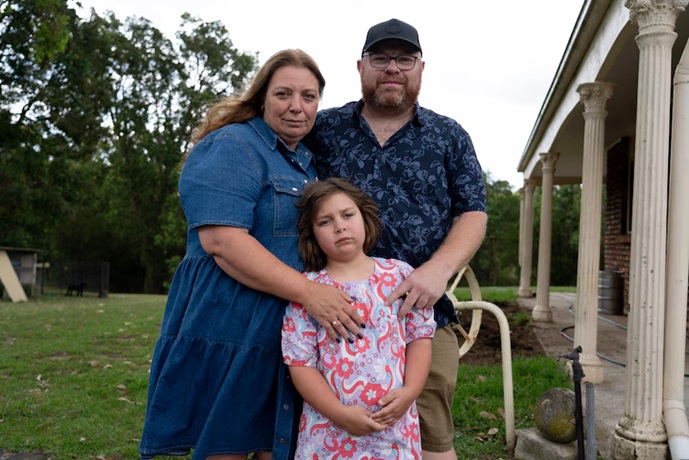
The devastating aftermath of the December 14 terror attack at Bondi Beach remains a raw, open wound in the Australian consciousness. During a celebratory “Chanukah by the Sea” community event at Archer Park, the peace of a summer evening was permanently shattered by an antisemitic, Islamic State-inspired mass shooting. Among the 15 innocent lives stolen in the assault was 10-year-old Matilda, a bright, deeply loved child described by her family as a “regular, awesome Aussie girl.” She was the youngest victim of the deadliest mass shooting on Australian soil since the 1996 Port Arthur massacre.
Now, breaking their silence in their first wide-ranging interview since the tragedy, Matilda’s parents, Valentyna Poltavchenko and Michael Britvan, have issued a stark, sobering warning to federal lawmakers. As the Commonwealth moves to fast-track sweeping anti-hate speech legislation, blacklists, and expanded deportation powers, the grieving parents are expressing deep skepticism.
For a government rushing to project a decisive response, the message from the epicenter of the tragedy is clear: symbolic legal frameworks cannot deter a determined extremist, and rushed legislation rarely yields effective justice.
“Criminals Do Not Care About Laws”: A Father’s Warning
Sitting down to recount the horrific moments of December 14, Valentyna and Michael recalled how a vibrant community festival instantly descended into terror. Matilda and her six-year-old sister, Summer, had gone over to enjoy the event’s petting zoo when the gunfire erupted. Initially mistaking the sound of gunshots for festive firecrackers, the family was caught completely unprepared for an act of planned ideological violence.
While Summer was heroically shielded behind a utility vehicle by a brave 20-year-old worker running the zoo, Matilda was fatally struck. The compounding trauma of that night has given her parents a pragmatic, uncompromising outlook on how the state combats violent extremism.
Michael Britvan openly questioned the efficacy of the Albanese government’s proposed legislative crackdown on hate speech and extremist groups, noting that legal prohibitions mean nothing to radicalized individuals planning mass casualty events.
“Criminals do not care about any laws you make about any speech or any guns. They will find their way,” Britvan stated flatly. “When the government tries to rush any laws, especially after some tragedy, they’re never good.”
The sentiment exposes a glaring disconnect between executive political maneuvering and the lived reality of terror victims. For Britvan and Poltavchenko, the incoming federal intervention risks being an exercise in political optics—a symbolic plaster placed over a deep-seated cultural and national security failure.
The Failure of Existing Frameworks
The skepticism voiced by Matilda’s parents is heavily validated by emerging details surrounding the security apparatus failure leading up to the attack. An interim royal commission report into the massacre revealed that the perpetrators—a father-and-son duo—had been operating beneath the radar of law enforcement despite significant red flags.
The surviving gunman had been linked by intelligence agencies to an Islamic State cell as far back as 2019. Despite this history, the perpetrators were able to secure legal firearm licenses, procure six weapons, travel to known extremist hotspots abroad just a month before the attack, and conduct physical combat training within regional New South Wales.
                    [The Radicalization Timeline]
                                  │
     ┌────────────────────────────┼────────────────────────────┐
     ▼                            ▼                            ▼
  [2019]                     [Nov 2025]                   [Dec 2025]
Perpetrator flagged for    Father and son travel to      Mass shooting executed
connections to an Islamic  overseas terror hotspots;     at Bondi Beach Hanukkah
State extremist cell.      conduct weapons training.     festival; 15 killed.
The fact that the existing, robust Australian counter-terrorism framework failed to flag or disrupt this trajectory is precisely why Matilda’s parents hold little confidence in superficial expansions of hate speech laws. The issue, as the family implies, was not a lack of laws against hatred, but a structural breakdown in intelligence sharing, border alert mechanisms, and proactive law enforcement intervention.
Honouring a Legacy: Yellow Dresses and Community Healing
Rather than focusing on punitive legislative expansions that offer little protective reassurance, Valentyna and Michael are redirecting their energy toward tangible community healing and permanent remembrance.
The parents have publicly requested that the footbridge utilized by the gunmen as a sniper perch during the shooting be preserved rather than demolished. They have proposed painting the bridge bright yellow—the color of the sundress Matilda wore on her final day—and installing a commemorative plaque honoring the 15 victims.
“I want it to be in place. So people can go on it and look at the park from the highest point and feel that pain that was just in front of them,” Valentyna Poltavchenko explained. The family has also advanced a moving proposal to officially rename the local recreation area “Matilda’s Park,” ensuring that the memory of their daughter’s vibrant life permanently outshines the darkness of the ideology that took her away.
Editor’s Opinion: The Trap of Performative Policymaking
There is an undeniable, cyclical habit in modern governance: when a horrific tragedy occurs, the state reacts by printing new laws. It is a defense mechanism intended to show an anxious public that leadership is taking action. However, as Michael Britvan correctly points out, rushed legislation drafted in the emotional wake of a massacre is historically flawed.
Punishing hate speech or expanding administrative deportation powers does absolutely nothing to deter a suicide operative or a radicalized cell completely detached from the legal boundaries of civilized society. By focusing the national conversation on hate speech laws, the federal government subtly diverts public scrutiny away from systemic intelligence oversights and border alert failures. We owe it to Matilda, and the 14 other victims who perished at Bondi, to demand structural accountability and sharp operational intelligence reform—not performative, symbolic legal adjustments that merely look good on a press release.
Official Event Context Matrix
| Metric / Detail | Historical Record |
| Date of Attack | December 14, 2025 |
| Location | Archer Park, Bondi Beach, Sydney, NSW |
| Target Event | “Chanukah by the Sea” Community Festival |
| Total Casualties | 15 Innocent Civilians Killed; 40 Injured |
| Youngest Victim | Matilda (10 Years Old) |
| Perpetrator Ideology | Antisemitic, Islamic State (IS) Inspired |
Frequently Asked Questions (FAQ)
Q: Why do Matilda’s parents oppose the rushed federal hate laws?
A: They do not believe that making stricter laws regarding speech or civil conduct will deter violent criminals or ideological extremists who have already resolved to commit acts of mass violence. They argue that rushed laws enacted right after a tragedy are rarely effective.
Q: What happened to Matilda’s sister during the Bondi attack?
A: Matilda’s six-year-old sister, Summer, survived the attack uninjured because she was heroically shielded behind a vehicle by an uninjured 20-year-old event worker, Tash Willemsen, when the shooting started.
Q: How do the parents want their daughter Matilda to be remembered?
A: They want her remembered as an awesome, loving Australian girl. They have proposed painting the Bondi footbridge yellow in honor of her favorite sundress and officially renaming the festival site “Matilda’s Park.”
The Anatomy of a Crisis: From Local Oversights to High-Speed Purges
The administrative blind spots exposed in the Bondi investigation reveal a frustrating, recurring pattern in global law enforcement: by the time an extremist or a violent offender is actively executing their plan in a public space, the state is already playing a desperate game of catch-up. When proactive threat-assessment channels break down, the burden shifts entirely onto tactical responders who must manage a rapidly deteriorating crisis in real time. This terrifying transition from silent, systemic failure to explosive, public violence isn’t isolated to international lone-wolf terrorism. It is an operational reality mirrored in domestic active shooter scenarios, where a single volatile individual can turn a quiet morning into a high-octane regional emergency.
To read our full, forensic timeline of how a sudden corporate ambush triggered a multi-county emergency response, dynamic roadblock operations, and a relentless interstate pursuit, explore our deep-dive report: [The Brailen Weaver Case: Inside the Kentucky Bank Murders and 130-MPH Manhunt].

