

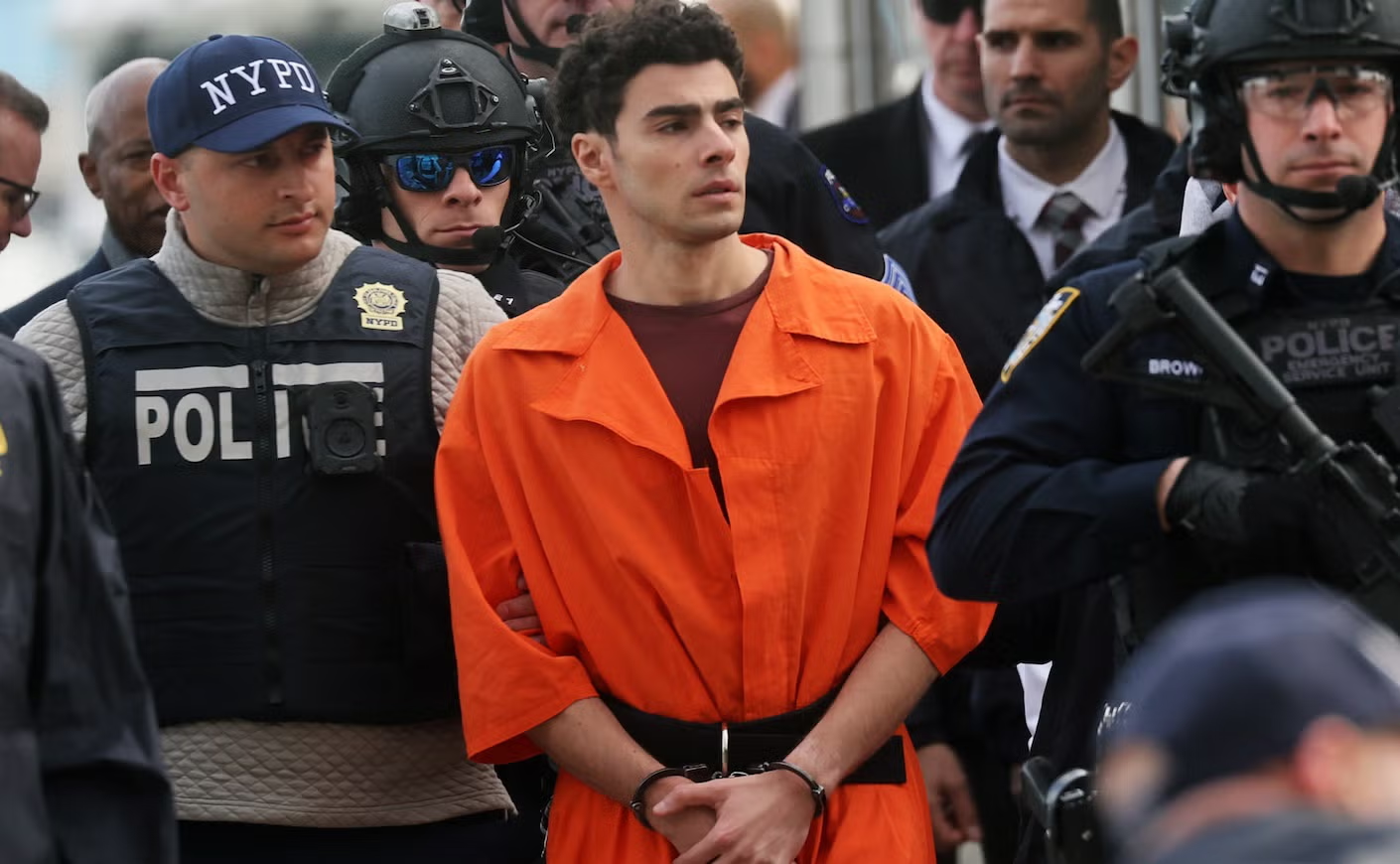
In the cold morning hours of December 4, 2024, a targeted execution outside a Manhattan hotel sent shockwaves through the American corporate landscape and triggered one of the most intense multi-state manhunts in recent history. The victim was Brian Thompson, the CEO of UnitedHealthcare, the nation’s largest private health insurer. The suspected gunman, apprehended days later in an ordinary Pennsylvania McDonald’s, was identified as Luigi Mangione—a 26-year-old Ivy League graduate, former valedictorian, and Ivy League researcher whose transformation from an elite academic to an alleged assassin has captivated forensic psychologists, legal scholars, and the public alike.
Click here to watch the chilling shooting footage of the CEO of UnitedHealthcare
As the criminal justice system grinds forward, this high-profile case has evolved beyond a simple homicide investigation. It stands at the intersection of violent criminal acts, systemic anti-corporate grievances, and a complex multi-jurisdictional legal battle that will test federal and state prosecutorial frameworks.
The Crime: The Manhattan Execution and the Escape Blueprint
The execution of the crime demonstrated a high degree of premeditation, operational security, and tactical planning. Brian Thompson was walking toward the New York Hilton Midtown to attend an annual investor conference when the gunman approached him from behind. Utilizing a suppressed 9mm handgun, the shooter fired multiple rounds, clearing a weapon malfunction mid-sequence with mechanical calmness, before fleeing into Central Park on a bicycle.
                    [The Manhattan Escape & Apprehension Timeline]
                                           │
                                           ▼
                            [December 4, 2024: The Shooting]
                            • Targeted execution outside Midtown hotel.
                            • Shooter flees via Central Park on a bicycle.
                                           │
                                           ▼
                            [The Multi-State Tactical Flight]
                            • Suspect utilizes commercial bus networks.
                            • Evades traditional law enforcement perimeters.
                                           │
                                           ▼
                           [December 9, 2024: The Altoona Catch]
                           • Recognized by a citizen at a Pennsylvania McDonald's.
• Local authorities secure arrest; fake IDs recovered.For five days, the suspect successfully evaded a massive joint task force composed of the NYPD, the FBI, and federal marshals. The escape blueprint relied heavily on anonymity: utilizing commercial buses, wearing face coverings under the guise of cold-weather gear, and staying in low-end hostels using fraudulent identification documents.
The manhunt concluded abruptly on December 9, 2024, in Altoona, Pennsylvania. A vigilant bystander noticed a striking resemblance between a patron at a local McDonald’s and the widely circulated surveillance images of the Manhattan shooter. Local authorities responded immediately, confronting Mangione. Upon his arrest, officers recovered a ghost gun equipped with a silencer, a handwritten manifesto, and multiple fraudulent driver’s licenses matching the physical description of the shooter.
The Manifest Charges: A Multi-Jurisdictional Legal Quagmire
The legal strategy surrounding Luigi Mangione is exceptionally complex due to the overlapping jurisdictions of the states involved and the potential for federal intervention.
1. Pennsylvania State Charges

Immediately following his arrest in Altoona, Pennsylvania prosecutors hit Mangione with a battery of felony charges related to his capture. These include carrying a firearm without a license, possession of an unlicensed silencer, forgery (relating to the multiple fake IDs), and possession of instruments of crime.
2. New York State Charges
The primary venue for the homicide prosecution remains New York. the Manhattan District Attorney’s office unsealed an indictment charging Mangione with Murder in the Second Degree, Criminal Possession of a Weapon in the Second Degree, and Criminal Possession of a Forged Instrument.
3. The Extradition Battle
A significant portion of early 2025 was dominated by procedural sparring regarding Mangione’s transfer from Pennsylvania to New York. Facing a high-profile target with substantial family resources, the defense scrutinized every facet of the interstate extradition warrants. However, standard interstate compacts ultimately prevailed, securing his physical return to New York to face the core murder charges.
The Motive: The Manifestoes of Systemic Grievance
What separates this case from standard contract killings or street violence is the explicit ideological framework driving the suspect. Investigators recovered a three-page, handwritten manifesto from Mangione’s person at the time of his arrest, alongside digital writings recovered from his encrypted devices.
The text outlines a radicalized grievance against the American healthcare infrastructure. Mangione, who had reportedly suffered from severe, chronic back pain that derailed his academic and professional trajectory, directed immense hostility toward corporate health insurance companies. In his writings, he accused private insurers of operating as predatory entities that maximize corporate profits by systematically denying life-saving medical coverage to everyday citizens.
Forensic psychologists notes that phrases like “deny, defend, depose”—historically associated with insurance industry litigation tactics—were found inscribed on the shell casings at the crime scene. This indicates that the shooting was intended not just as a personal vendetta, but as a symbolic, violent strike against an entire corporate network.
Editor’s Opinion: The Dangerous Myth of the Vigilante Assassin
The Luigi Mangione case has exposed a deeply unsettling fracture in public sentiment. In the wake of the shooting, social media platforms were flooded with commentary that stopped short of condemnation, with some fringe groups attempting to paint the suspect as a folk hero or an anti-corporate vigilante fighting a broken system. This is a highly dangerous romanticization of cold-blooded violence.
No matter how deeply flawed, bureaucratic, or frustrating the American health insurance system may be, the normalization of targeted assassinations shatters the foundational rule of law. Brian Thompson was a husband, a father, and a human being—not an abstract corporate logo. Allowing ideological grievances to justify public executions sets a catastrophic precedent. True justice must be blind to political or social frustration; the court system must prosecute this act with clinical precision, proving that systemic anger can never be a license to murder.
Key Evidence and Investigative Ledger
| Evidence Item | Discovery Location | Forensic and Prosecutorial Value |
| 9mm Ghost Gun & Silencer | Recovered from suspect’s backpack in Altoona, PA. | Ballistic matching confirms it as the weapon used in the Midtown Manhattan execution. |
| Handwritten Manifesto | Found on Mangione’s person at arrest. | Explicitly establishes premeditation, ideological intent, and sanity parameters. |
| Inscribed Shell Casings | Crime Scene (New York Hilton Midtown). | Links the physical ammunition to the anti-corporate phrases found in the digital writings. |
| Hostel Logbooks & Fake IDs | Manhattan Hostel / Arrest Scene. | Establishes a clear operational timeline of flight, consciousness of guilt, and evasion tactics. |
Frequently Asked Questions (FAQ)
Q: Why was Luigi Mangione charged with Second-Degree Murder instead of First-Degree Murder in New York?
A: In New York State, First-Degree Murder is generally reserved for highly specific aggravating circumstances, such as killing a law enforcement officer, killing a witness to prevent testimony, or murder-for-hire schemes. For a targeted assassination of a private civilian corporate executive, Second-Degree Murder is the standard maximum charge, which still carries a maximum penalty of 25 years to life in prison.
Q: Could the federal government take over the prosecution?
A: Yes. Because Mangione crossed state lines during his flight, utilized interstate commerce and transportation networks, and targeted the executive of a major national corporation, federal prosecutors could introduce charges such as interstate stalking resulting in death or federal weapons violations. Currently, state prosecutors are taking the lead, but federal agencies maintain active overlapping investigations.
Q: What role does his family background play in his legal defense?
A: Mangione hails from a highly prominent, affluent Maryland family with significant real estate and political ties. This financial resource ensures an elite legal defense team capable of filing extensive procedural motions, challenging forensic evidence, and potentially building a complex mental health or diminished capacity defense based on his documented history of chronic pain and isolation.
The Legal Perimeter: Premeditated Execution vs. Disputed Self-Defense
The clinical execution of the Manhattan shooting demonstrates a clear, unyielding pursuit of a target where the concepts of self-defense are legally nonexistent. However, the American judicial system faces a entirely different set of evidentiary challenges when a high-profile killing occurs not on a public street, but inside a private residence where the boundary between protection and criminal liability is highly contested. When a homicide involves disputed property boundaries, escalating verbal friction, or sudden firearm deployment within a domestic zone, prosecutors cannot rely on a written manifesto to prove intent. Instead, they must conduct a meticulous forensic evaluation of state-specific castle doctrine frameworks to determine if a shooting was a lawful act of protection or a tragic case of preventable homicide.
To read our complete, step-by-step forensic analysis of how local prosecutors balance property protection rights against criminal negligence charges in suburban disputes, explore our deep-dive report: [Castle Doctrine vs. Manslaughter: Analyzing the Case of Dayton Knapton and the White Lake Shooting].

