

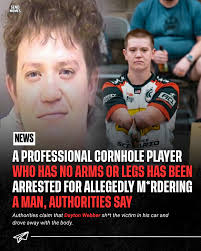
The case of Dayton Webber, a 27-year-old quadruple amputee and professional athlete, has sent shockwaves through both the sporting world and the criminal justice system. Webber, once celebrated as a symbol of resilience and the first quadruple amputee to compete in the American Cornhole League (ACL), now finds himself at the center of a complex murder investigation in Charles County, Missouri. This analysis moves beyond the “shock factor” of the headlines to examine the forensic possibility of the crime, the legal ramifications of the charges, and the societal impact of this high-profile fall from grace.

1. The Subject: The Rise and Fall of an Inspirational Figure
To understand the weight of the current allegations, one must acknowledge the stature Dayton Webber held prior to his arrest. Born in 1994, Webber’s life began with a traumatic medical battle; at just 10 months old, a severe bacterial infection necessitated the amputation of all four limbs.
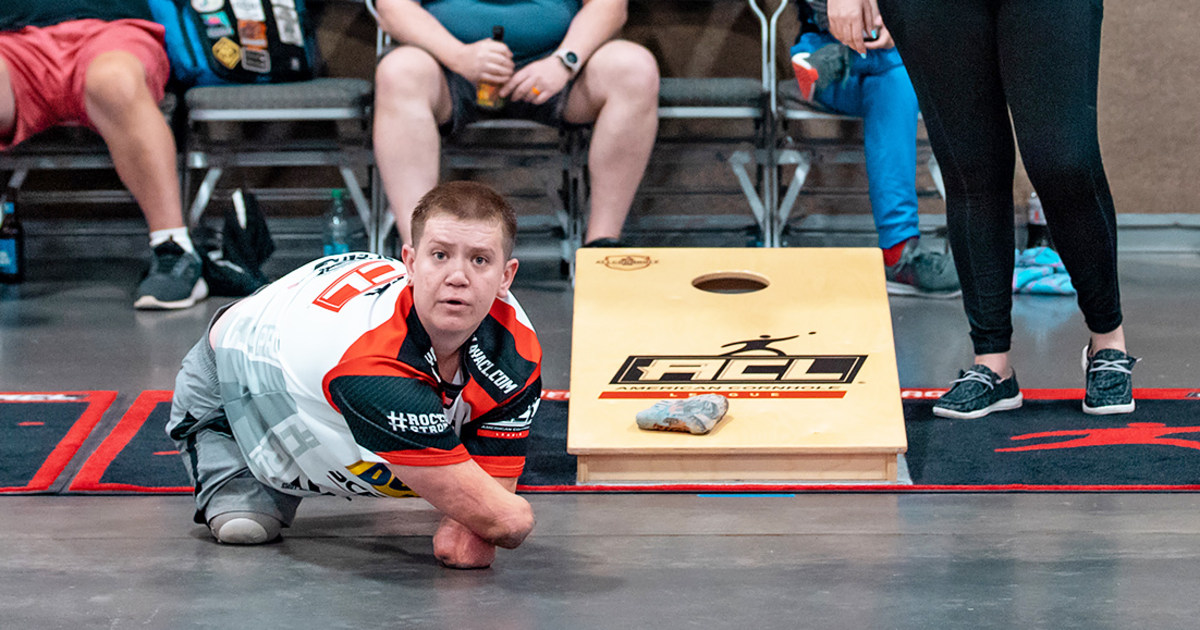
Despite these physical limitations, Webber achieved national prominence through the American Cornhole League. His ability to manipulate the bean bags with professional-grade accuracy made him a staple on networks like ESPN, where his story was framed as a testament to the human spirit. He wasn’t just an athlete; he was a “Brand of Hope.” The transition from the cover of sports magazines to a police mugshot represents a catastrophic collapse of personal and professional capital.
2. The Mechanics of the Incident: Addressing the “How”
The most prevalent question in the public discourse surrounding this case is: How is it physically possible for a quadruple amputee to operate a firearm and a motor vehicle during a violent escalation?
The Forensic Evidence of Capability
Digital forensics and social media archives have provided significant insight into Webber’s mechanical adaptations.
- Vehicle Operation: Webber has previously demonstrated the ability to operate motor vehicles using specialized adaptations or specific physical leverage. At the time of the shooting, he was reportedly “behind the wheel,” suggesting a high level of functional independence.
- Firearm Manipulation: Investigators point to video evidence—some of which was reportedly uploaded by Webber himself—demonstrating his ability to handle and discharge firearms. In the context of forensic ballistics, the absence of traditional “fingers” does not preclude the ability to trigger a mechanism if sufficient leverage or a modified interface is present.
- The “Shorts” Incrimination: A video uploaded to social media platforms appears to show Webber’s proficiency with a firearm, which may serve as a critical “capability exhibit” for the prosecution to prove that the defendant had the physical means to carry out the act.
3. Anatomy of the Crime: The Charles County Escalation
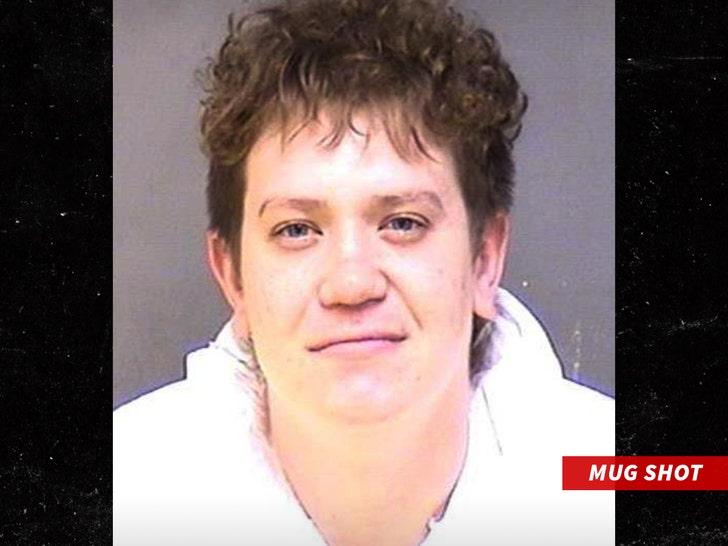
The prosecution alleges that on a Sunday night in Charles County, Missouri, a verbal argument broke out between Webber and his front-seat passenger, Bradrick Michael Wells. According to witness statements from two other passengers in the back seat, the dispute escalated “rather quickly.”
The Aftermath and Disposal
The details provided by the surviving witnesses paint a chilling picture of the moments following the discharge of the weapon:
- Instruction to Assist: Reports indicate that Webber allegedly instructed the back-seat passengers to help him remove Wells’ body from the vehicle.
- The Flight: The witnesses refused, fled the vehicle, and flagged down police officers at approximately 10:30 PM.
- The Discovery: Nearly two hours later, a resident on Newport Church Road discovered Wells’ body in their front yard.
- The Arrest: Webber was eventually located at a hospital in Charlottesville, Virginia, where he was being treated for an unrelated medical issue. He was arrested immediately upon his release.
4. Legal Analysis: Charges and Extradition
Dayton Webber faces a litany of charges, the most severe being First-Degree Murder and Second-Degree Murder.
- First-Degree Murder (Premeditation): To secure a conviction on this charge, the prosecution must prove that Webber acted with “deliberation”—meaning he had a moment, however brief, to reflect on the intent to kill. The act of reaching for a firearm during a verbal argument often meets the legal threshold for premeditated intent.
- Second-Degree Murder: Often used as a secondary charge, this applies if the killing was committed with the intent to cause serious physical injury or manifested a “depraved indifference” to human life.
- Extradition Logistics: As the arrest occurred in Virginia, the legal process of “Extradition” is currently underway to return Webber to Missouri. This involves a formal request from the Governor of Missouri to the Governor of Virginia, asserting that the defendant is a fugitive from justice.
5. Societal Impact: The Shattered Image
The tragedy of this case is twofold: the loss of Bradrick Michael Wells’ life and the destruction of an icon. For many in the disability community, Webber was a beacon of what is possible. His alleged actions have replaced a narrative of “overcoming the odds” with a narrative of “violent volatility.”
From a criminal psychology perspective, this case highlights that physical disability does not exempt an individual from the “darker” impulses of human nature—anger, impulsivity, and aggression. The “Inspiration Porn” trope often dehumanizes disabled individuals by assuming they are incapable of malice; the Webber prosecution, conversely, treats the defendant with the same legal scrutiny and agency as any other able-bodied suspect.
FAQ: The Dayton Webber Murder Case
How can someone without limbs fire a gun? Forensic evidence and social media videos suggest that Webber had developed significant dexterity and utilized leverage points to operate tools, including firearms. Specialized adaptations or the use of residual limbs can allow for the discharging of a trigger.
What are the specific charges Webber is facing? Webber is currently charged with First-Degree Murder, Second-Degree Murder, and other related firearm and disposal charges in Charles County, Missouri.
Who was the victim in this case? The victim has been identified as 27-year-old Bradrick Michael Wells, who was reportedly a friend or associate of Webber.
Where is Dayton Webber now? Following his arrest in Charlottesville, Virginia, he is awaiting extradition back to Missouri to face trial.
Legal Analysis & Disclaimer
This report is for informational and analytical purposes only. Under the United States Constitution, Dayton Webber is presumed innocent until proven guilty in a court of law. The information presented is based on public police reports from the Charles County Sheriff’s Office and verified media profiles from ESPN and the American Cornhole League. If you or someone you know is a victim of domestic or interpersonal violence, please contact local law enforcement or a national crisis hotline.

